
Linen Sourcing Glossary
The vocabulary of a bulk linen order - specification, construction, quality, certification and export terms, defined in plain English.
Terry Construction in Pictures
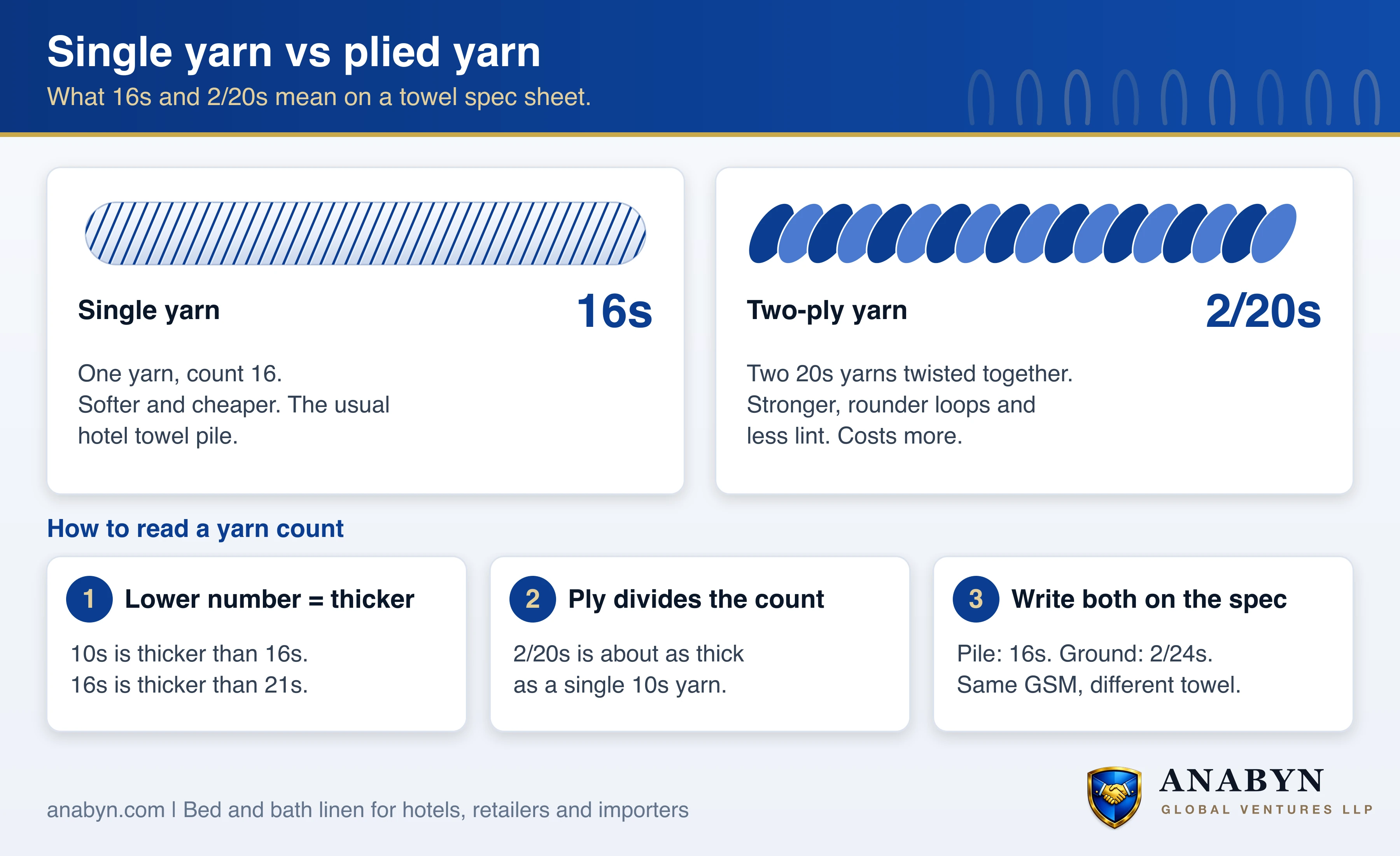
The construction terms below, drawn out. Use them when you write a towel spec: pile type, yarn count, ply, twist and spinning method all change the towel at the same GSM.
 Tap to enlarge
 Tap to enlarge
 Tap to enlarge
 Tap to enlarge
 Tap to enlarge
Jump to a section
Specification
GSM
Also called: Grams per square metre · Fabric weight
- Grams per square metre - the weight of one square metre of fabric, and the single most important number when specifying a towel. Hotel bath towels are typically 400-700 GSM, pool towels 350-500 GSM, and bath mats 800-1200 GSM. Higher GSM means denser pile, more absorbency and slower drying.Hotel linen weight chart by GSM
Thread Count
Also called: TC
- The number of warp and weft threads in one square inch of woven fabric, used to specify bed linen rather than towels. Hotel bed linen is commonly 200-400 TC; above roughly 600 TC the gains are marginal and often come from multi-ply yarn counting rather than a genuinely finer weave.300 thread count bed sheets
Yarn Count
Also called: Ne · 16s · 21s · 30s
- A measure of yarn fineness, written as a number followed by "s" (16s, 21s, 30s). A higher number means a finer yarn. Coarser 16s yarn gives a firmer, hard-wearing towel favoured by high-turnover properties; finer 21s and 30s yarns give a softer hand-feel at the same GSM.16s vs 21s yarn towels
Tech Pack
Also called: Technical specification sheet · Spec sheet
- The document that defines exactly what is being manufactured: dimensions, GSM or thread count, yarn count, weave, colour reference, border style, logo placement, packing and labelling. A quotation without a tech pack is an estimate, not a price - anything left unstated becomes the factory's default.
Pantone TCX
Also called: Pantone Textile · Colour reference
- The cotton-swatch edition of the Pantone colour system, and the correct reference for textiles. Specifying a TCX code rather than a printed TPX/TPG or a screen colour is what makes a colour reproducible across dye lots and repeat orders.
Ends and picks
Also called: EPI · PPI
- Ends per inch are warp threads across the width of cloth. Picks per inch are weft threads along the length. Their total gives the thread count.Reading a hotel linen spec
Construction
Terry
Also called: Terry towelling · Loop pile
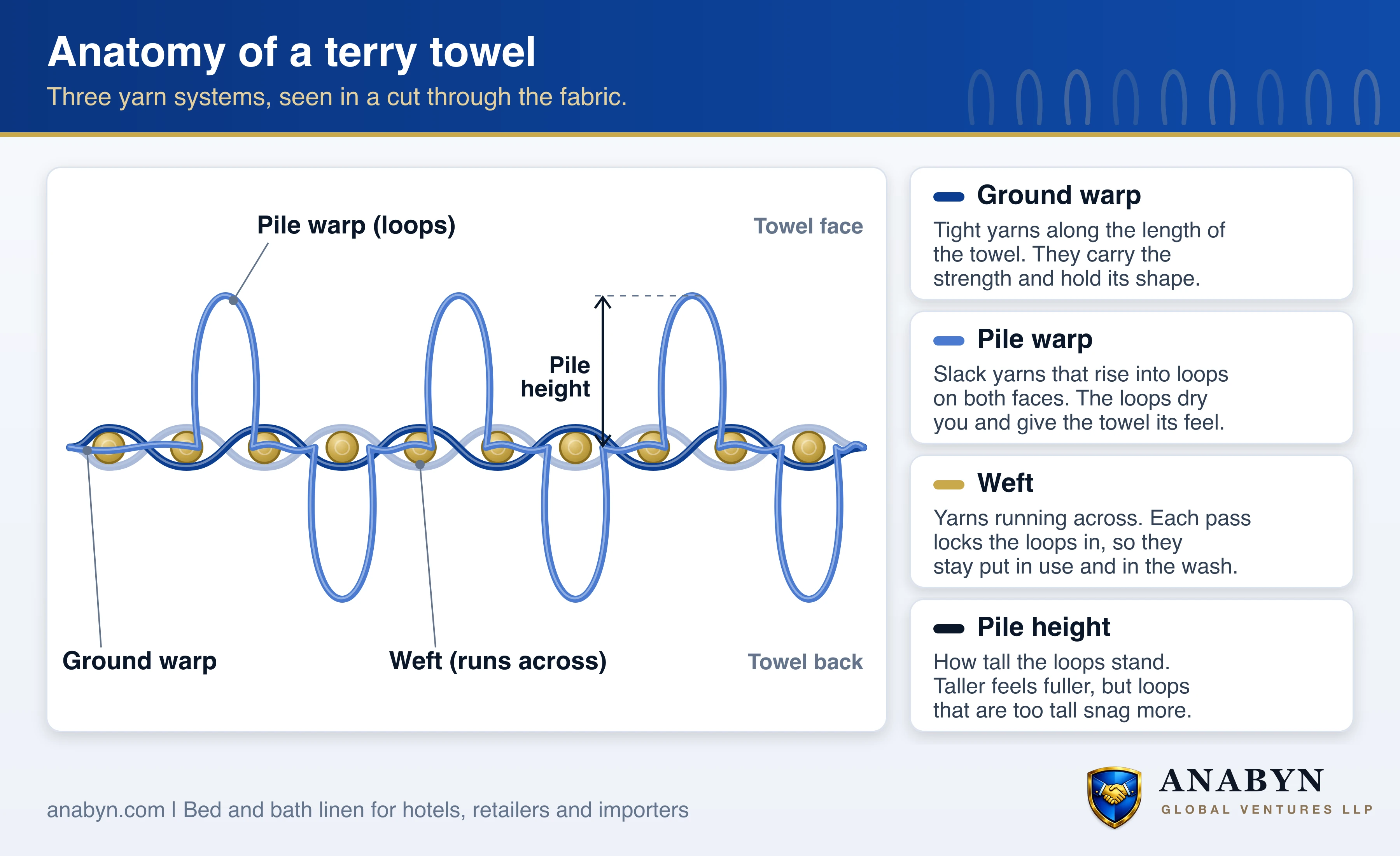
- A woven fabric with uncut loops standing proud of the ground weave, which is what makes a towel absorbent. The loops are formed on the loom from a separate pile warp - denser and taller loops give higher GSM and greater water uptake.Terry towel collection
Ground Warp
- The tight lengthwise yarns that form the base cloth of a terry towel. The ground warp carries the strength and holds the shape; the loops are formed by a separate, slacker pile warp.How a terry towel is built
Pile Warp
Also called: Pile yarn · Loop yarn
- The lengthwise yarns in a terry towel that are fed slack on the loom so they rise into loops on one or both faces. The pile does the drying and gives the towel its feel, so its count, ply and twist matter more to the buyer than the ground yarn.How a terry towel is built
Weft
Also called: Pick · Filling
- The yarns that run across a woven fabric, from selvedge to selvedge. In terry, each weft pass is beaten in to lock the pile loops so they do not pull out in use or in the wash.
Pile Height
Also called: Loop height
- How tall the terry loops stand above the ground cloth, usually a few millimetres. Taller loops feel fuller and hold more water but dry more slowly and snag more easily; pile height is one of the levers that changes GSM at a given size.
Single Pile vs Double Pile
Also called: Double pile terry
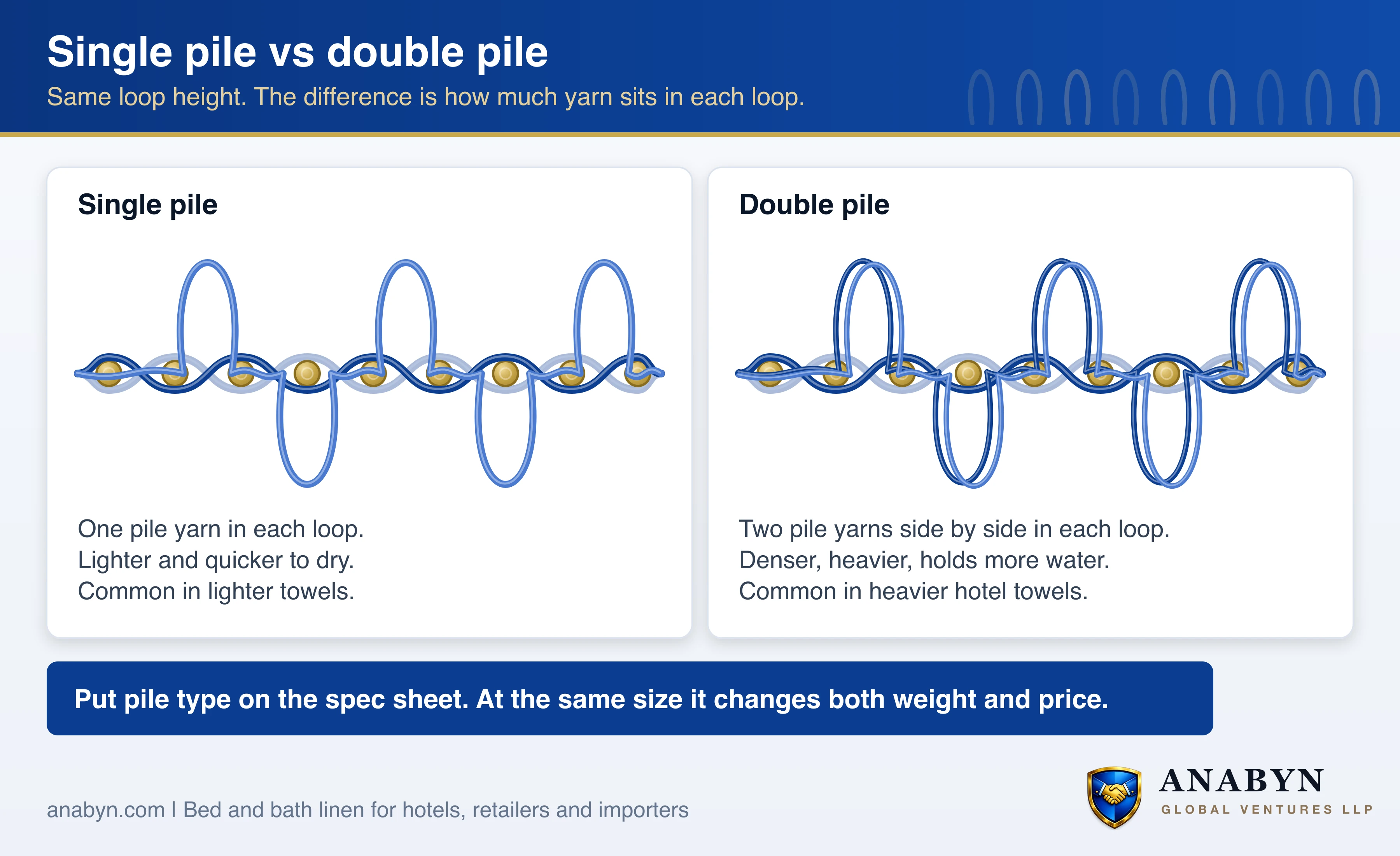
- Single pile terry has one pile yarn in each loop; double pile runs two pile yarns side by side in each loop. Double pile is denser and heavier at the same loop height, so it should be stated on the spec sheet when comparing quotes.
Open-End Yarn
Also called: OE yarn · Rotor yarn
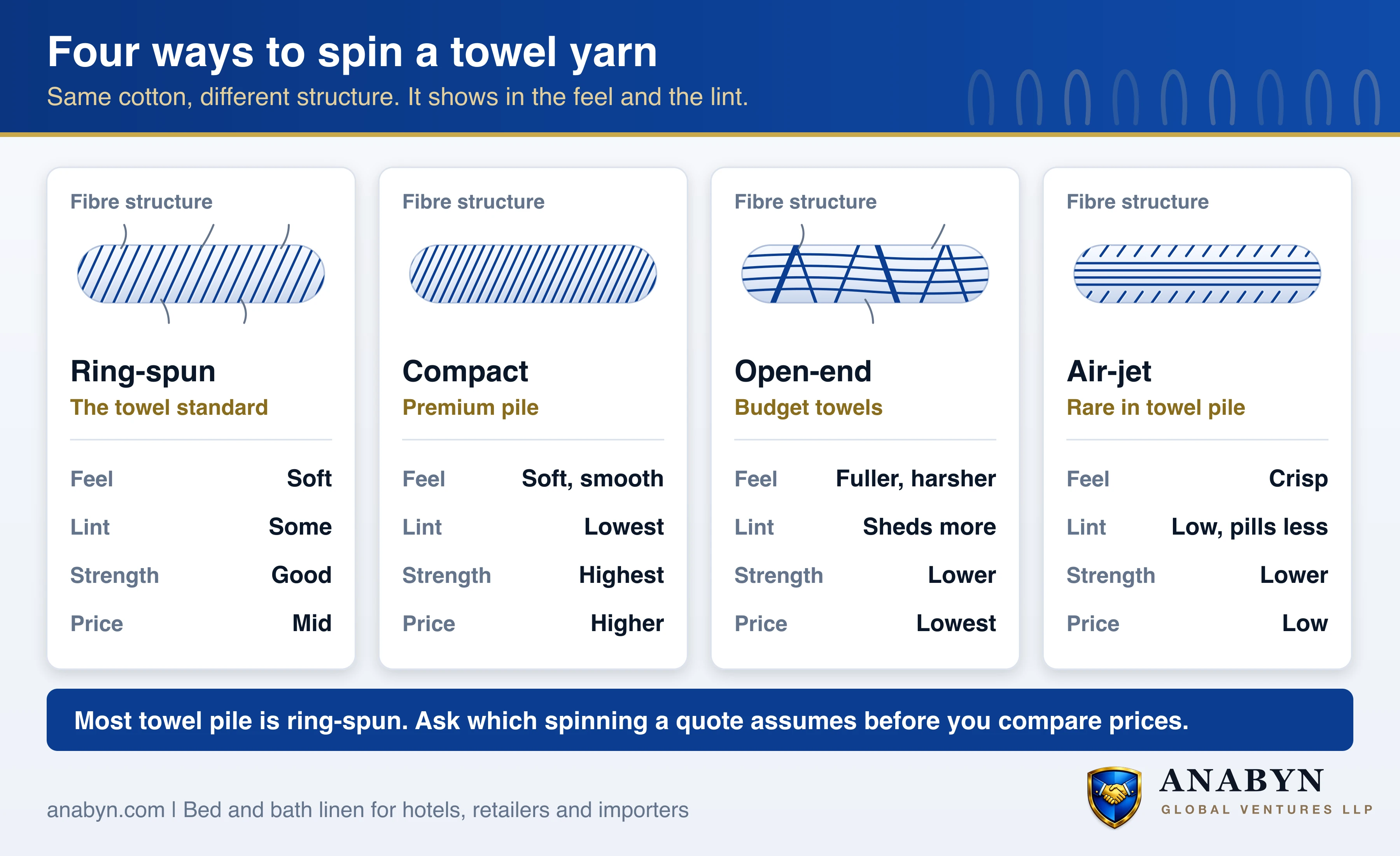
- Yarn spun on a rotor rather than a ring frame. It is cheaper to make and gives a fuller but harsher hand-feel, lower strength and more lint in service, which is why it is common in budget towels.Spinning methods compared
Compact Yarn
Also called: Compact spun · Compact ring-spun
- A refined ring-spinning process that condenses the fibres before they are twisted, so fewer fibre ends stick out. Compact yarn is smoother and stronger than standard ring-spun and gives the lowest lint, at a higher yarn price.Spinning methods compared
Plied Yarn
Also called: 2-ply · 2/20s · Doubled yarn
- Two or more single yarns twisted together, written as plies over count: 2/20s is two 20s yarns, about as thick as one 10s single. Plied pile is stronger, rounder and sheds less lint than single yarn, and costs more.Reading a yarn count
Zero Twist
Also called: Untwisted yarn
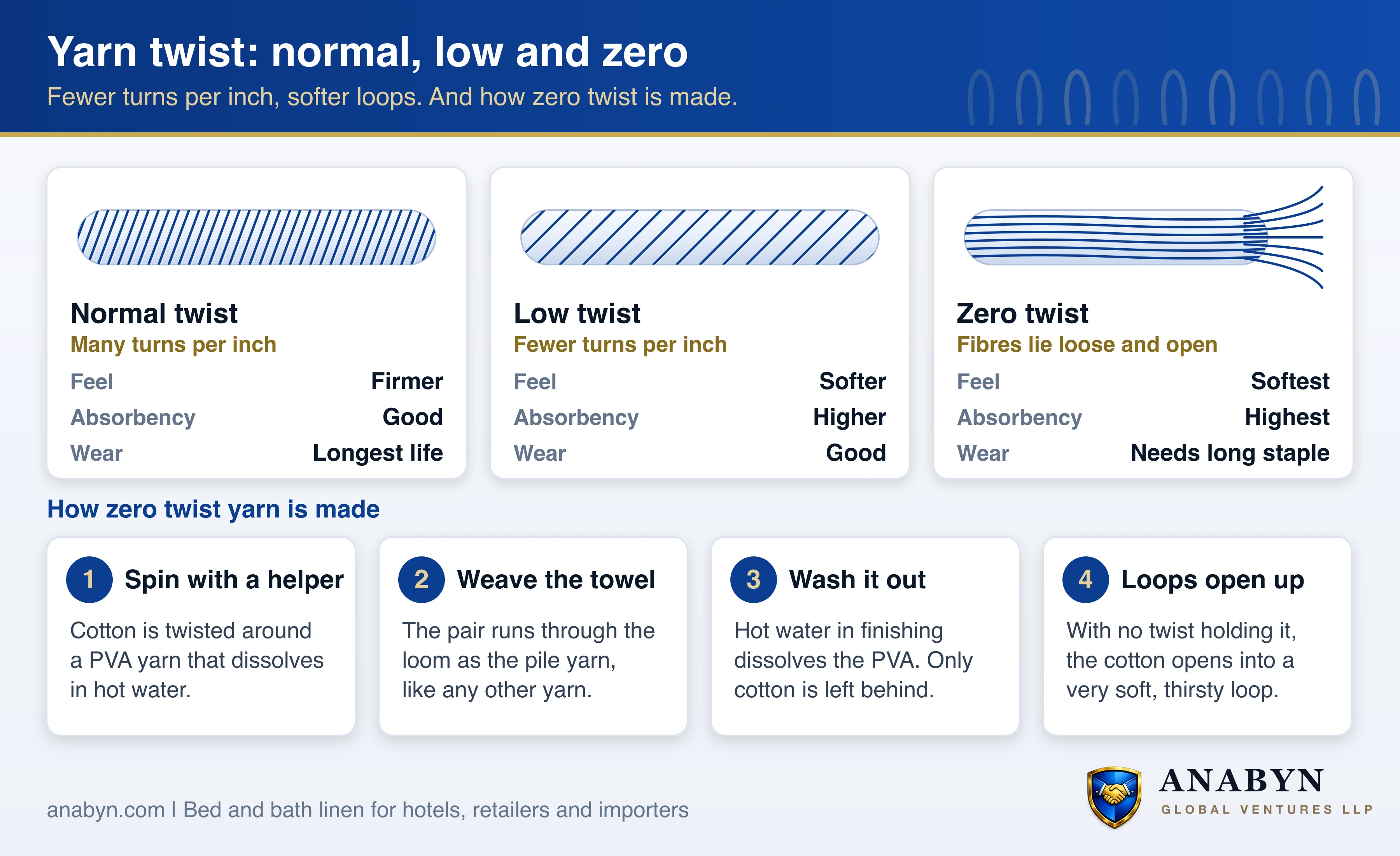
- Pile yarn spun with minimal twist, so the fibres stay open rather than being wound tight. The result is a notably softer, faster-drying and more absorbent towel at a given GSM, at the cost of some long-term durability compared with a conventional twisted pile.Normal, low and zero twist compared
Ring Spun Cotton
- Yarn made by continuously twisting and thinning the cotton strand, producing a finer, stronger and smoother yarn than open-end spinning. Ring-spun pile gives a softer hand-feel and holds up better through repeated commercial laundering.
Combed Cotton
- Cotton that has been mechanically combed before spinning to remove short fibres and impurities. Fewer short fibres means less linting and pilling in service - which matters most on bed linen and on towels destined for high-wash-cycle hospitality use.
Percale
- A one-over-one-under plain weave for bed linen, giving a matte finish and a crisp, cool hand-feel. Percale is the traditional hotel sheeting weave and is generally more breathable and more durable than sateen at the same thread count.Hotel bed linen
Sateen
- A weave that floats several warp threads over each weft thread, putting more yarn surface on the face of the cloth. This produces a soft, lustrous, slightly heavier sheet that drapes better than percale but shows wear sooner under commercial laundering.
Waffle Weave
Also called: Honeycomb weave
- A recessed grid weave that creates a large surface area with very little fabric weight. Waffle bathrobes and towels dry far faster and pack far smaller than terry, which is why spas and warm-climate resorts specify them.
Dobby Border
- The flat woven band across the ends of a towel, produced on a dobby loom. It gives a towel its finished look, is the usual location for a woven logo or stripe, and reinforces the hem against fraying.
Hemming
Also called: Double-fold hem
- The stitched finish on the cut edges of a towel or sheet. A double-fold hem with a locked stitch is the hospitality standard because a single-fold hem is the first thing to fail after repeated industrial washing.
Lyocell
Also called: Tencel
- A fibre regenerated from wood pulp in a closed-loop process. Tencel is the brand name of lyocell made by Lenzing. Silky and absorbent, but not as strong as cotton.Fibres compared
Modal
- A regenerated cellulose fibre made from beech wood pulp. Very soft and drapey, but weaker than cotton when wet.Fibres compared
Viscose
Also called: Rayon · Bamboo viscose
- A regenerated cellulose fibre made by dissolving wood or bamboo pulp. Most bamboo fabric is viscose. It is weaker than cotton when wet.Fibres compared
Flax linen
- Cloth made from the flax plant. Crisp, durable and textured. Used here to tell the fibre apart from the trade word "linen" for all bed and bath textiles.Fibres compared
Poly-cotton
Also called: Polyester-cotton
- A blend of polyester and cotton, for example 65/35. It resists creasing, dries fast and lasts more washes in hard laundering, with less breathability than pure cotton.Fibres compared
Dobby
- A loom attachment that lifts groups of warp threads in a set pattern to weave small geometric designs. On towels it makes the woven border.Dobby borders
Jacquard
- A loom system that controls warp threads individually, so it can weave logos, names and large detailed designs.Jacquard towels
Sateen stripe
Also called: Satin stripe
- A stripe made by weaving bands of sateen next to plain weave. It is tone on tone and cannot wash out.Sateen weave
Velour
Also called: Sheared terry
- Terry whose loops are sheared off one side to give a smooth, plush face with a sheen. The cut face absorbs less than the loop side.Velour bathrobes
Shawl collar
- A single continuous rolled collar on a bathrobe that frames the neck. The classic hotel robe style.Bathrobe sizing
Kimono collar
Also called: Kimono robe
- A flat wrap style with a straight front, lighter and simpler to make than a shawl collar robe.Kimono robes
Hemstitch
Also called: Hem
- The stitched fold at a cloth edge. Stitch density and tidy finishing matter because wear often starts at the hem.Dobby borders
Quality
AQL 2.5
Also called: Acceptable Quality Limit · AQL inspection
- A statistical sampling standard (ISO 2859-1) that defines how many units to inspect from a lot and how many defects may be found before the lot is rejected. AQL 2.5 for major defects is the normal acceptance level for hospitality and retail textile shipments.AQL 2.5 inspection in practice
Master Sample
Also called: Counter sample · Approved sample · Sealed sample
- The physical sample both buyer and factory sign off before bulk production, retained by each side as the reference for the order. Bulk goods are judged against the master sample, so approving one without physically handling it removes your main quality remedy.
Colourfastness
Also called: Color fastness · Wash fastness
- How well a dyed fabric resists losing or transferring colour under washing, rubbing, light and perspiration, graded 1-5 on ISO test methods. Hospitality linen is usually specified at grade 4 or better for wash and rub fastness, since it is laundered far more aggressively than domestic linen.
Shrinkage
Also called: Residual shrinkage · Dimensional stability
- The dimensional loss a textile shows after washing, quoted as a percentage. Cotton terry typically shrinks 5-8% and cotton sheeting 3-5%; a specification should state finished-after-wash dimensions, otherwise "70x140cm" is ambiguous.
Linting
Also called: Shedding
- The loose short fibres a new towel sheds in its first several washes. Some shedding is normal on any terry; persistent linting past roughly five wash cycles usually indicates lower-grade or insufficiently combed cotton in the pile.
Colour fastness grade
Also called: Grey scale rating
- A rating from 1 (poor) to 5 (excellent) for how well colour resists washing, rubbing or light, judged against a grey scale. Written with the ISO 105 test method.Colour fastness guide
Pilling grade
- A 1 to 5 rating of how much a fabric forms pills after a standard abrasion test such as ISO 12945. Higher is better.Pilling fixes
Martindale
Also called: Abrasion test
- A test (ISO 12947) that rubs a fabric against a standard abrasive in a figure-of-eight motion and counts the cycles to wear or break-through.Reading a test report
Tensile strength
- The force a fabric strip can bear before breaking, measured to a standard method such as ISO 13934.Reading a test report
Tear strength
- The force needed to continue a tear in a fabric, measured to a standard method such as ISO 13937. Resin finishes tend to lower it.Reading a test report
Dimensional stability
Also called: Dimensional change
- How much a fabric changes size after washing, measured to ISO 5077 using a wash procedure such as ISO 6330.Shrinkage guide
Absorbency test
Also called: Water flow test
- A measure of how quickly and how much water a towel takes up. ASTM D4772 is a common method for terry fabric.Why new towels are not absorbent
Thermal disinfection
- Using heat in the wash to control bacteria. UK guidance HTM 01-04 gives 65°C for at least 10 minutes or 71°C for at least 3 minutes for healthcare linen.For commercial laundries
Critical defect
- A defect that makes a product unsafe or breaks a legal rule. Usually zero are allowed.AQL calculator
Major defect
- A defect likely to cause a return or failure in use, such as a hole or an open hem.AQL calculator
Minor defect
- A small fault that does not affect use and is unlikely to cause a return, such as a loose thread end.AQL calculator
Pulled loop
- A terry loop that has been snagged and pulled longer than the rest of the pile.Final inspection
Broken pick
- A missing or broken weft thread, which shows as a thin line across the fabric.Final inspection
Slub
- A thick spot in a yarn that shows as a small lump in the fabric.Final inspection
Oil stain
- A mark from machine oil, picked up during weaving or sewing. Usually a major defect.Final inspection
Shade variation
- A visible colour difference within a piece, between pieces or between cartons.Shade bands
Crooked border
- A border or hem that does not run straight across the towel.Final inspection
Skipped stitch
- A gap in a seam where the needle failed to form a stitch. A weak point that can open in washing.Final inspection
Bow and skew
- Weft threads that curve or slant instead of running straight across. It can make borders and patterns look crooked.Final inspection
Inspection level
- Sets how many pieces are sampled in AQL inspection. General level II is the usual choice.AQL calculator
Acceptance number
Also called: Ac
- The highest number of defects allowed in an AQL sample for the lot to pass.AQL calculator
Pre shipment inspection
Also called: PSI · Final inspection
- A final check done when production is finished and most goods are packed, before the balance is paid.Final inspection
During production inspection
Also called: DUPRO
- A check while production is running, so faults are caught before the whole order is made.Final inspection
Grey scale
- A set of grey pairs used to grade colour change or staining from 1 to 5. Grade 5 means no change.Colour fastness
D65 light
- A standard artificial daylight used in light booths to compare colours the same way every time.Colour matching
Metamerism
- When two colours match under one light but not under another. The reason to agree a light source for colour approval.Colour matching
GSM tolerance
- How far the measured weight may differ from the ordered GSM and still pass, written as a plus or minus number.GSM explained
Seam strength
- The force a sewn seam takes before it breaks or opens, tested under ISO 13935.Making up guide
Finish & Colour
Mercerising
Also called: Mercerisation
- A treatment in which cotton yarn or cloth is soaked in strong sodium hydroxide under tension. The fibre swells and rounds, which adds lustre and strength and lets it take dye more deeply. The effect is permanent.Finishes explained
Sanforizing
Also called: Compressive shrinkage control
- A mechanical process that compresses woven cloth lengthwise to pre-shrink it. It is used mainly on flat woven fabric such as sheeting. Terry towels are normally controlled by pre-washing instead.Shrinkage guide
Singeing
- Passing cloth quickly over a flame or hot plate to burn off the loose fibre ends on the surface. It reduces pilling and lint and gives a cleaner surface for dyeing.Finishes explained
Enzyme wash
Also called: Bio-polish · Cellulase finish
- A treatment with cellulase enzymes that removes loose surface fibres from cotton. It leaves a smoother surface with less pilling. If overdone it reduces fabric strength.Finishes explained
Silicone softener
- A finish that coats fibres with a slippery layer for a smooth, soft hand. A heavy coat can repel water, so new towels may absorb slowly until it wears off.Why new towels are not absorbent
Hydrophilic softener
- A softening finish that keeps the fibre surface water-loving, so towels feel soft without slowing water uptake. Usually the better choice for towels than a heavy silicone coat.Finishes explained
Peaching
Also called: Brushed finish
- A light abrasion of the cloth surface that raises a fine nap of fibre ends and gives a suede-like feel. The raised fibres can also pill.Finishes explained
Calendering
- Passing cloth between heated, pressed rollers to flatten the surface and add lustre. The effect is partly temporary and fades with washing.Finishes explained
Resin finish
Also called: Non-iron finish · Easy-care finish
- A cross-linking treatment that helps cloth resist creasing. It reduces tear strength, and older systems released formaldehyde, which OEKO-TEX Standard 100 limits by product class.Finishes explained
Optical brightener
Also called: Fluorescent whitening agent · OBA
- A fluorescent agent that converts invisible ultraviolet light into blue light so white cloth looks brighter. It fades with washing and sunlight.White vs coloured towels
Azo-free
- Dyed without azo dyes that can break down into restricted aromatic amines. Those amines are restricted in the EU under REACH. Test reports are better evidence than the claim alone.Reactive dyeing
Lab dip
- A small dyed sample made to match a reference colour, approved before bulk dyeing begins. The approved piece is kept as the master standard for reorders.Reactive dyeing
Dye lot
Also called: Batch
- One batch of cloth or yarn dyed together. Shade can differ slightly between lots, which is why a reorder may not match the first order unless matched to a master standard.White vs coloured towels
Shade band
Also called: Colour tolerance
- The agreed range of colour difference allowed from the approved master standard, usually written as a delta E limit.White vs coloured towels
Pantone TCX / TPX
- TCX swatches are dyed on cotton cloth and are the right reference for cotton textiles. TPX swatches are printed on paper and look different from dyed cotton.Reactive dyeing
Pigment print
- A print that fixes colour to the cloth surface with a binder. It can feel stiffer and may wear with washing, unlike reactive print, which bonds chemically to cotton.Reactive dyeing
Certification
OEKO-TEX Standard 100
- A product certification confirming every component of a textile - fabric, thread, dye, trim - has been tested against limits for substances harmful to human health. It certifies chemical safety of the finished article; it says nothing about organic fibre content or social compliance.Anabyn certifications
GOTS
Also called: Global Organic Textile Standard
- The leading certification for organic fibre textiles, covering organic content, permitted chemical inputs, wastewater treatment and social criteria across the whole processing chain. GOTS goods require an unbroken certified chain of custody with a transaction certificate per shipment.
ISO 9001:2015
- The international standard for quality management systems. It certifies that a manufacturer runs documented, audited processes for handling specifications, inspection and corrective action - it is a process certification, not a product quality grade.
Commercial
MOQ
Also called: Minimum Order Quantity
- The smallest quantity a factory will produce for an order, usually counted per colour and size rather than across the whole order. It exists because dyeing and loom set-up costs are fixed per run - which is why splitting one quantity across many colours raises the price.Request a quote with your quantities
OEM / Private Label
Also called: White label · Own brand
- Manufacturing goods that carry the buyer's brand rather than the factory's - woven labels, custom packaging, buyer-specified construction. OEM production requires the buyer to own the specification, which is why it is usually paired with a signed tech pack and master sample.OEM and private label programs
Proforma Invoice
Also called: PI
- A binding quotation issued before production that states goods, specification, quantity, price, Incoterm, payment terms and delivery window. Signing it is what converts an enquiry into an order, and it is normally the document a buyer's bank needs to release an advance payment or open a letter of credit.
Letter of Credit
Also called: LC · Documentary credit
- A bank undertaking to pay the exporter once it presents documents matching the credit exactly. It protects both sides on larger orders, but payment turns on document compliance rather than on the goods, so the LC wording must match the shipping documents precisely.
Lead Time
- The time from order confirmation to goods being ready to ship, excluding ocean transit. For bulk bed and bath linen it typically runs 30-45 days from receipt of the advance payment, with samples taking a further 7-14 days beforehand.The export process step by step
Export & Logistics
Incoterms
Also called: FOB · CIF · DDP · ExW
- The ICC-published trade terms that define where the seller's responsibility for cost and risk ends and the buyer's begins. FOB puts the goods on the vessel at the origin port, CIF adds sea freight and insurance to destination, and DDP delivers duty-paid to the buyer's door - so two quotes are only comparable on the same Incoterm.
FOB Cochin
- Free On Board at Cochin (Kochi) port, Kerala - the price of goods loaded aboard the vessel at Cochin, with sea freight and insurance for the buyer's account. Cochin is the natural gateway for Kerala-made linen and routes efficiently to the Gulf, Europe and the Indian Ocean rim.
HS Code
Also called: Harmonised System code · Tariff code
- The international commodity classification that determines the import duty payable. Terry towels normally fall under HS 6302.60 and cotton bed linen under HS 6302.21 - declaring the correct subheading is what makes a preferential duty claim stand up.
Certificate of Origin
Also called: COO
- The document certifying where goods were manufactured, issued by an authorised chamber or export council. It is the paperwork that unlocks preferential duty rates under schemes such as the UK DCTS or the India-UAE CEPA - a missing or wrong COO is the most common reason a buyer pays full duty on goods that qualified for zero.
FCL / LCL
Also called: Full Container Load · Less than Container Load
- FCL means the shipment fills a container booked for one buyer; LCL means it is consolidated with other shippers' cargo. LCL suits trial and small repeat orders, while FCL gives a materially lower cost per piece - which is why volume price breaks usually appear at full-container quantities.
IEC
Also called: Importer Exporter Code
- The ten-character code issued by India's DGFT that a business must hold to export from India. Asking a prospective Indian supplier for its IEC is a quick way to confirm you are dealing with a registered exporter rather than an unregistered intermediary.Verify Anabyn's registrations
LUT
Also called: Letter of Undertaking
- Letter of Undertaking. An Indian exporter files it on the GST portal each financial year so it can export goods without paying IGST up front.
Commercial invoice
- The final sale invoice for a shipment. Customs in both countries use it to check value, and the importer uses it to pay duty.Export documents in order
Packing list
- A list of every carton in a shipment, with its contents, weights and size. Customs and the receiving warehouse check the goods against it.Export documents in order
Shipping bill
- The export declaration filed with Indian customs, electronically on ICEGATE, usually by a customs broker. Goods cannot be loaded without it.Export documents in order
Let export order
Also called: LEO
- Permission from Indian customs, given after the shipping bill is checked, that allows the goods to be loaded for export.Export documents in order
Bill of lading
Also called: BL
- The document a shipping line issues when goods are on board. It is a receipt, the contract of carriage and, in its original form, the title to the goods.Export documents in order
Sea waybill
- A transport document like a bill of lading, but not a title document. The named consignee can collect the goods without presenting an original.Export documents in order
Telex release
- An instruction from the shipping line to release goods at destination without the original bill of lading, after the originals are surrendered at origin.Export documents in order
eBRC
- Electronic Bank Realisation Certificate. It is generated on the DGFT system from bank data and proves that payment for an export has been received.Export documents in order
EDPMS
- Export Data Processing and Monitoring System, run by the Reserve Bank of India. It matches each shipping bill with the payment received for it.Export documents in order
RoSCTL
Also called: Rebate of State and Central Taxes and Levies
- Rebate of State and Central Taxes and Levies. An Indian scheme that refunds taxes built into the cost of exported apparel and made ups, such as towels.
Duty drawback
- A refund of customs duty paid on inputs used in exported goods. In India it is mostly paid at fixed All Industry Rates.
ICEGATE
- The online portal of Indian customs, used to file shipping bills and other export and import documents.
Customs broker
Also called: CHA · Customs house agent
- A licensed agent who files customs documents and clears goods for the exporter or importer. In India also called a CHA.
Consignee
- The party the goods are shipped to, as named on the bill of lading. Usually the buyer or the buyer agent.
Notify party
- The party the shipping line informs when the goods arrive. Often the buyer or the customs broker.
CFS
Also called: Container Freight Station
- Container Freight Station. A facility near a port where shared container loads are packed and unpacked, and where customs checks are often done.
VGM
Also called: Verified Gross Mass
- Verified Gross Mass. The weighed total weight of a packed container, which the shipper must declare before loading under international safety rules.
Demurrage
- A charge for keeping a container inside the port terminal beyond the free days.Incoterms
Detention
- A charge for keeping the shipping line container outside the terminal, for example at your warehouse, beyond the free days.Incoterms
Cargo insurance
- Cover for loss or damage to goods in transit. Under CIF the seller buys only the minimum cover, so many buyers arrange their own.FOB, CIF and DDP
CBM
Also called: Cubic metre
- Cubic metre. The unit for carton and shipment volume, and the basis for shared container freight charges.Container calculator
Making Up
Making up
- All the work after fabric is woven and finished: cutting, hemming, sewing, labels and logos.Making up guide
Cut size
- The size a piece of fabric is cut to before sewing. It is larger than the finished size to allow for hems and shrinkage.Making up guide
Finished size
- The size of the product after making up, and after washing if it is pre washed. This is the size to put on an order.Making up guide
Size tolerance
- How far a finished piece may differ from the target size and still pass, written as a plus or minus number.Making up guide
Selvedge
Also called: Selvage
- The firm edge a loom weaves along the length of the cloth so it cannot fray. The long sides of most towels are selvedges.Making up guide
Flat woven end
- The band at each end of a towel woven without loops, so it can be cut and folded into a neat, flat hem.Making up guide
Double fold hem
- A hem where the edge is folded twice so the cut edge is sealed inside. The usual hem for towels.Making up guide
Overlock
Also called: Serging
- A stitch that wraps thread around a cut edge to stop it fraying. Used on seams and on the sides of some towels.Making up guide
Stitches per inch
Also called: SPI
- The number of stitches in one inch of seam or hem. More stitches make a stronger seam, up to a point.Making up guide
Lockstitch
- A stitch that locks two threads together. It does not run if one stitch breaks, so it is used for hems.Making up guide
Chain stitch
- A looped stitch that is fast to sew but can unravel along the seam if the thread is cut.Making up guide
Bar tack
- A short, dense block of stitches that reinforces a stress point, such as the ends of a belt loop or the corners of a pocket.Making up guide
Taped seam
- A seam covered with a strip of tape. Stronger and softer against the skin, often used at the back neck of a robe.Making up guide
Yoke
- A shaped panel across the shoulders or upper back of a garment. Some robes use a contrast yoke.Making up guide
Cuff
- The finished end of a sleeve. On robes it is often turned back or banded.Making up guide
Belt loop
- A small sewn loop at the side of a robe that holds the belt in place. Should be reinforced with bar tacks.Making up guide
Patch pocket
- A pocket made by sewing a piece of fabric onto the outside of a garment. The usual pocket on robes.Making up guide
Piping
- A narrow folded strip of fabric sewn into an edge as trim, often in a contrast colour.Making up guide
Machine embroidery
- A logo or design stitched on by machine. The price depends mainly on the number of stitches.Embroidered towels
Applique
- A shaped piece of fabric sewn onto the product as a design, often edged with embroidery.Making up guide
Pattern pieces
- The flat shapes cut from fabric to make a garment. A shawl collar robe uses about eleven.Making up guide
Pre production sample
Also called: PP sample
- A sample made with the real fabric, trims, labels and logo before bulk starts. Once approved it becomes the standard for inspection.Making up guide
Packing and Labelling
Polybag
- A clear plastic bag for a single piece or an inner pack. Common for retail, often skipped for hotel orders.Packing and labelling guide
Inner pack
- A small bundle of pieces, often 5 or 10, packed together inside a master carton.Packing and labelling guide
Master carton
Also called: Export carton
- The outer export carton that holds the inner packs. Usually strong corrugated board.Packing and labelling guide
Carton marks
Also called: Shipping marks
- The printing on the outside of an export carton: buyer mark, order number, item, quantity, carton number, weights, size, destination and origin.Packing and labelling guide
Gross weight
- The weight of a carton including the goods and all packing.Packing and labelling guide
Net weight
- The weight of the goods alone, without cartons, bags or other packing.Packing and labelling guide
Solid carton
- A carton holding one size and one colour only.Packing and labelling guide
Assorted carton
Also called: Assortment
- A carton holding a set mix of sizes or colours, packed to a ratio the buyer gives.Packing and labelling guide
Care label
- A sewn label with washing, drying and ironing instructions, usually as symbols.Packing and labelling guide
Fibre content label
- A label stating what the product is made of, such as 100 percent cotton. Required by law in most markets.Packing and labelling guide
Origin label
- A label stating the country where the product was made, such as Made in India. Required in the US and expected by most buyers.Packing and labelling guide
RN number
- A Registered Identification Number from the US Federal Trade Commission. A US company may print it on labels instead of its name.Packing and labelling guide
Hangtag
- A card attached to a product by a string or pin, with brand, price or product story. Used mainly for retail.Packing and labelling guide
Belly band
- A printed card band wrapped around a folded towel or set for retail display.Packing and labelling guide
Barcode
Also called: EAN · UPC
- A scannable product number, usually EAN 13 or UPC A. The numbers come from the brand owner through GS1.Packing and labelling guide
Desiccant
- A sachet that absorbs moisture, added to cartons to prevent mould on humid sea voyages.Packing and labelling guide
Know the terms? Send us the spec.
Share GSM or thread count, sizes, quantities and your target Incoterm. We respond within 24 hours with factory pricing and a sample offer.
Request Factory Quote