
AQL Inspection Calculator
Work out the sampling plan your pre-shipment inspection will actually run, and what it takes to fail a lot - before you agree the terms rather than after the report lands.
AQL Inspection Planner
How many pieces the inspector draws, and how many faults it takes to fail the lot.
Sample size code L
Draw 200 pieces from 5,000
Or have it sent to your inbox
Critical defects
AQL 0
Any one fails the lot
Major defects
AQL 2.5
10
accept
11
reject
Minor defects
AQL 4.0
14
accept
15
reject
What counts as what - agree this before production
Critical
Unsafe, unsaleable, or a legal problem. Normally inspected at AQL 0 - a single critical defect fails the lot.
Broken needle fragment in the piece · Missing or wrong fibre-content label where the market requires one · Wrong country of origin marking
Major
The guest or end customer would notice and reject it. This is the class the headline AQL usually refers to.
Hole, tear or open seam · Prominent stain or oil mark · Shade materially off the approved swatch · Size outside the agreed tolerance · Missing embroidery or logo on a branded piece
Minor
A departure from the spec that would not by itself cause a rejection. Usually inspected one AQL level looser than majors.
Slight loose thread · Minor uneven hem within tolerance · Small variation in pile height · Faint crease from packing
Tightening the AQL is the obvious lever and rarely the useful one. Most inspection disputes are about whether a shade variation is a major or a minor, not about the number - so settle the classification list with the mill while the goods are still on paper.
Why a supplier publishes this
It is a fair question. A calculator that tells buyers exactly how to fail our lots is not an obvious piece of marketing. We publish it because the alternative is worse for both sides: an inspection where the buyer and the mill discover at the container door that they had different ideas about what AQL 2.5 covered.
A rejected lot costs us more than it costs you. Everything that makes an inspection predictable - an agreed classification list, an approved shade swatch, a plan both sides read the same way - is in our interest before it is in yours.
What sampling does and does not buy you
A passed inspection means the sample drawn was consistent with a lot at or better than the agreed limit. It does not mean every piece is perfect, and defects below the accept number were found and accepted - that is how the plan is designed to work. If you need certainty on every piece, you are asking for 100% inspection, which is a different service at a different price.
What sampling is genuinely good at is catching a process that has gone wrong. A mill running a bad batch will fail a Level II plan reliably. A mill running well will pass it. That is the question an inspection is built to answer.
Related: check a wash trial against ISO 6330 shrinkage benchmarks · verify our certifications at source · set the size tolerances an inspection measures against
Free buyer kit
Goods-Receiving Checklist
What to check the day your container of linen arrives, before you sign anything off.
- Before you open the container (3 checks)
- Count and look (4 checks)
- Open a sample of cartons (3 checks)
- Check the goods against your spec (7 checks)
- Record and report (4 checks)
No sign-up. Works for any supplier, not just us.
Two easy ways to start
No account, no sales call, no import paperwork to fill in. Pick whichever suits you.
Buying a full container, or need Incoterms and compliance documents? Use the full RFQ form.
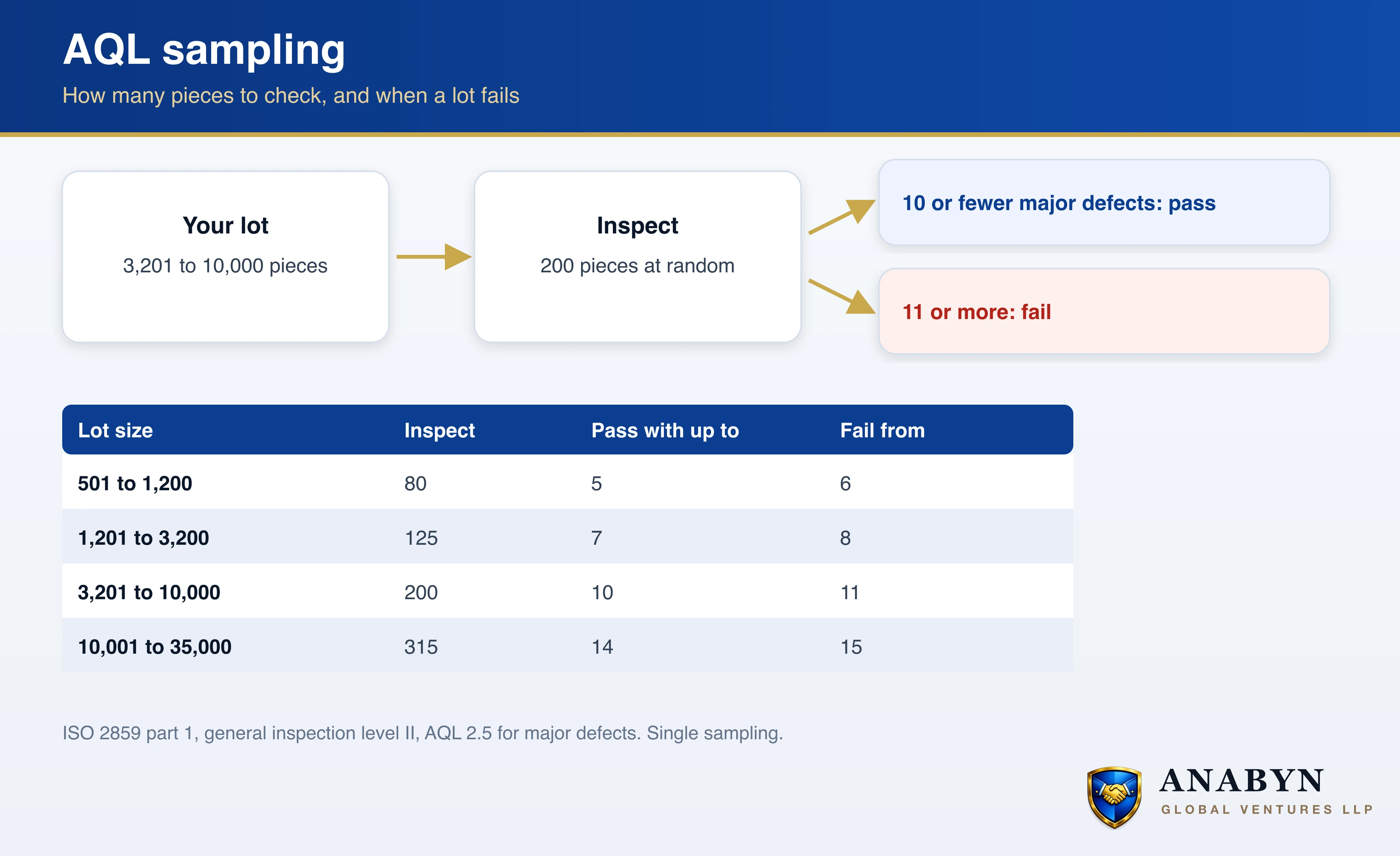
How AQL sampling works
The standard sample sizes behind the calculator above.
 Tap to enlarge
Common questions
What does AQL 2.5 actually mean?+
AQL stands for Acceptable Quality Limit, and 2.5 is the defect rate at which a lot is still considered acceptable in the long run. It is not a promise that 2.5% of your goods will be faulty, and it is not a target. It is the parameter that sets how many defective pieces the inspector can find in the sample before the lot is rejected. On a 5,000-piece lot the inspector draws 200 pieces at General Level II, and at AQL 2.5 they accept the lot at 10 defects and reject it at 11.
How many pieces does an inspector actually check?+
Far fewer than most buyers expect, and the number does not scale linearly with the order. A 1,000-piece lot gets an 80-piece sample. A 5,000-piece lot gets 200. A 30,000-piece lot gets 315. That is the whole point of statistical sampling - the confidence comes from the sampling plan rather than from checking everything - but it does mean a single inspection is a check on the process, not a guarantee about every piece in the container.
What AQL should I specify for hotel towels and bed linen?+
AQL 2.5 for major defects with 4.0 for minors is the common hospitality standard and is what most third-party inspection bodies will assume if you do not say otherwise. Critical defects are inspected at zero, meaning any one of them fails the lot. Retail and private-label programmes often tighten majors to 1.5. Going below that starts to cost real money in rework without much practical gain, because at some point you are paying to chase defects the guest would never see.
What is the difference between a critical, major and minor defect?+
A critical defect makes the goods unsafe or unsaleable, or creates a legal problem - a broken needle fragment, or a missing fibre-content label in a market that requires one. A major is something the guest or end customer would notice and reject: a hole, a prominent stain, a shade materially off the approved swatch, a size outside tolerance. A minor is a departure from spec that would not on its own cause a rejection, like a loose thread or a slightly uneven hem within tolerance.
Why do inspections get disputed if the AQL is agreed?+
Because almost every dispute is about classification, not about the number. Buyer and mill both agree on AQL 2.5, then disagree about whether a shade variation is a major or a minor - and that single judgement can flip a lot from accepted to rejected. The fix is unglamorous and effective: agree the defect classification list, and an approved shade swatch, before production starts rather than at the inspection.
What is General Inspection Level II?+
It is the default inspection level in ANSI/ASQ Z1.4 and ISO 2859-1, and it is what third-party textile inspections almost always run. Level I uses a smaller sample and gives less protection; Level III uses a larger one and costs more. There are also special levels used for destructive or expensive tests where only a handful of pieces can be sacrificed. Unless you have specifically negotiated otherwise, assume Level II.
Does a passed inspection mean every piece is good?+
No, and it is worth being clear-eyed about that. A passed inspection means the sample drawn was consistent with a lot at or better than the agreed quality limit. Defects below the accept number were found and accepted - that is how the plan works. If you need certainty on every piece you are asking for 100% inspection, which is a different service at a different price, and for most linen programmes it is not worth what it costs.
What is your minimum order — can I buy just one carton?+
For towels our minimum is 500 pcs trial / 2,000 pcs wholesale. "Per SKU" means per size and colour combination. Smaller towel orders can join a run we already have in production, in that run's size, GSM and colour. Tell us your size and GSM and we will list the runs that are close. Bed linen starts at 50 pcs per size at 200, 300 and 400 TC, standard or custom sizes (250 TC subject to availability). Bathrobes start at 50 pcs per size in white, standard or custom sizes (colours on enquiry). A custom towel below 500 pieces costs more per piece, because a loom set-up and a dye lot cost the same for 100 towels or 1,000. We will tell you that plainly before you commit.
How much does a sample cost and how fast do I get it?+
2 free pcs per spec, you pay courier only. Courier from Kerala to most countries runs $35–$60 via DHL or FedEx and arrives in 7–14 days. We recommend asking for two GSM weights side by side — most buyers change their mind about weight once they hold both. Sample cost is credited back against your first bulk order.
How do I pay, and what protects me if the goods are wrong?+
50% advance, 50% on production completion (before dispatch). The balance falls due only once the finished goods have passed our AQL 2.5 inspection against your approved sample, and you get photos of the actual production run before you pay it. You can also appoint a third-party inspector (SGS, Bureau Veritas or Intertek, roughly $300–$500 for a single inspection) to check the goods at the specialist unit before you release the balance; we will schedule it and give them access. If a shipment does not match the approved sample, we remake or credit it. For larger orders, an L/C at sight is accepted instead.
Do I need an import licence to buy this?+
In most countries, no — not for commercial quantities of ordinary cotton textiles. In the US, UK, EU, UAE, Australia and Canada, a business tax or VAT registration number is normally all that is required, and your freight forwarder or customs broker files the entry for you. Some markets do require an importer registration (Saudi Arabia and Egypt among them). Tell us your country and we will tell you plainly what you need before you commit any money.
What does it cost delivered to my door, not FOB?+
FOB means the price to get goods loaded onto the ship at Cochin port — freight, duty and local delivery are on top. As a rough guide, sea freight adds $0.15–$0.45 per towel on a shared container and less on a full one; import duty is typically 6–12% depending on your country. We quote CIF (freight included) or DDP (everything included, delivered to your address) on request, so you can compare one final number instead of guessing. Our landed-cost calculator does the arithmetic for you.
Can I order without any certification requirement?+
Yes, absolutely. Certification is not a hoop we make you jump through — it is simply how we already manufacture. Every piece is made under OEKO-TEX Standard 100 whether you ask for the certificate or not, and it costs you nothing extra. If you do not need the paperwork, do not ask for it and nothing about your order or price changes. Buyers who supply hotel groups or EU retailers usually want the documents; an Airbnb host or a salon owner almost never does.
How long from order to goods in my hands?+
30–45 days for production, plus shipping. Sea freight is 10–16 days to the Gulf, 22–30 days to Europe and the UK, 28–38 days to the US east coast, and 18–25 days to Australia. Air freight cuts that to 3–5 days but costs roughly 6–8× more per kilo, so it is worth it for samples and rarely worth it for bulk. Plan on about 8–10 weeks door to door for a first sea shipment.
Are you a manufacturer or a trading company?+
Fair question, and one you should ask everyone. Yes, we are a manufacturer and exporter, not a trader. We run production stage by stage through specialist units: spinning, weaving, dyeing, finishing, stitching, embroidery and labelling are each done by a unit that specialises in it, and we own the spec, the approved shade, the AQL 2.5 inspection and the shipment as exporter of record. You deal with one accountable party, not a chain of middlemen, and you can video-call the unit running your order. We will give you our IEC (Import Export Code) and GST registration to check.
Can you put my brand on it?+
Yes. Woven labels, printed care labels, embroidered logos, custom packaging and retail barcodes are all standard. Logo embroidery adds about $0.30–$0.60 per piece; a custom woven label adds about $0.06–$0.12. Private-label MOQ is 2,000 pieces per SKU rather than 500, because the label and packaging themselves carry a minimum run.
Related pages
Origin Comparator
Two origins landed at your door, plus the FOB price at which the answer flips.
Container Loading Calculator
How many towels or sheet sets fit in a 20ft or 40ft container.
Par Level Calculator
How much linen a property actually needs, by room count.
Bed Size Converter
Mattress and sheet dimensions across UK, EU, US, Australian and Japanese sizing.
Official references
Duty rates, HS codes and certification rules change. Check them with the issuing body before you order.