How Towels and Bathrobes Are Cut and Sewn
Making up is everything that happens after the fabric is woven and finished: cutting, hemming, sewing, labels and logos. It is where most visible faults start, and where a clear order line prevents them.
What does making up mean?
Weaving makes the cloth. Making up turns the cloth into a product. It covers cutting, hemming, sewing seams, adding labels and adding logos.
A good fabric can still become a poor towel if the hems are weak or the size is wrong. That is why buyers who check only GSM and colour often miss the faults that cause returns.
Read more: How a towel is made, step by step
How is a towel made up?
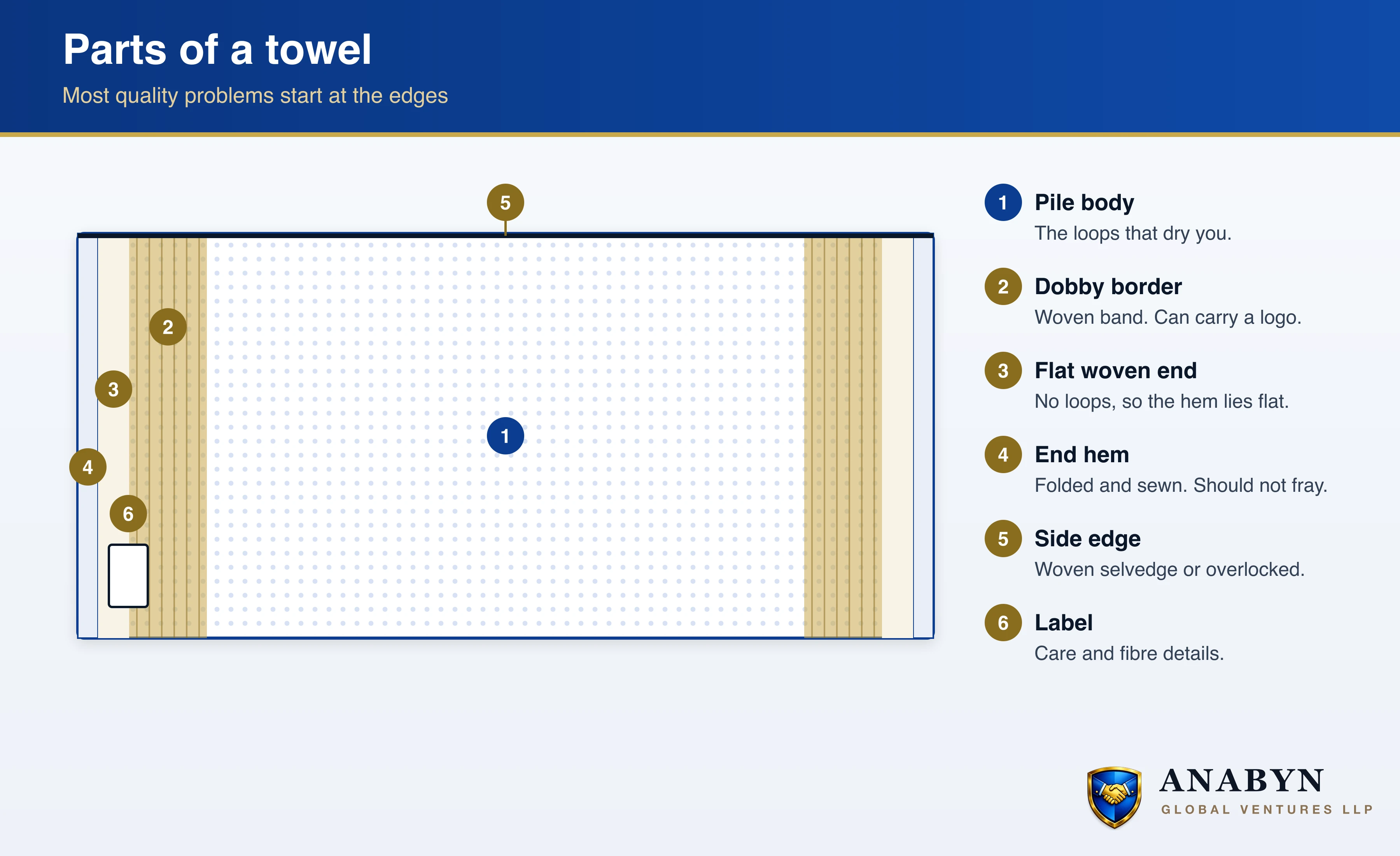
Towels are woven as one long strip. The loom leaves a flat band with no loops between one towel and the next. The strip is cut across that flat band, and each cut end is folded and sewn into a hem.
The long sides of a towel are usually not sewn at all. They are a selvedge, a firm edge the loom weaves so it cannot fray. Some cheaper towels are cut from wide cloth instead and have overlocked sides.
The care label is normally sewn into one end hem, near a corner.
Read more: Dobby borders
Which hem should I ask for?
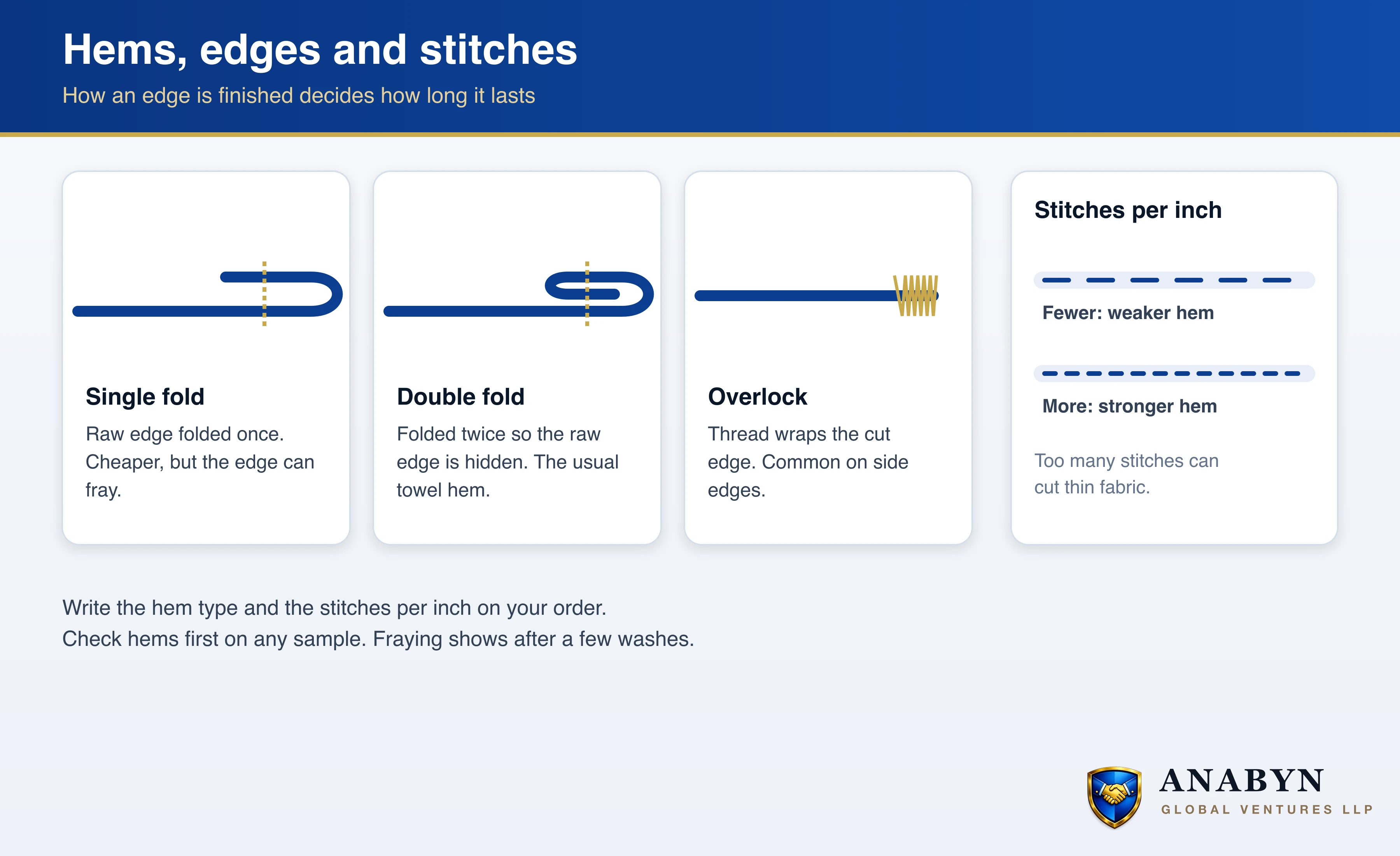
Ask for a double fold hem on towel ends. The cut edge is folded twice, so it is sealed inside and cannot fray. A single fold hem leaves the cut edge inside the fold, where it can work loose in a hard wash.
Stitches per inch, or SPI, is how many stitches fit in one inch of seam. More stitches make a stronger hem, up to the point where the needle holes start to weaken thin cloth. Write the number you want on the order, and count it on samples.
Hems are sewn with a lockstitch, which locks two threads together and does not run if one stitch breaks. A chain stitch is faster to sew but can unravel along the whole seam if the thread is cut.
What is the difference between cut size and finished size?
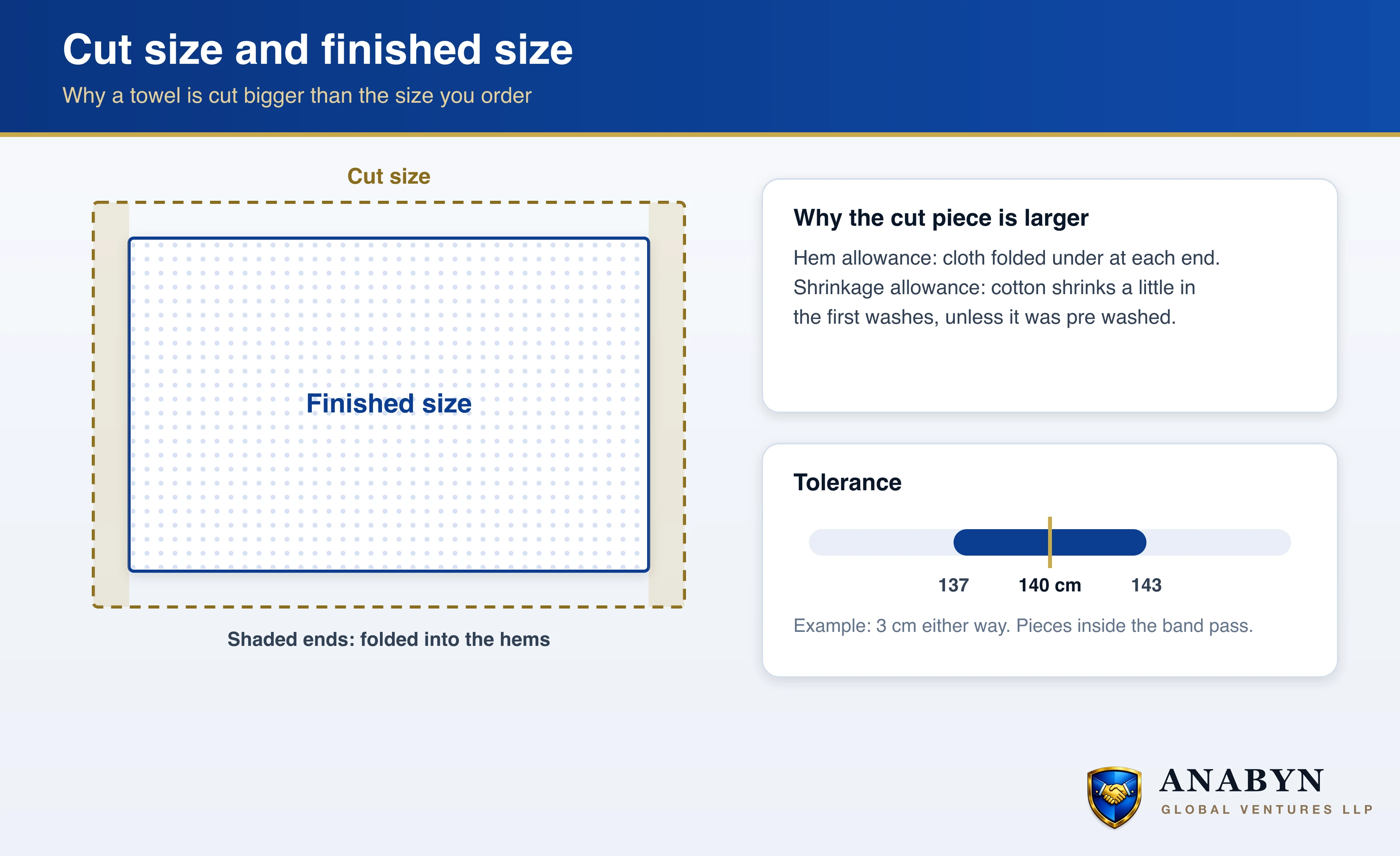
The piece of fabric is cut larger than the size you order. Some of it folds into the hems. Some of it allows for shrinkage in the first washes. The size you order is the finished size, measured after making up, and after washing if the towel is pre washed.
No two towels come out exactly the same size, so agree a tolerance: how far a piece may be from the target and still pass. Write it on the order as a plus or minus number, and say how and when the piece is measured.
Read more: Shrinkage · Towel size chart
How is a bathrobe made?
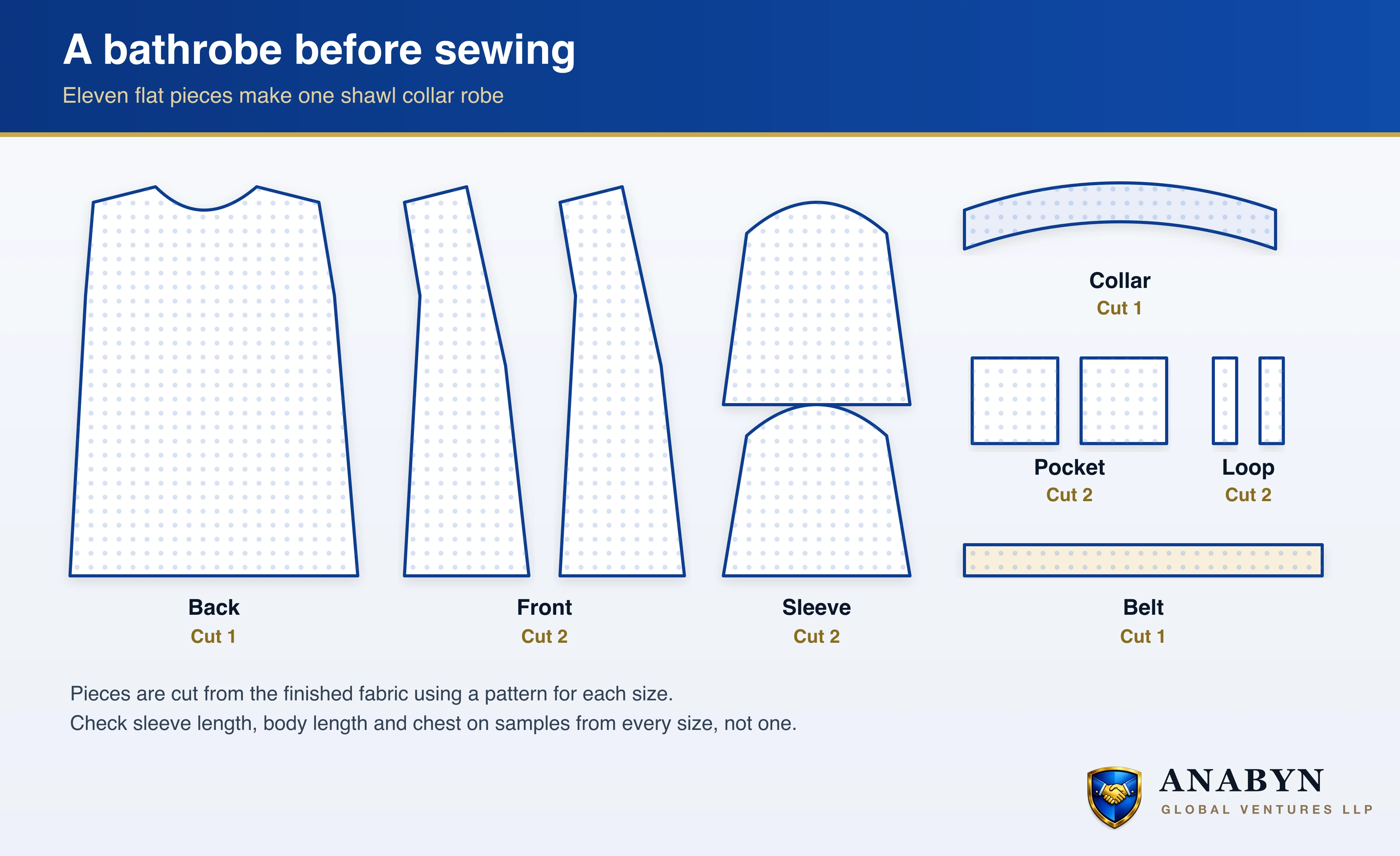
A robe is cut from finished fabric using a pattern for each size. A shawl collar robe needs about eleven pieces: a back, two fronts, two sleeves, a collar, two pockets, a belt and two belt loops.
The pieces are sewn together at the shoulders, the sides and the sleeves. The collar is attached last, then the hem and cuffs are finished. Each step is a place where size can drift, so check samples in every size you order, not just one.
Read more: Robe sizes and weights
What should a robe order name?
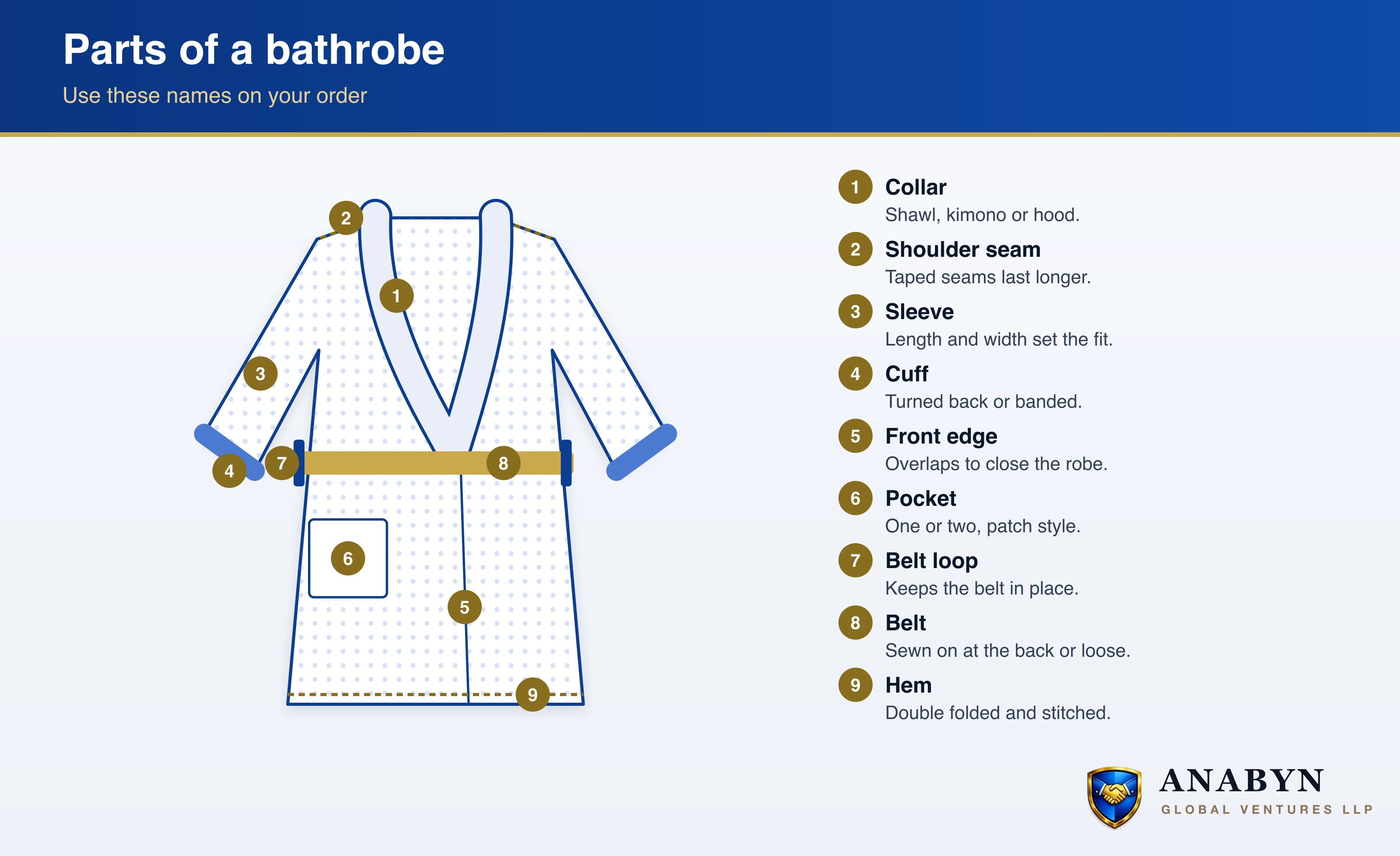
Use the part names on your order. Say which collar you want, whether the belt is sewn on at the back or loose, how many pockets, whether the cuffs are turned back, and where the logo goes.
Ask for bar tacks at the belt loops and pocket corners. A bar tack is a short, dense block of stitches that stops a stress point tearing. Belt loops without them are a common first failure.
Many robes have a strip of tape sewn over the inside neck seam. A taped seam is stronger and softer against the skin than a bare overlocked edge.
How do I put a logo on towels or robes?
There are four common ways, and each suits a different order.
- Private label and logo orders start at 2,000 pieces per SKU.
- Send the logo as a vector file, with thread or Pantone colours.
- Approve a stitched or woven sample of the logo before bulk.
| Method | How it works | Best for |
|---|---|---|
| Woven in the border | The logo is woven into the dobby or jacquard border on the loom | Large repeat orders. Needs the longest set up. |
| Embroidery | The logo is stitched on by machine. Cost depends mainly on the stitch count | Robes, and towels in smaller runs |
| Applique | A shaped piece of fabric is sewn on, often edged with embroidery | Bold logos and kids products |
| Woven brand label | Your own label sewn into a hem or the back neck | Retail and private label |
Read more: Embroidered towels · Monogrammed robes · Jacquard borders
What is a pre production sample?
It is a sample made with the real fabric, thread, labels and logo, before bulk production starts. It is the last chance to catch a mistake cheaply.
Check it against your order line by line: size, hem, stitches per inch, label position, logo size and colour. Keep one approved piece, sealed and signed, as the standard the bulk is inspected against.
Read more: Samples · Final inspection
What goes wrong, and how to prevent it
| What you see | Why it happens | How to prevent it |
|---|---|---|
| Hems fray after a few washes | Single fold hem, or too few stitches per inch | Double fold hem with a stated SPI |
| Hems look wavy | Fabric stretched while sewing, or uneven thread tension | Check hems on the pre production sample and at inspection |
| Sizes vary within one order | Cutting from mixed fabric lots or worn patterns | Set a size tolerance and measure every size at inspection |
| Belt loops tear off | No bar tacks at the loop ends | Ask for bar tacks on loops and pocket corners |
| Embroidery puckers | No backing behind the stitches, or a design too dense for the fabric | Approve a stitched logo sample on the real fabric |
| Labels scratch the skin | Stiff label with sharp cut edges | Ask for a soft printed label or heat cut edges |
How it is tested
| What is checked | Standard | What to ask for |
|---|---|---|
| Finished size | Measured flat against your spec | A target size with a plus or minus tolerance |
| Stitches per inch | Counted at inspection | A minimum SPI for hems and seams |
| Seam strength | ISO 13935 2 | A minimum value for robe seams |
| Size after washing | ISO 6330 to wash, ISO 5077 to measure | A shrinkage limit after a set number of washes |
Written by Dr Abin Babu. Last checked 15 October 2026.
Putting this in your spec
Put these on your order
- Finished size for each item, with a plus or minus tolerance.
- Hem type and stitches per inch.
- For robes: collar style, belt sewn or loose, pockets, cuffs and bar tacks.
- Logo method, position, size and colours, with a vector file.
- Label type and position.
- A pre production sample to approve before bulk.
Frequently asked questions
Why do towel sides not have a hem?
Because the loom weaves a firm edge called a selvedge along each side. It does not fray, so it does not need sewing. Only the two cut ends are hemmed.
Should I order the cut size or the finished size?
Always the finished size. The maker works out the cut size from it, allowing for hems and shrinkage.
What is the strongest way to put a logo on a towel?
Weaving it into the border. It is part of the cloth, so it cannot peel or fray. It needs the longest set up, so it suits large repeat orders.
How many sizes of sample should I check for robes?
Every size you order. A pattern can be right in medium and wrong in extra large.