
FOB vs CIF vs DDP for Textile Imports
Who pays for freight, insurance, and duty at each stage - and which Incoterm suits your experience level as a bulk linen or towel importer.
Why Incoterms Matter for Textile Buyers
Incoterms (International Commercial Terms), published by the International Chamber of Commerce, define exactly where responsibility for freight, insurance, risk, and customs clearance shifts from seller to buyer. For bulk textile imports - bed linen, towels, bathrobes - the three most common terms quoted are FOB, CIF, and DDP.
Choosing the wrong term for your experience level is a common costly mistake: first-time importers who take on FOB without a freight forwarder relationship can face unexpected freight-booking headaches and uninsured cargo risk. Experienced importers who default to DDP often overpay, since the seller's bundled freight and duty markup is rarely as competitive as a direct forwarder relationship.
Responsibility Comparison: FOB vs CIF vs DDP
| Stage | FOB | CIF | DDP |
|---|---|---|---|
| Export customs clearance | Seller | Seller | Seller |
| Main freight (sea/air) | Buyer arranges & pays | Seller arranges & pays | Seller arranges & pays |
| Cargo insurance | Buyer's responsibility | Seller (minimum cover) | Seller's responsibility |
| Risk transfer point | On board vessel, origin port | On board vessel, origin port | Buyer's named destination |
| Import customs clearance | Buyer | Buyer | Seller |
| Import duty & taxes | Buyer pays | Buyer pays | Seller pays (built into price) |
| Inland delivery to door | Buyer arranges | Buyer arranges | Seller arranges |
| Price transparency | Highest - pure product cost | Medium - freight bundled | Lowest - all costs bundled |
| Best suited for | Experienced importers with own forwarder | Buyers wanting freight handled, duty control kept | First-time importers wanting one all-in price |
Who pays for each leg
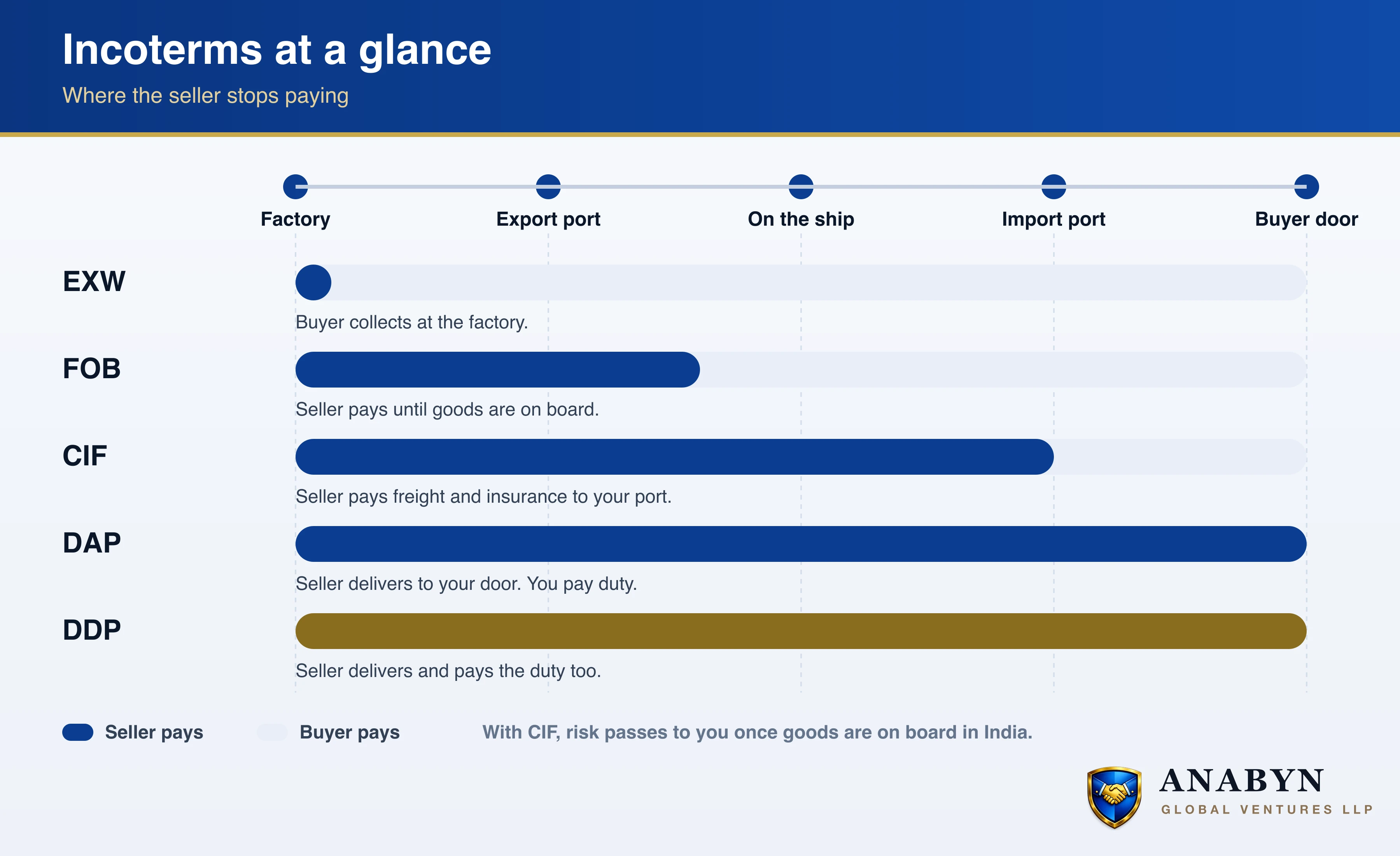 Tap to enlarge
Frequently Asked Questions
What is the difference between FOB, CIF, and DDP?
FOB (Free On Board) - the seller's responsibility ends once goods are loaded onto the vessel at the origin port; the buyer arranges and pays for ocean/air freight, insurance, and destination-side duty and delivery. CIF (Cost, Insurance, Freight) - the seller arranges and pays for freight and insurance to the destination port, but risk transfers to the buyer once goods are loaded at origin; the buyer still handles customs clearance and duty at destination. DDP (Delivered Duty Paid) - the seller handles everything, including destination customs clearance and duty payment, delivering the goods to the buyer's door fully cleared.
Which Incoterm is best for a first-time importer?
DDP is usually the simplest starting point for a first-time importer, since the seller handles freight booking, insurance, customs clearance, and duty payment - the buyer just receives goods at their door with one all-in price. The tradeoff is typically a higher unit price (the seller's margin covers logistics risk and admin) and less visibility/control over the shipping process. As buyers gain experience and want to control freight costs directly, they typically shift to FOB or CIF.
Why do experienced importers prefer FOB over DDP?
Experienced importers with an established freight forwarder relationship often prefer FOB because it lets them shop freight rates directly, choose carriers and routing, and negotiate better rates than a manufacturer's bundled freight markup. FOB pricing is also the cleanest way to compare quotes across multiple suppliers, since freight and duty variables are stripped out of the per-unit product price.
Who is responsible for cargo insurance under each Incoterm?
Under FOB, the buyer must arrange their own marine cargo insurance from the point goods are loaded at origin - many first-time buyers forget this and ship uninsured. Under CIF, the seller is required to arrange minimum insurance coverage (typically Institute Cargo Clauses C, a basic level) to protect the buyer, though buyers often top this up to a higher coverage level (Clauses A) for full protection. Under DDP, insurance is the seller's responsibility throughout, bundled into the delivered price.
Does the choice of Incoterm affect who pays import duty?
Under FOB and CIF, the buyer (importer of record) is responsible for paying import duty and taxes at the destination country, in addition to the product price agreed. Under DDP, the seller pays destination duty and taxes as part of the delivered price - meaning the seller must be registered or use an agent capable of paying duty in the buyer's country, which not all overseas manufacturers can do for every destination market.
Can I negotiate which Incoterm a supplier uses?
Yes - Incoterms are a contractual choice, not fixed by the supplier. Most established exporters, including Anabyn, quote FOB by default (the global norm for bulk B2B textile trade) but can also quote CIF or DDP on request, calculating the added freight, insurance, and (for DDP) duty into the landed price. Ask your supplier for a side-by-side FOB/CIF/DDP quote to compare true cost and control tradeoffs.
What Incoterms version applies in 2026?
Incoterms 2020, published by the International Chamber of Commerce (ICC), is the current version in standard use and remains applicable through 2026 pending the ICC's next scheduled revision cycle (Incoterms are typically revised roughly every 10 years). Always reference the specific version - e.g. "FOB Cochin, Incoterms 2020" - on your purchase order and commercial invoice to avoid ambiguity.
What is a typical FOB price for towels and CIF price for bed linen from India?
As a worked example at FOB Cochin: 600 GSM cotton bath towels run roughly $2.80-$3.50 per piece, and bed sheet sets (flat sheet + 2 pillowcases) run $5.00-$28.00 per set depending on thread count (200TC to 600TC). To convert to CIF, add ocean freight and insurance - typically $0.50-$1.50/kg for an FCL booking, or $1.50-$3.50/kg for LCL below container volume - which usually adds a few percent to a few tens of percent per unit depending on destination and order size. These are indicative; request a formal FOB and CIF quote side by side for your exact spec, quantity and destination.
Get Quoted in the Incoterm That Suits You
Tell us whether you want FOB, CIF, or DDP pricing - we'll break down the landed-cost components clearly either way.
Request Factory Quote