
Labels for Towels, Bed Linen and Robes: Woven, Satin, Digital Print or Embroidery
A plain guide for brands, hotels and importers who want their own name on the product. It explains the four main choices, how they differ, which one to pick, where each label goes and what to send your supplier.
What kinds of labels are there?
A brand label shows your name or logo. A care label tells people what the item is made of and how to wash it. Some products carry one label that does both.
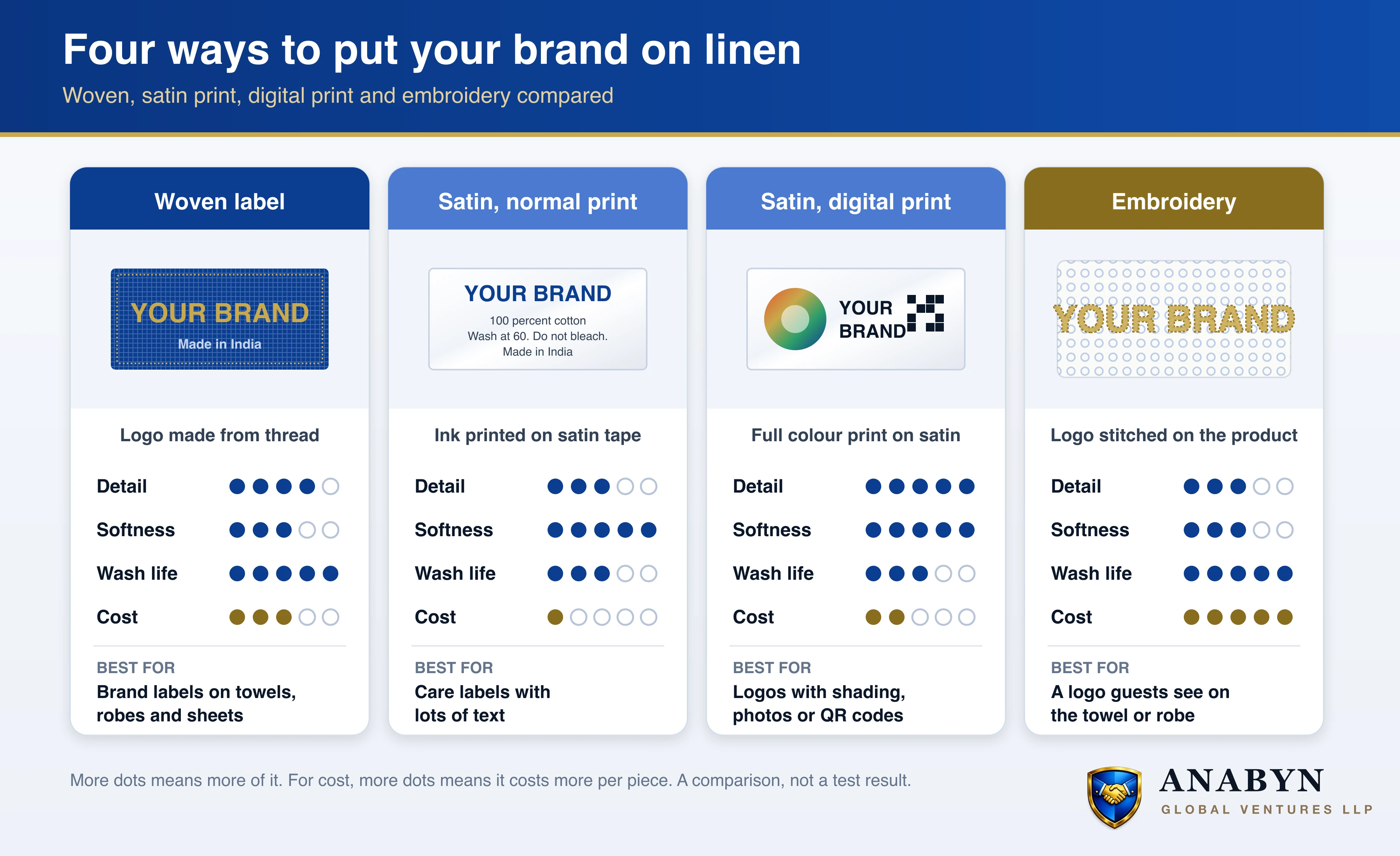
There are four common ways to make them. A woven label is made on a loom, so the logo is part of the label. A satin label is a smooth tape with the words printed on it. A digital print satin label is the same tape printed in full colour. Embroidery is not a label at all. The logo is stitched straight onto the product.
Satin labels are sometimes called sateen labels. It is the same thing.
Satin label or woven label: which is better?
Neither is better everywhere. They do different jobs. A woven label is stronger and looks more premium, and the logo cannot wash off. A satin label is softer and cheaper, and small text is easier to read on it.
That is why many brands use both. A woven label carries the brand where people see it. A printed satin label carries the care text inside a seam.
| Woven label | Satin label, printed | |
|---|---|---|
| How the logo is made | Woven in with thread | Ink printed on the tape |
| Looks | Rich and textured | Smooth and shiny |
| Feel | Firmer | Very soft |
| Small text | Good, best on damask | Very good |
| After many washes | Logo stays | Print can fade over time |
| Cost per label | Higher | Lower |
| Best use | Brand label | Care and size label |
What is a woven label, and what is damask?
A woven label is made on a small loom from fine threads, usually polyester. The logo and the background are woven at the same time. Because the colour is in the thread, it cannot wash off.
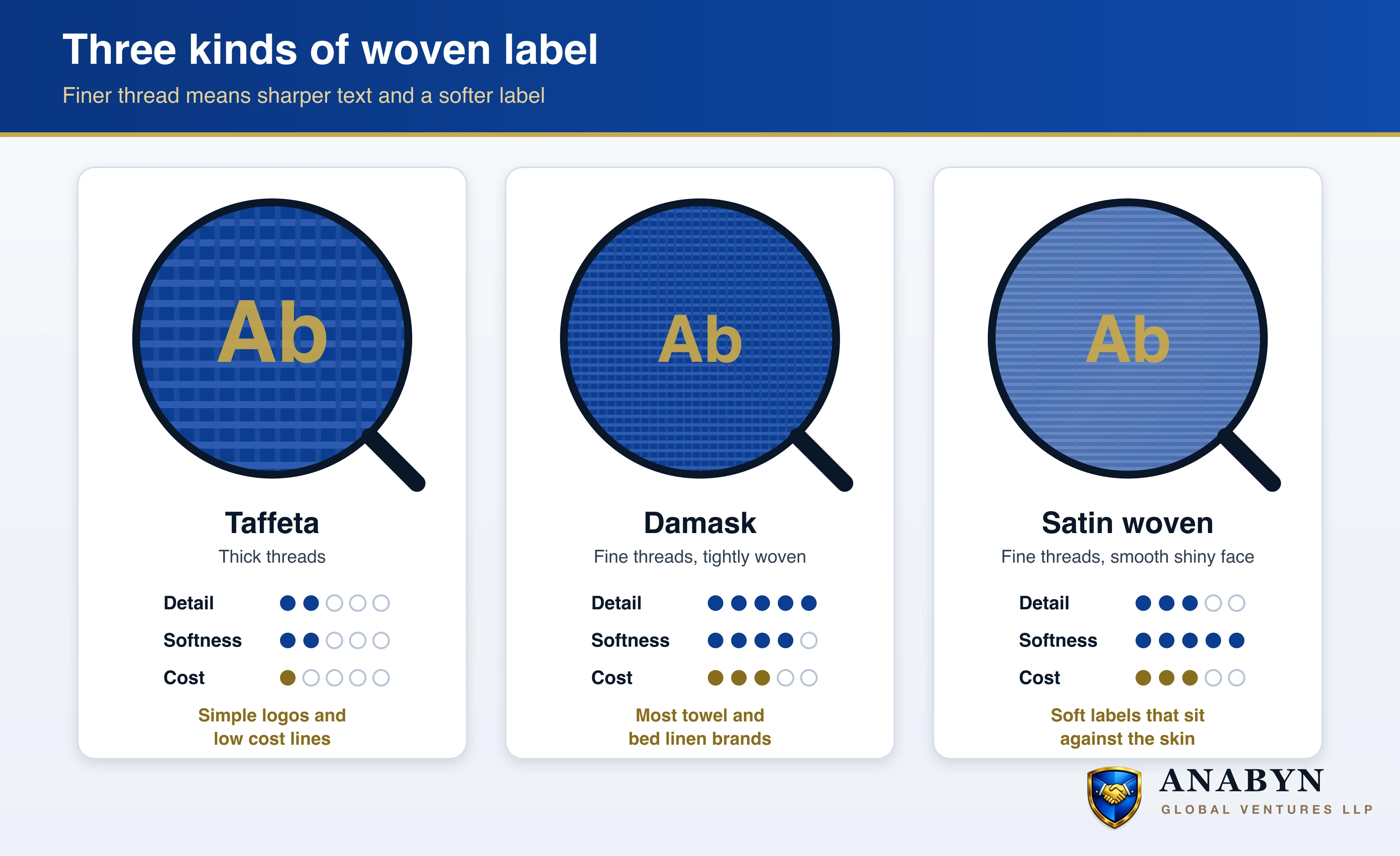
Woven labels come in three main qualities. Taffeta uses thicker threads. It is the cheapest and suits simple logos. Damask uses fine threads woven tightly. It shows small text clearly and feels softer, so most towel and bed linen brands choose it. Satin woven has a smooth, shiny face. It is the softest woven label and suits robes and anything that touches the skin.
Very thin lines and very small letters can still blur on any woven label. If your logo has fine detail, ask for a woven proof before you order.
Read more: Label and branding options · How private label works
What is a printed satin label?
A satin label is a smooth polyester tape. The words and logo are printed on it in one or a few colours. It is soft, thin and cheap, and it can hold a lot of small text. That makes it the usual choice for care labels.
Ink sits on the surface, so print can fade after many hot washes. Hotel linen is washed hot and often. If that is your use, wash a sample label with the product before you approve it.
Care labels are sometimes printed on cotton tape or thin nylon tape instead. Cotton tape feels natural. Nylon tape is thin and low cost but less soft.
What is a digital print label?
A digital print label is a satin label printed by a digital printer, like a very fine office printer. It can print any colour, shading, small photos and QR codes. A normal print label cannot do this well.
There is no printing plate to make. That suits small runs and many designs, such as one label for each size or each colour.
The ink still sits on the surface, so treat it like any printed label. Wash a sample with the product first.
When should I use embroidery instead of a label?
Use embroidery when you want people to see the logo on the product itself. Hotels and spas often put their logo on towels, robes and pillowcases this way.
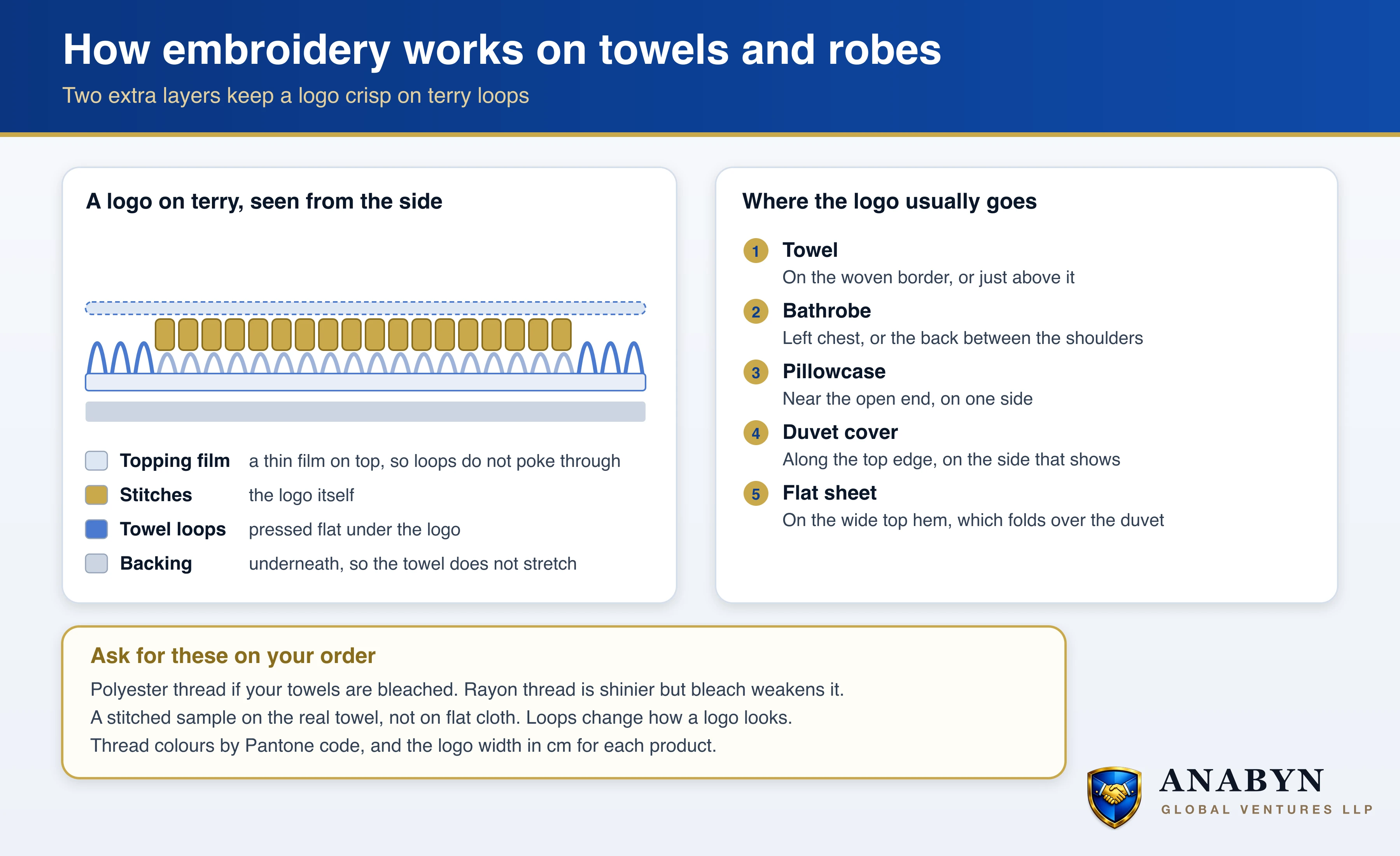
On a towel, the loops get in the way. A thin film goes on top so loops do not poke through the stitches. A backing goes underneath so the towel does not stretch. Ask your supplier to stitch a sample on the real towel, not on flat cloth.
The price depends on the size of the logo, how many stitches it needs and how many thread colours it uses. A small logo with one or two colours costs least. If your towels are bleached, ask for polyester thread. Rayon thread is shinier, but bleach weakens it.
A logo can also be woven into the towel border instead. That is called a jacquard border. It costs more to set up, but it cannot fray or come loose.
Read more: Embroidered towels · Monogrammed robes · Embroidered bed linen · Jacquard towels
What about labels with no tag at all?
A heat transfer label is printed onto the fabric with heat, so there is no tag to cut off or itch. It works well on smooth fabric, such as a robe lining or a jersey sheet.
It does not stick well to towel loops. For towels, a sewn label or embroidery is the safer choice.
Which label should I choose?
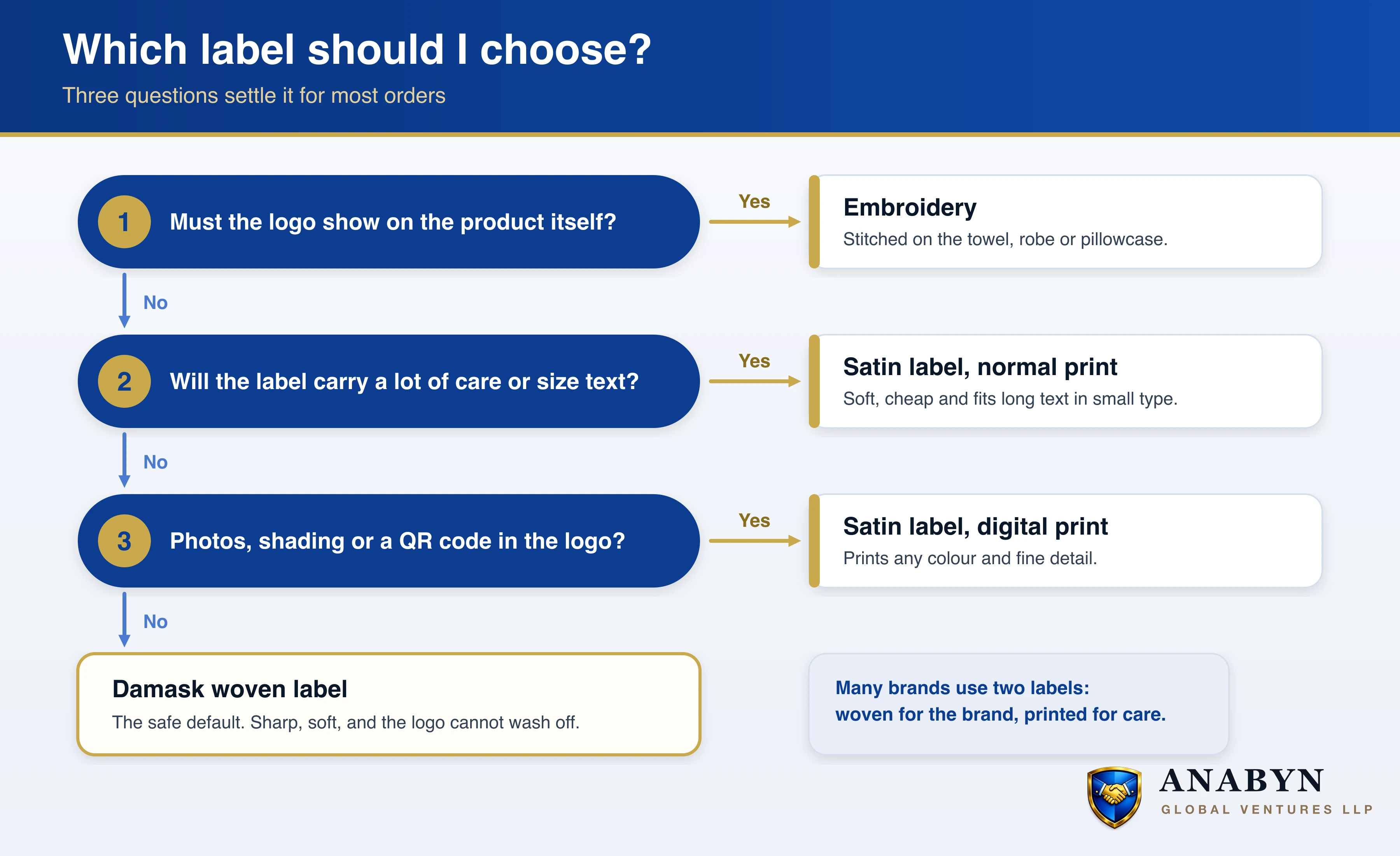
Answer three questions. Must the logo show on the product? Choose embroidery. Will the label carry a lot of text? Choose a printed satin label. Does the logo have shading, photos or a QR code? Choose a digital print satin label. If none of these apply, a damask woven label is the safe choice.
How is a label folded and sewn on?
The same label can be cut and folded in different ways. The fold decides where it can go.
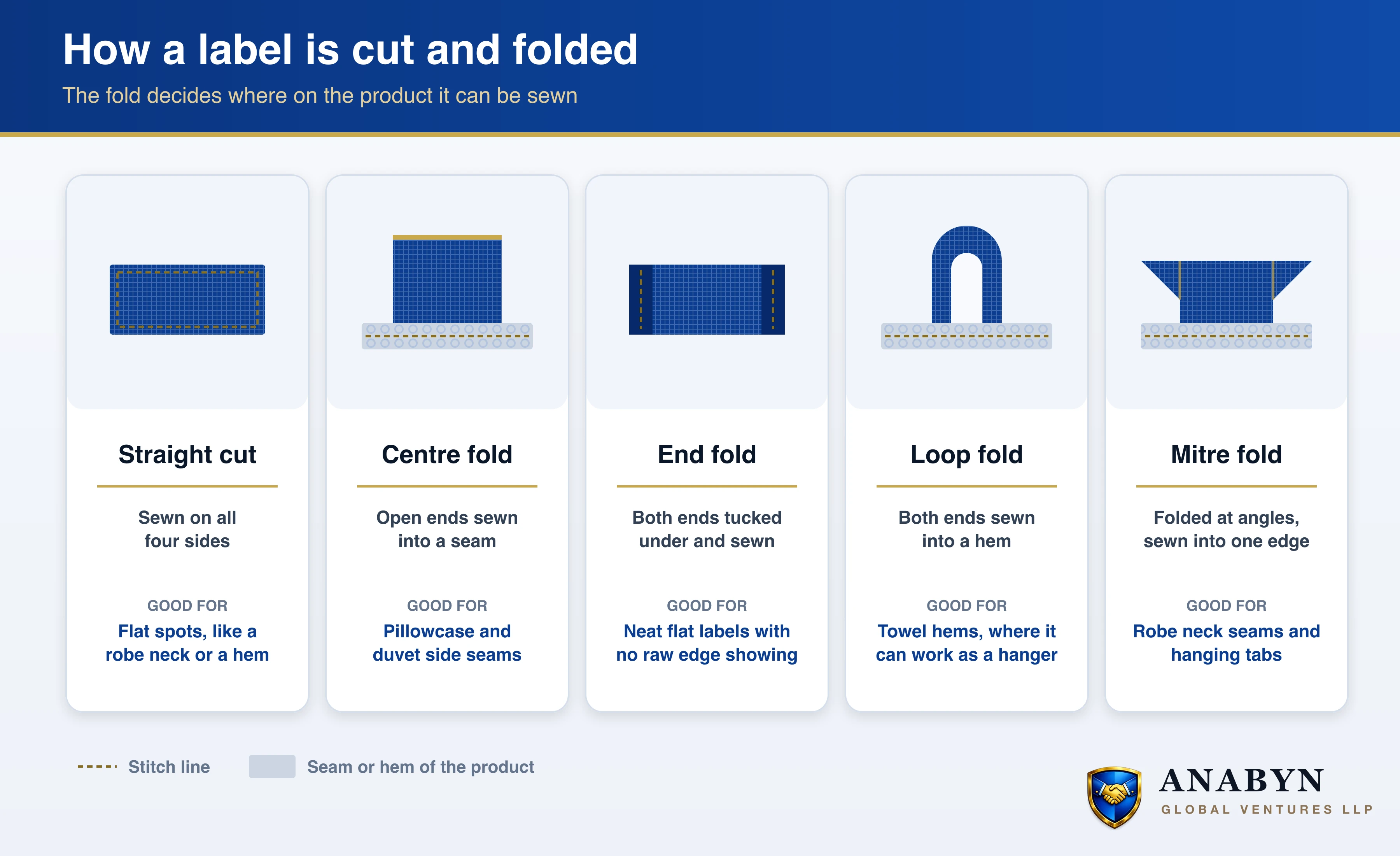
- Straight cut: flat, sewn on all four sides. Good for a robe neck or a hem.
- Centre fold: folded in half, with the open ends caught in a seam. Good for pillowcases and duvet covers.
- End fold: both ends tucked under and sewn. Neat, with no raw edge.
- Loop fold: both ends sewn into a hem, so it stands up as a loop. Common on towels.
- Mitre fold: folded at angles and sewn into one edge. Used at robe necks and for hanging tabs.
Where does the label go on each product?
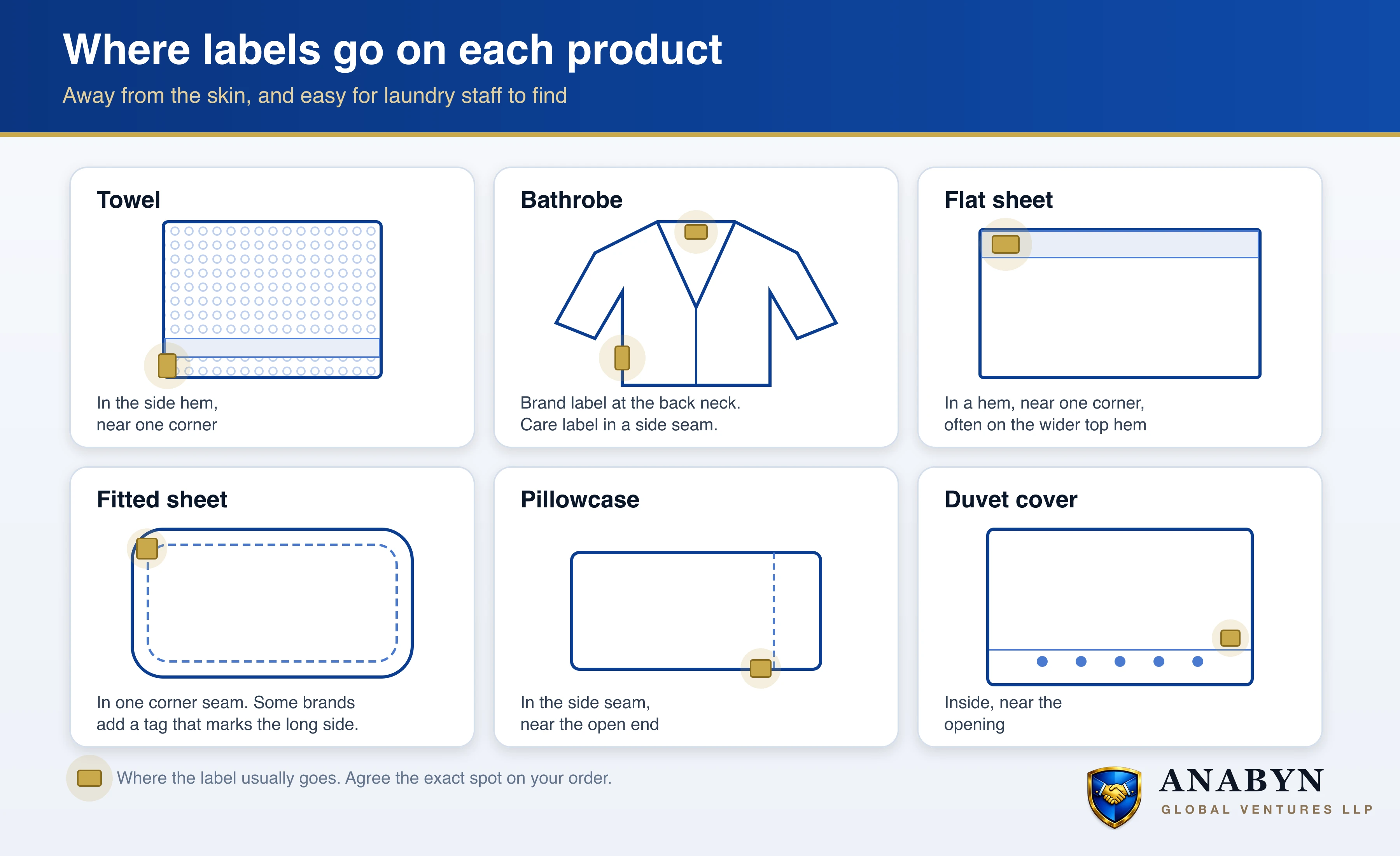
Put the label where it will not rub the skin and where laundry staff can find it fast. On towels it usually sits in the side hem near a corner. On robes the brand label goes at the back neck and the care label goes in a side seam.
On a fitted sheet the label usually sits in one corner seam. Some brands add a small tag that marks the long side, which makes the bed faster to make. On a pillowcase it goes in the side seam near the opening. On a duvet cover it goes inside near the opening.
Common brand label sizes are 25 x 25 mm, 40 x 25 mm and 55 x 30 mm. A care label is usually longer, because it carries more text.
What should a care label say?
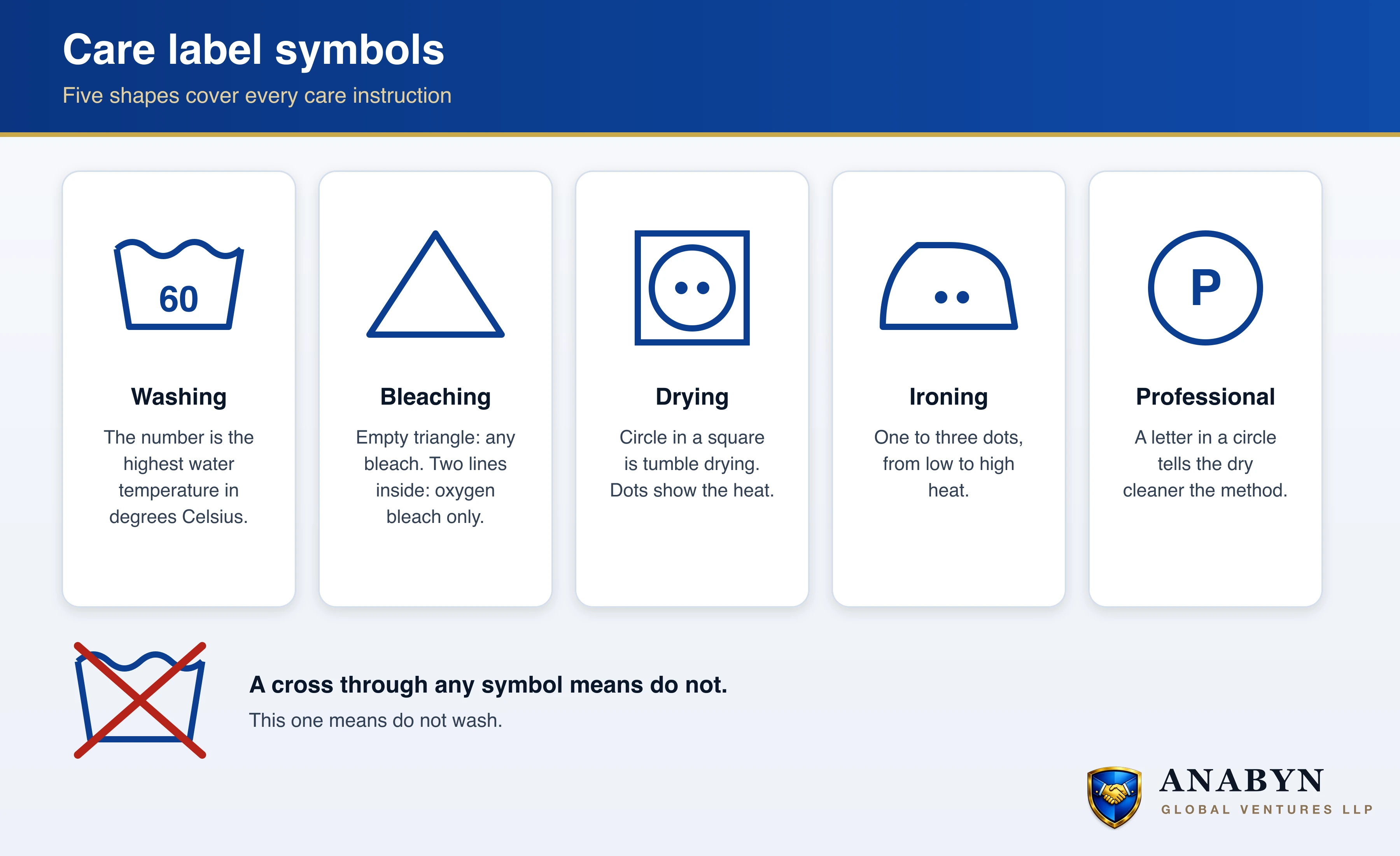
A care label usually shows the fibre, such as 100 percent cotton, the washing symbols and the country of origin. Some markets also want the name of the maker or seller.
What is required by law differs by market. The packing and labelling guide covers the rules for the US, the EU, the UK and the Gulf.
Read more: Label rules by market · Care problems and fixes
What do I send for a label order?
Always approve a real label sample, or a stitched embroidery sample, before production starts. A screen proof does not show how thread or ink will look.
- Your logo as a vector file, such as AI, EPS, PDF or SVG. A photo or a small JPG is not enough.
- Colours as Pantone codes, for the label and for any embroidery thread.
- The label type, size in mm and fold for each product.
- The full care text, in every language you need.
- Where each label goes on each product.
- For embroidery, the logo width in cm and the spot on each product.
Do I supply the labels, or do you?
Either works. You can send us your own labels, and we sew them on. Or we have them made in India to your artwork and include the cost in your quote.
Private label is possible at 50 pieces per size if you supply your own labels.
Labels must be ready before stitching starts. Approve the label at the same time as the product sample, which takes 7 to 14 days, so it does not hold up the order.
Read more: Private label bed linen · White label towels · Linen for online brands
Where does Anabyn fit in?
Anabyn is an export house based in Thrissur, Kerala. We make towels, bed linen and robes to your spec, add your labels, embroidery and packaging, check the goods before they ship and handle the export papers.
Send us your logo, the products and the quantities. We will reply with the label options and a quote.
Read more: Bath linen buyer guide · Bed linen buyer guide · Request a quote
What goes wrong, and how to prevent it
| What you see | Why it happens | How to prevent it |
|---|---|---|
| Label scratches the skin | Stiff cut edge or a taffeta label at the neck | Use satin or damask, and place it away from the skin |
| Care print fades | Ink not suited to hot washes | Wash a sample label with the product before you approve it |
| Hem puckers around the label | Towel shrinks but the label does not | Use pre washed fabric and sew the label with a little ease |
| Loops poke through the logo | No topping film on terry | Ask for topping film and a stitched sample on the real towel |
| Embroidery fades after bleach | Rayon thread | Ask for polyester thread for bleached linen |
| Wrong text on the label | Artwork not signed off | Approve a real label sample before production |
How it is tested
| What is checked | Standard | What to ask for |
|---|---|---|
| Label after washing | ISO 6330 | Wash the label on the product, then check print, size and edges |
| Colour fastness to washing | ISO 105 C06 | A minimum grade for print and embroidery thread |
| Print rubbing off | ISO 105 X12 | A minimum rubbing grade for printed labels |
| Colour fastness to bleach | ISO 105 N01 | For embroidery on linen that is bleached |
| Care symbols | ISO 3758 | Symbols drawn to the standard, in the right order |
Written by Dr Abin Babu. Last checked 5 November 2026.
Putting this in your spec
Before you send a label enquiry
- Your logo as a vector file, with Pantone colours.
- Which label type you want for brand and for care.
- The size, fold and position for each product.
- The care text and the languages you need.
- Whether you will supply the labels or want us to.
Frequently asked questions
What is the difference between a satin label and a woven label?
A woven label is made of thread, so the logo is part of it and cannot wash off. A satin label is a smooth tape with the words printed on it. Woven looks more premium and lasts longer. Satin is softer, cheaper and better for long care text.
What is a damask label?
A damask label is a woven label made with fine threads woven tightly. It shows small text clearly and feels softer than taffeta. It is the most common woven label on towels and bed linen.
Is a sateen label the same as a satin label?
Yes. People use both names for a smooth, shiny label tape. Sateen is also the name of a bed sheet weave, which is a different thing.
What size should a towel label be?
Brand labels on towels are often 25 x 25 mm, 40 x 25 mm or 55 x 30 mm. Care labels are longer because they carry more text. Choose a size that fits the hem width of your towel.
Where is the label on a fitted sheet?
Usually in one corner seam. Some brands add a small tag that marks the long side, so the sheet goes on the right way first time.
Can I put my logo on towels and robes?
Yes. You can embroider it, weave it into a jacquard border or sew on a woven label. Embroidery is the most common choice for hotels and spas.
Can I supply my own labels?
Yes. Send them to us and we sew them on. Private label is possible at 50 pieces per size if you supply your own labels.
What file do I need for my label artwork?
A vector file, such as AI, EPS, PDF or SVG, with Pantone colour codes. A photo or a small JPG is not sharp enough to weave or print from.