
Packing and Labelling Towels and Robes for Export
How towels and bathrobes are folded, packed, marked and labelled for export, what your market requires by law, and what to write on your order so the goods arrive ready to use or sell.
Why does packing matter?
Packing protects the goods on a long sea journey. It also decides how fast your warehouse can receive them, and whether retail goods can go straight onto a shelf.
Packing details are cheap to agree before production and expensive to fix after. Repacking at the destination costs labour and time.
What are the levels of export packing?
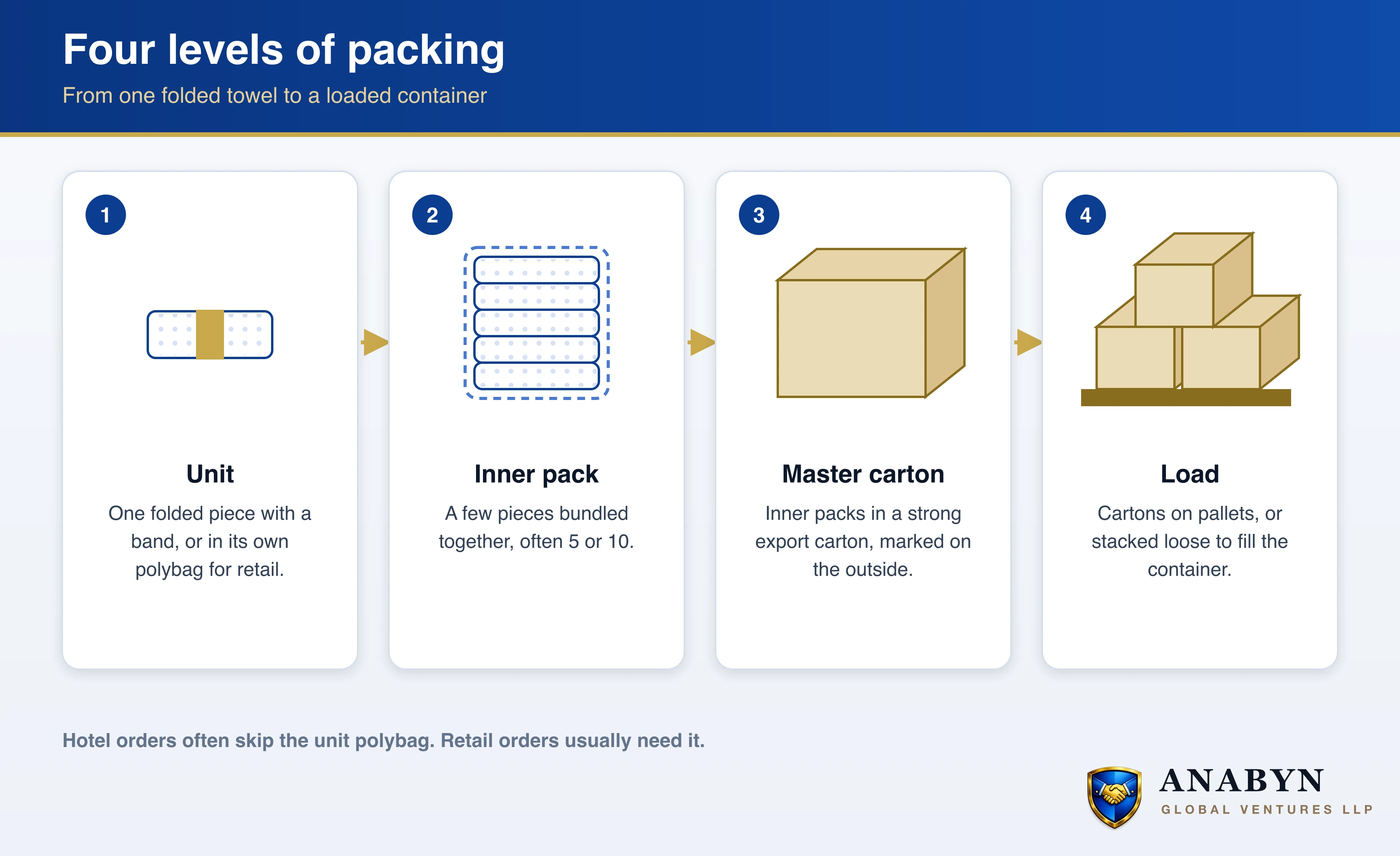
There are four. The unit is one folded piece. The inner pack is a few pieces bundled together. The master carton holds the inner packs. The load is how the cartons go into the container.
Hotel orders are usually packed simply: folded pieces in bundles, with no polybag on each piece. Retail orders usually need each piece in its own polybag or belly band, with a barcode.
How are towels and robes folded?
Agree the fold on the order, with a photo if you have one. A retail towel is folded to show the border and the brand. A hotel towel is folded flat and square, so bundles stack well.
Robes are folded with the collar on top, and the belt tied or tucked inside. Retail robes are often hung or boxed instead.
Pack goods only when fully dry. Damp cotton sealed in plastic can grow mould on a long voyage. Many shippers add moisture absorbing sachets to cartons for humid routes.
What should the cartons be like?
Export cartons are made of strong corrugated board, often five layers thick. Ask for the carton size and weight before production, because they decide how many cartons fit a container.
Many buyers set a maximum carton weight, often around 20 kg, so warehouse staff can lift cartons safely. Write your limit on the order.
Keep one size and one colour in each carton unless you ask for an assortment. A carton with mixed sizes is called an assorted carton. A carton with one size and colour is called a solid carton.
Read more: Container calculator
What goes on the outside of a carton?
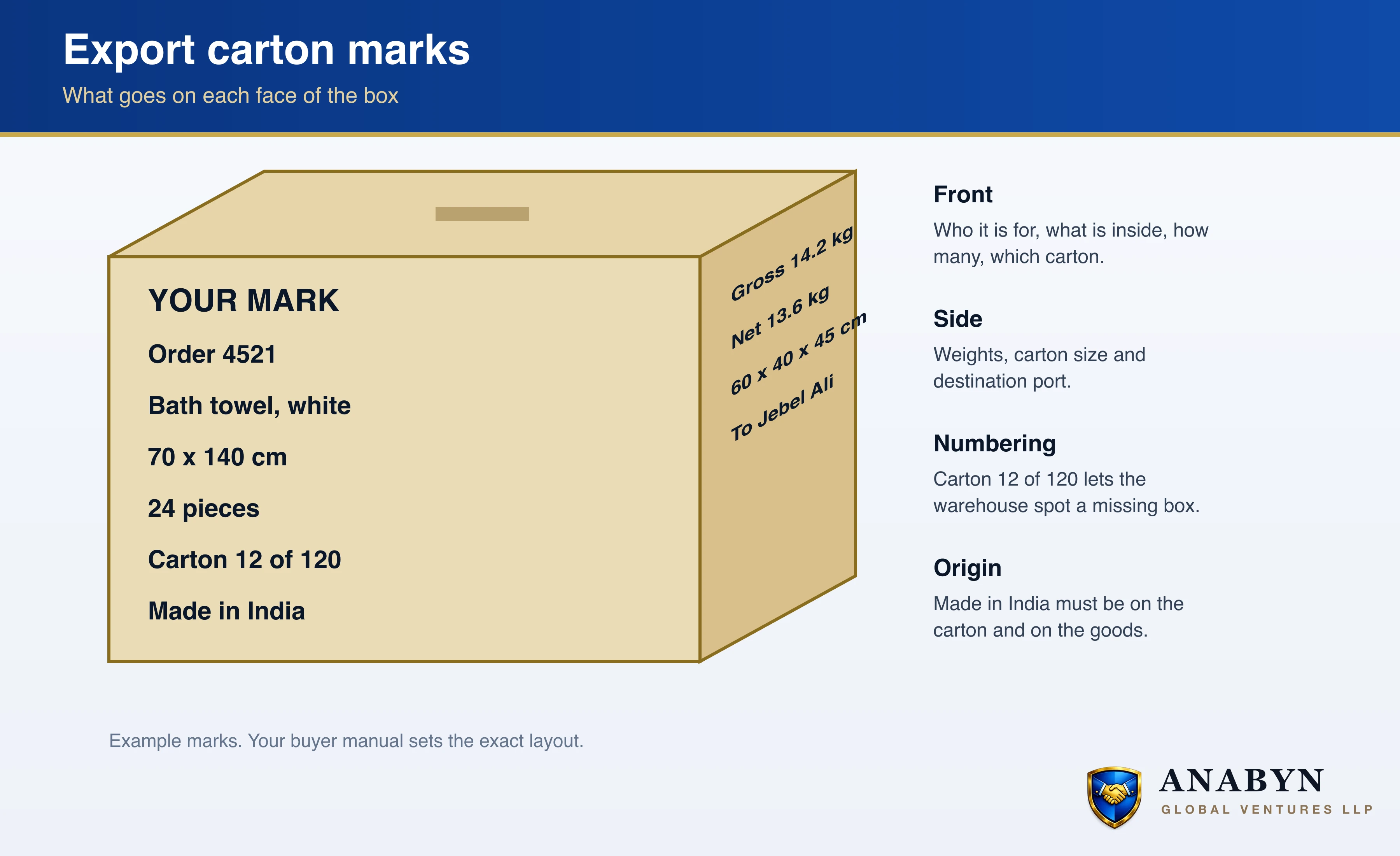
The marks on the carton let the receiving warehouse check the goods without opening the box. The front usually shows your mark, the order number, the item and colour, the size, the pieces per carton, the carton number out of the total and the country of origin. The side shows the weights, the carton size and the destination port.
Your buyer manual may set an exact layout. Send it before production.
Which labels go on the product?
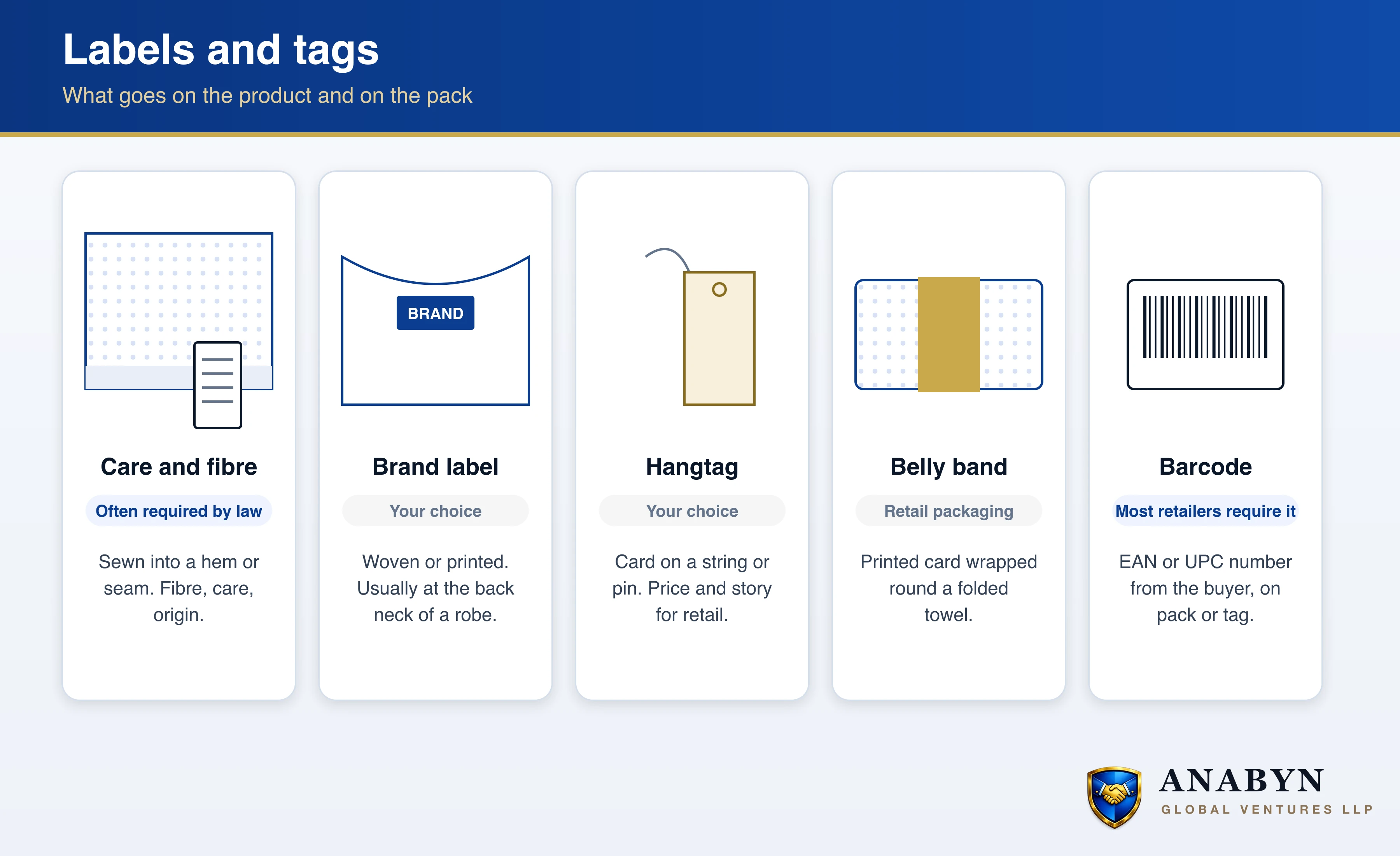
Some labels are required by law. Others are your choice. The care and fibre label is the one most markets require. A brand label, a hangtag and a belly band are your choice. A barcode is not a legal rule, but most retailers will not accept goods without one.
What do care label symbols mean?
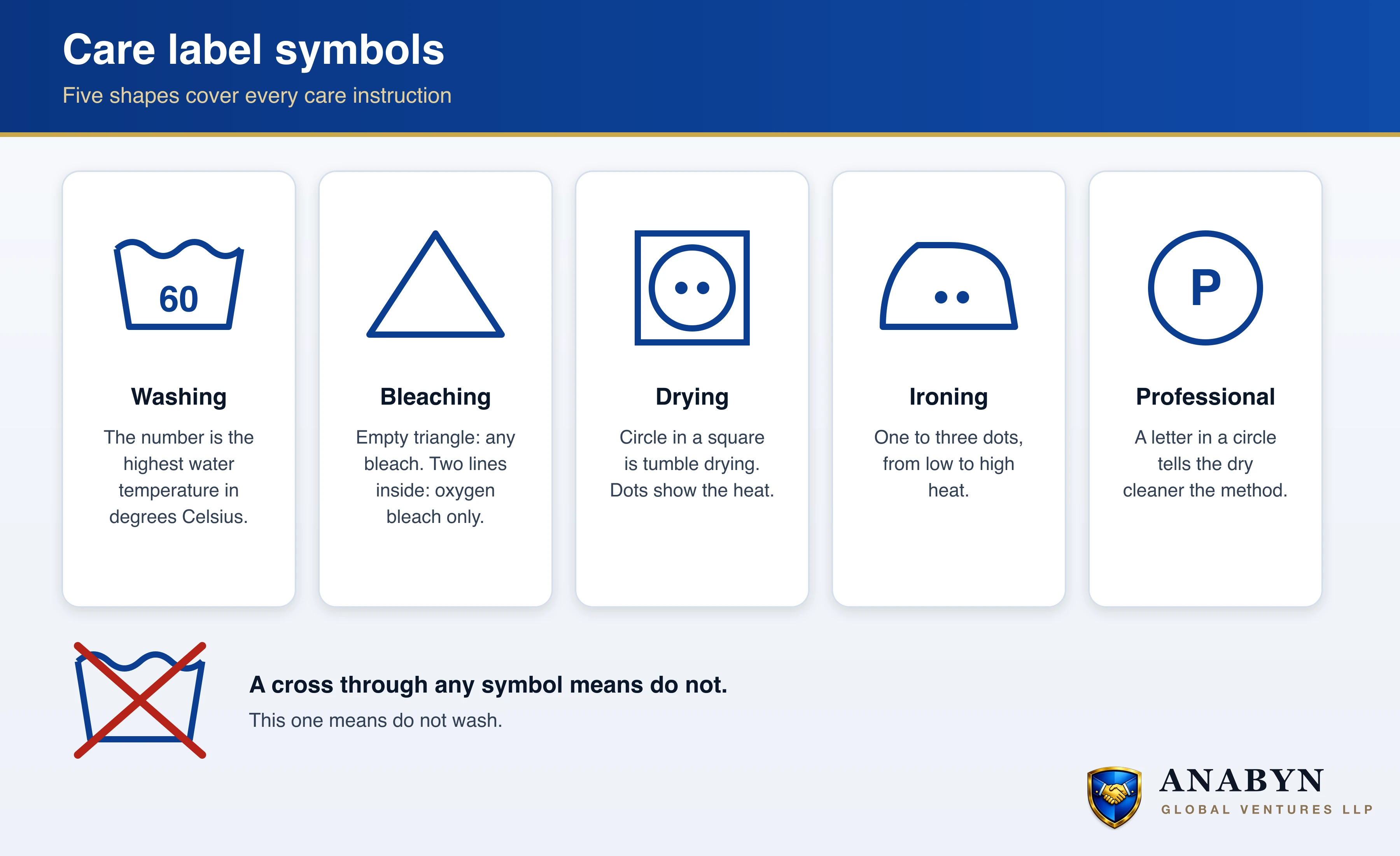
Five shapes cover every care instruction: a tub for washing, a triangle for bleach, a square for drying, an iron for ironing and a circle for professional cleaning. A cross through any of them means do not.
Choose symbols that match how the product should really be washed. A hotel towel washed hot in a commercial laundry needs different symbols from a retail towel washed at home.
Read more: Care problems and fixes
What do labelling rules require in my market?
Rules differ by country and by product. These are the main points. Always confirm the current rule for your product with your importer or customs broker.
| Market | Main requirements |
|---|---|
| United States | The Textile Act requires fibre content, country of origin and the maker or seller identity, by name or RN number, on most household textiles, including towels. The FTC Care Labeling Rule requires care instructions on clothing, which includes bathrobes. |
| European Union | Regulation 1007 of 2011 requires fibre composition using the official fibre names, in the language of the country of sale. Care and origin labels are not required by EU law, but most retailers expect them. |
| United Kingdom | Fibre composition is required under the UK textile labelling regulations. Care and origin labels are expected by most retailers. |
| Gulf countries | Labels are generally expected to carry Arabic, and Saudi Arabia applies its own technical rules through SABER. Check the current SASO rule for your product. |
Read more: Saudi SABER guide · HS code finder
How do barcodes work for textiles?
Retail goods carry a barcode, usually EAN 13 in Europe and most of the world, or UPC A in the United States. The numbers belong to the brand owner, so the buyer gets them through GS1 and sends them to the supplier.
Each size and colour needs its own number. Send the list with the order, and ask for a printed proof before production. Check that the barcodes scan on the sample.
What about polybags and plastic?
Polybags keep retail goods clean, but many hotel buyers now skip them to cut plastic. If you need them, say the size, the thickness and whether you want recycled content.
Many retailers ask for a printed suffocation warning on polybags above a set size. Some countries now charge a tax or fee on plastic packaging, so check what applies where you import.
What goes wrong, and how to prevent it
| What you see | Why it happens | How to prevent it |
|---|---|---|
| Cartons crushed on arrival | Weak board, or cartons packed too heavy | State the board grade and a maximum carton weight |
| Mould or musty smell | Goods packed damp before a humid voyage | Pack fully dry and add moisture absorbers |
| Barcodes do not scan | Wrong number, poor print or too small | Send the number list, approve a proof and scan the sample |
| Goods held at customs | Missing origin or fibre label for the market | Confirm the label rules for your market before production |
| Wrong count in cartons | Packing not checked against the packing list | Count cartons and pieces at final inspection |
| Mixed sizes in a solid carton | Packing instructions unclear | State solid or assorted packing on the order |
Written by Dr Abin Babu. Last checked 15 October 2026.
Putting this in your spec
Put these on your order
- Fold style, and whether each piece needs a polybag, band or hangtag.
- Pieces per inner pack and per master carton.
- Maximum carton weight and the carton marks layout.
- Labels required in your market, with the text and the language.
- Barcode numbers for each size and colour.
- Solid or assorted cartons.
Frequently asked questions
Do towels need a care label?
It depends on the market. Most markets require a fibre content label on towels. In the US, the care label rule covers clothing, so it applies to bathrobes but generally not to towels. Most retailers ask for care labels anyway.
What is an RN number?
A Registered Identification Number issued by the US Federal Trade Commission. A US company can print it on labels instead of its name.
Who provides the barcode numbers?
The brand owner, usually the buyer, through a GS1 membership. The supplier prints them but should not create them.
How heavy should an export carton be?
Many buyers set a limit around 20 kg so staff can lift cartons safely. Write your own limit on the order.