
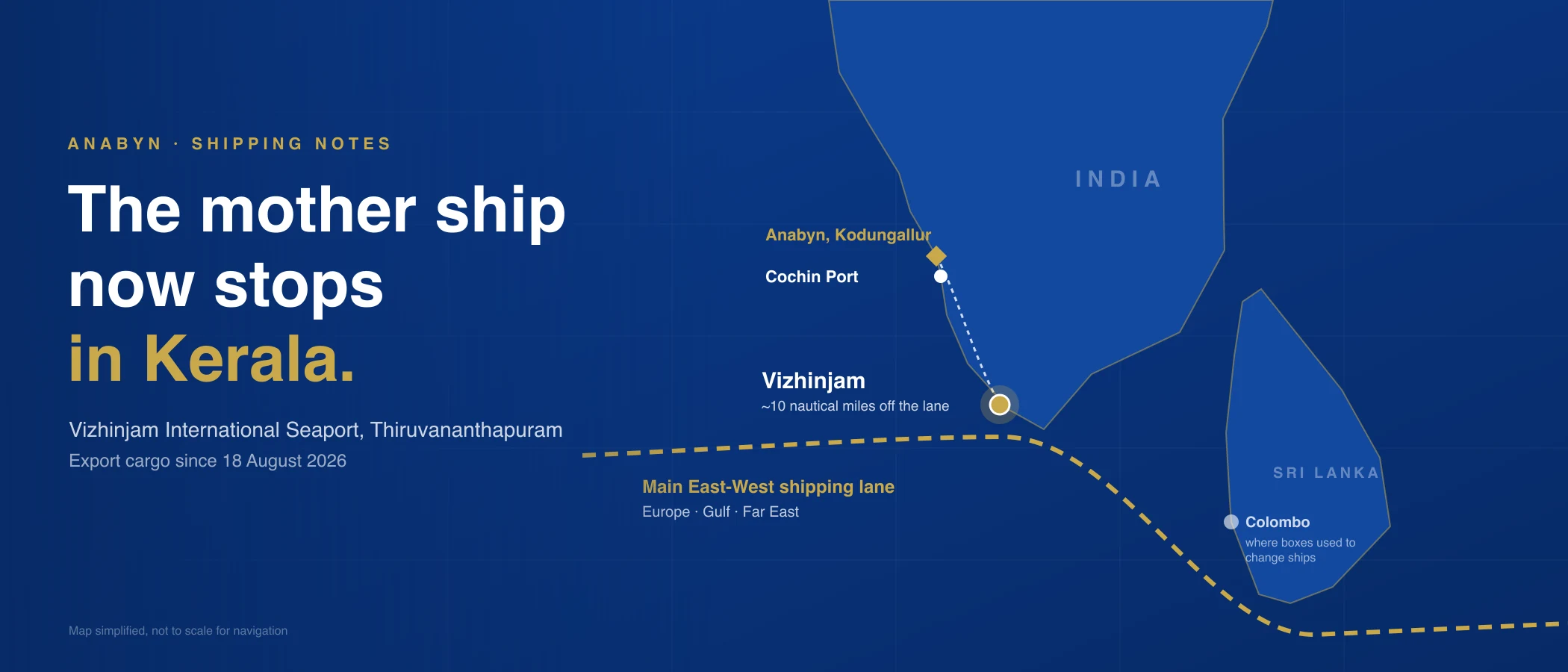
On 18 August 2026, a container of Kerala food products left Vizhinjam, near Thiruvananthapuram, bound for Valencia in Spain. It was a small shipment: jackfruit chips, jaggery, frozen curries. It also changed how goods leave the southern tip of India.
Until that week, Vizhinjam could only move containers from one ship to another. Now it can take export cargo off a truck at the gate and load it onto a ship going to Europe. If you buy towels or bed linen from Kerala, that matters to you. Here's what changes, what doesn't, and how to use it.
What a mother ship is, in plain terms
Think of air travel. A big long-haul plane doesn't land at every small airport. You take a small plane to a hub, change, and fly the big plane onward.
Ships work the same way. A mother ship is the long-haul giant, carrying 15,000 to 24,000 containers between Asia, the Gulf and Europe. A feeder is the small ship that carries containers from smaller ports to the hub. Changing ships at a hub is called transshipment.
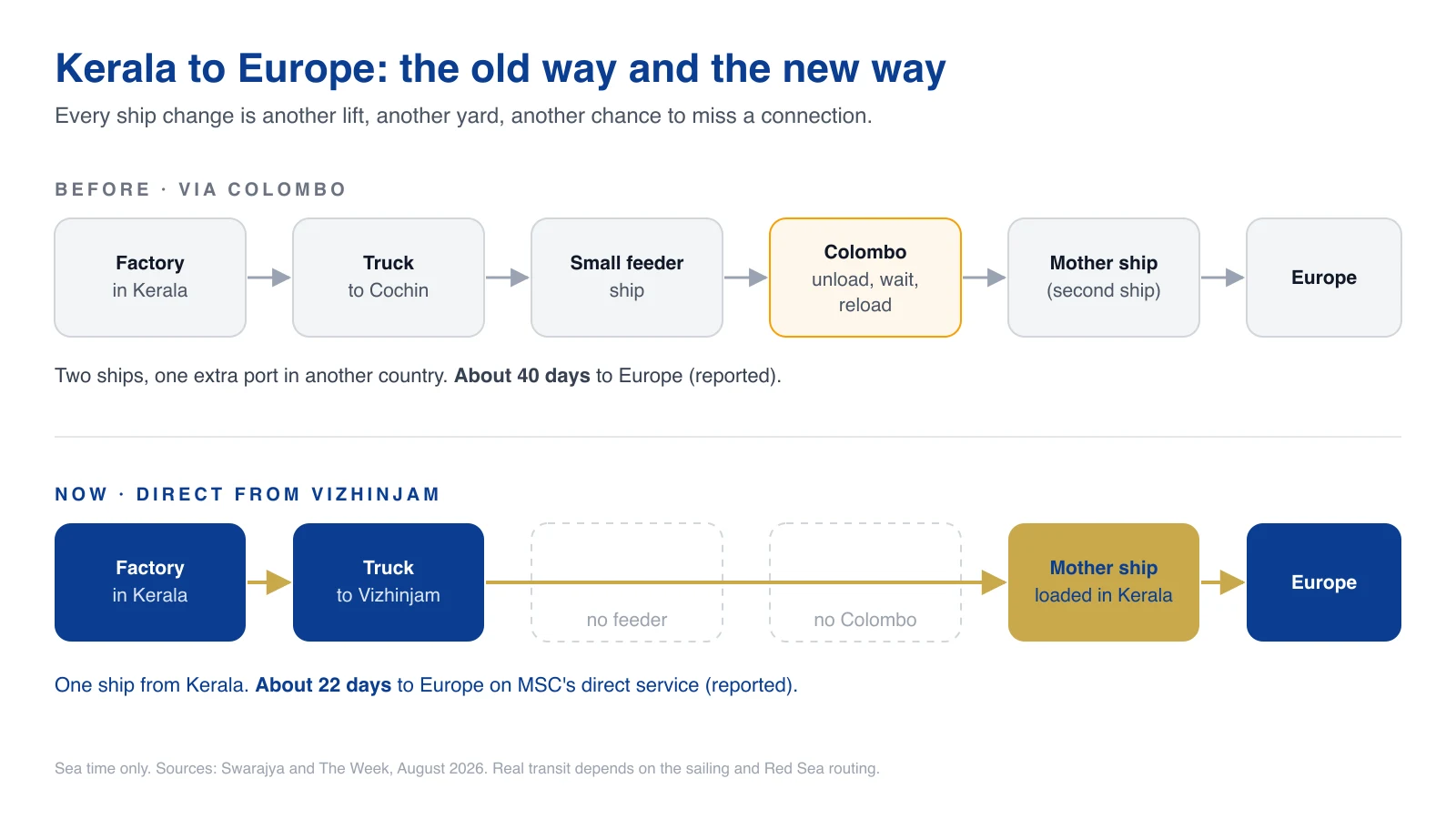
For decades India had no port deep enough, and close enough to the main route, for the biggest ships to stop. So most of our containers took a feeder to Colombo in Sri Lanka, waited in a yard there, and were then loaded onto a mother ship. More than 75% of India's transshipment cargo has been handled at foreign ports, mostly Colombo and Singapore.
What makes Vizhinjam different
Two things: deep water and location.
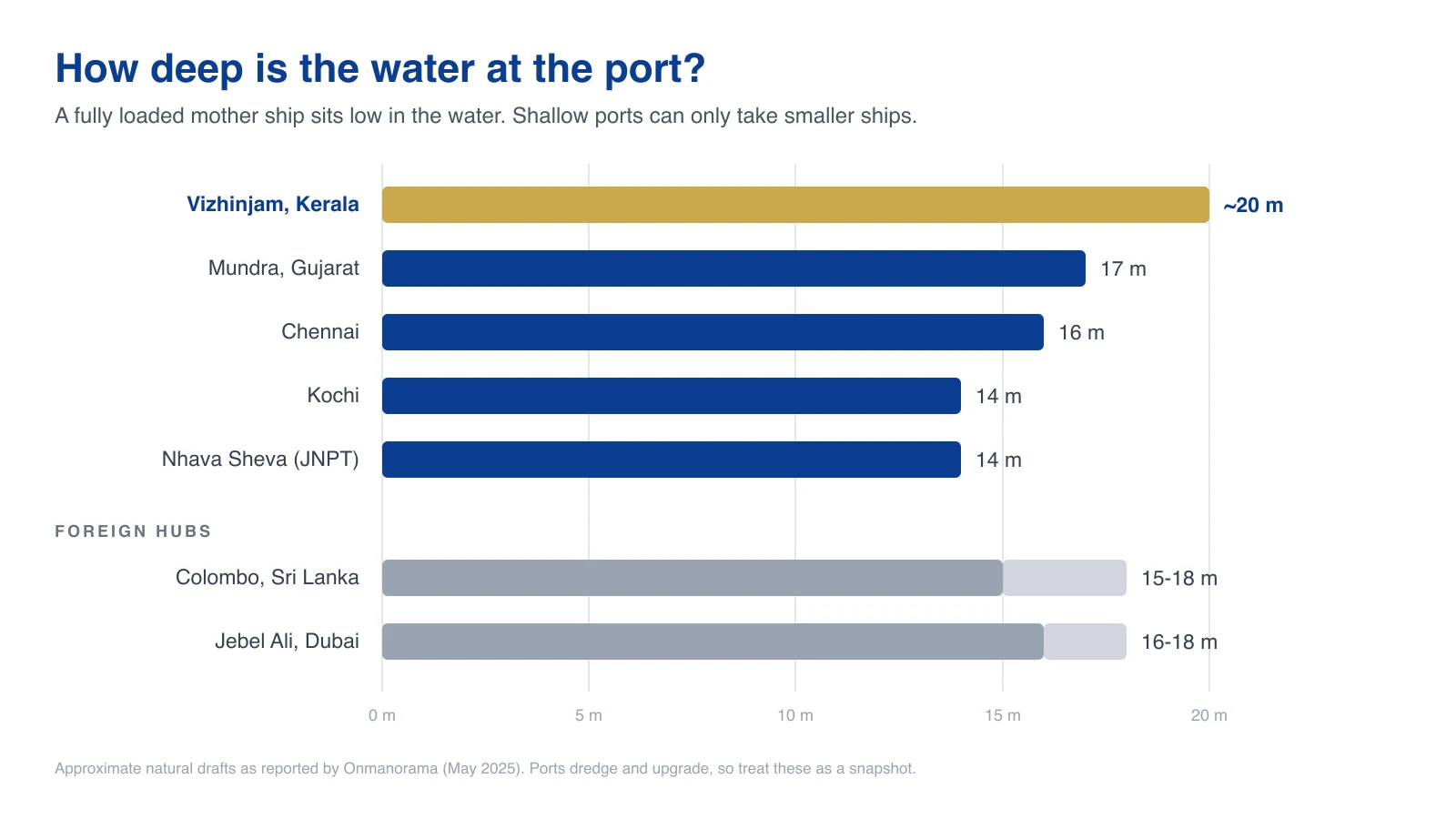
A fully loaded mother ship sits very low in the water. Vizhinjam has around 20 metres of natural depth close to shore, so the biggest ships can come straight in. Most Indian container ports are 14 to 17 metres. In June 2025 the port handled MSC Irina, one of the largest container ships in the world at 24,346 containers.
It's also about 10 nautical miles from the main East-West shipping lane, the route ships take between Europe, the Gulf and the Far East. A ship barely has to leave its route to call. Colombo, where our cargo used to change ships, is about 135 nautical miles away.
The port has grown fast. It handled over 2 million containers (counted in TEU, the standard 20-foot box) in its first 18 months, and its 1,000th ship arrived in June 2026. Phase 2, due by December 2028, will lift capacity from 1.6 million to 5.7 million TEU a year and add 1,200 metres of berth.
What changed in August 2026
Before August, Vizhinjam only did transshipment. Boxes arrived on one ship and left on another, and Indian exporters couldn't use it directly.
On 18 August 2026, customs approved it for export and import cargo (called gateway or EXIM cargo). MSC, the shipping line behind nearly every call at the port, opened two direct export services:
What this means for you as a buyer
1. Faster to the Mediterranean and West Africa
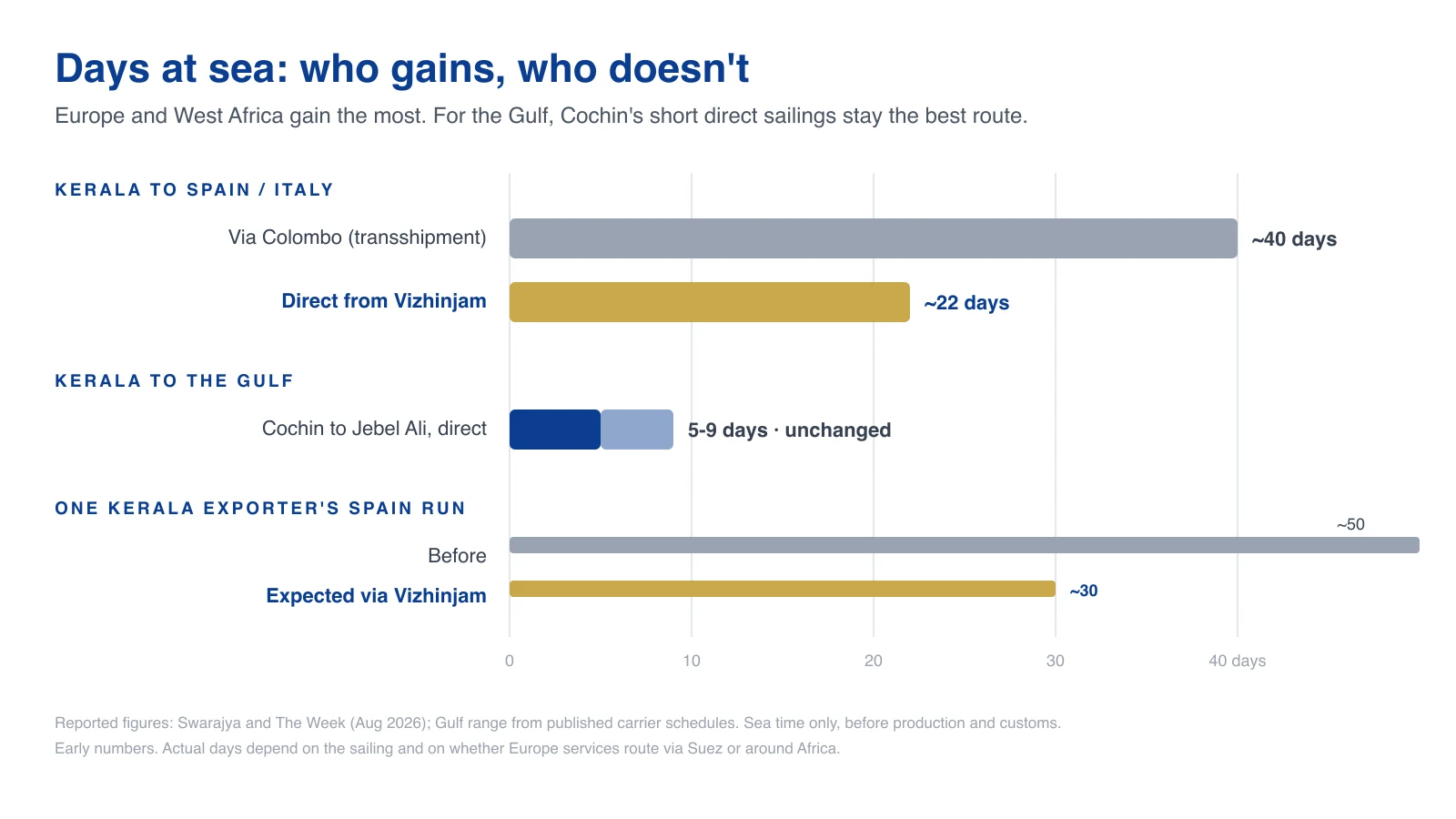
Reported sea time from Vizhinjam to Europe is about 22 days, against roughly 40 days from other ports in the region that route through Colombo. One Kerala exporter expects their Spain shipments to drop from about 50 days to about 30. These are early numbers. We'll know the real average once a few months of sailings have run.
2. Fewer hands on your cargo
Every ship change means your container is lifted off, stacked in a yard, and lifted onto another ship. That's where delays start: the feeder runs late, the mother ship is full, and your box waits a week for the next one.
With a direct call, your container is loaded once in Kerala and not touched again until it reaches your port. If you're stocking a hotel before opening day, one missed connection in Colombo can cost you more than the freight itself.
3. Lower cost, mostly in time and surprises
Using a foreign hub has cost Indian shippers an estimated $80 to $100 extra per container. Exporters in other states have told reporters they expect to save around ₹75,000 per container by shipping from Vizhinjam instead of through Colombo.
We won't promise you a fixed saving. Freight rates move every week. What reliably drops is the number of things that can go wrong between our loading bay and your warehouse.
4. A second deep-water option in the same state
We ship from Cochin Port, about 30 km from our unit in Kodungallur. Vizhinjam is about 240 km south by road. With two ports in one state, if one lane is congested or a sailing gets cancelled, we can move your cargo to the other without crossing a state border or starting the paperwork again.
What doesn't change yet
We'd rather tell you this now than after you book.
The Kerala advantage over other Indian textile towns
India's towel and home-textile production sits in a handful of clusters. Where the factory is decides how far your goods travel before they reach a big ship.
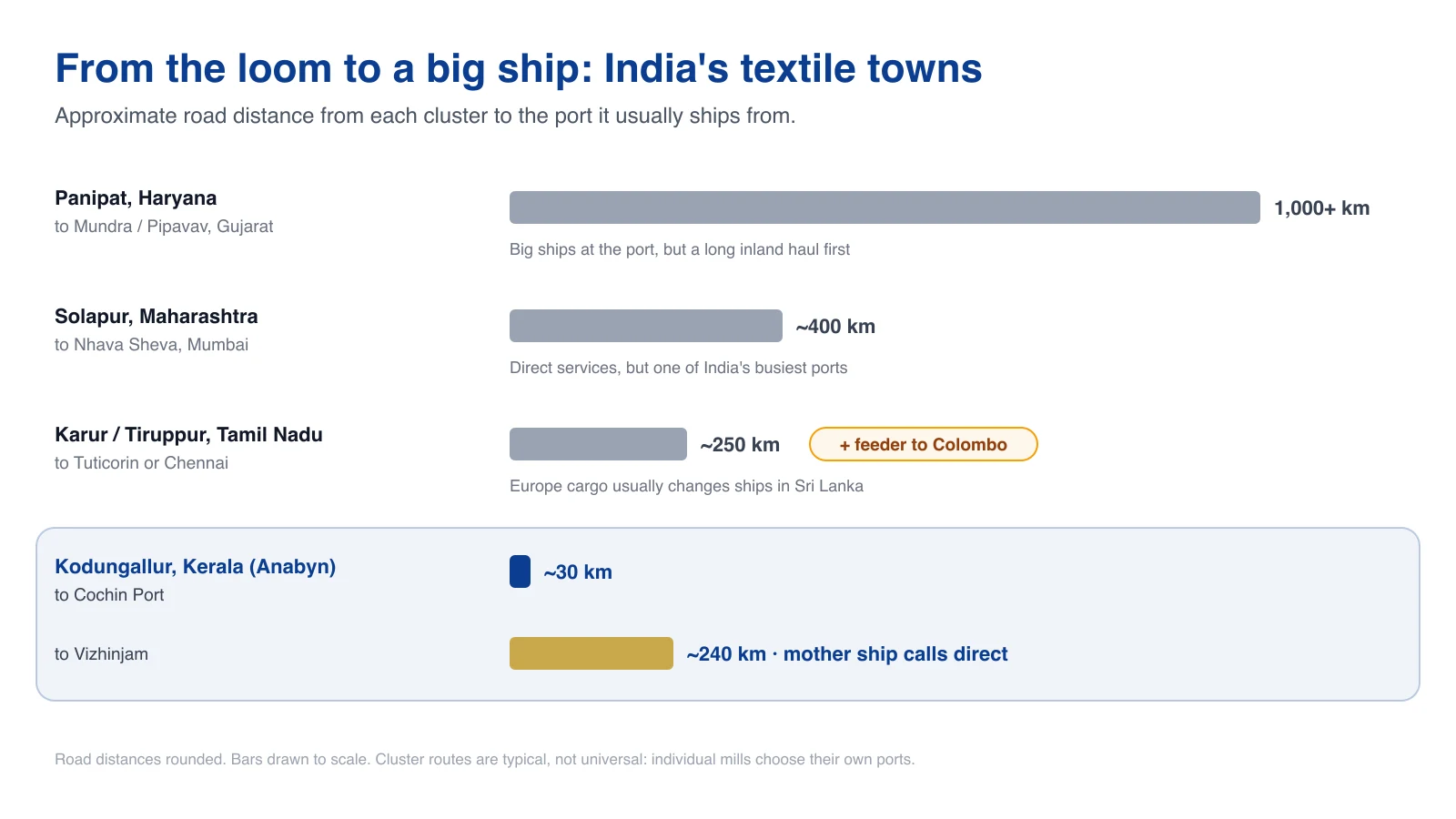
To be fair to our neighbours, a good mill in Karur or Solapur can still ship well, and plenty do. Vizhinjam doesn't make Kerala towels any softer. It makes the trip from our partner mills to your warehouse shorter and simpler, especially for Europe and Africa.
Kerala also has Cochin International Airport close to our unit, so urgent samples and top-up air shipments leave from the same area as the sea cargo.
How to use this on your next order
To check what fits in a box, try the container loading calculator. For your total cost to the door, see how to calculate landed cost. If you're weighing sea against air for a rush order, read sea vs air freight for linen imports.
The short version
The world's biggest container ships now stop at the southern tip of India and take export cargo directly. For buyers in Spain, Portugal, Italy and West Africa, that can mean around two to three weeks less at sea and one less ship change. For Gulf buyers, Cochin's short direct sailings still win. For all our buyers, there's now a second deep-water port within a day of our unit.
Want to see what this looks like for your next order? Send us your destination and quantity and we'll come back with both routes compared.
Sources: Vizhinjam International Seaport and MSC service announcements; The Week (18 August 2026); Swarajya (August 2026); IANS (18 August 2026); Business Today (June 2026); Maritime Gateway (2026); Onmanorama (May 2025); Outlook Business. Figures are as reported and will change as the port grows.
Share this article

Author Bio
Dr Abin Babu
Published by the Anabyn Export Intelligence Team - dedicated to providing technical clarity and compliance guidance for global textile procurement.
Ready to Order?
Discuss your technical specifications with our sourcing desk. We provide comprehensive export proposals within 24 hours.
Request an Export QuoteWhere to go next