A good sample proves nothing if you only look at it. It looks soft, it is white, the price is right, and you place the order. Then the first wash shrinks it, the colour runs, or it feels thinner than the sample did.
You can catch most of this before you pay. You don't need a lab. You need a kitchen scale, a tape measure, a white cloth and a washing machine. This takes about an hour of work spread over two days.
Before you start
Ask the supplier for two things with the sample: the spec sheet (size, GSM, cotton type, colour) and the wash instructions they used. Without a spec sheet you have nothing to check the towel against.
Ask for two or three pieces, not one. If a supplier sends you one hand-picked piece, you learn about that piece only. Our own policy is 2 free pieces per spec, and you pay only the courier.
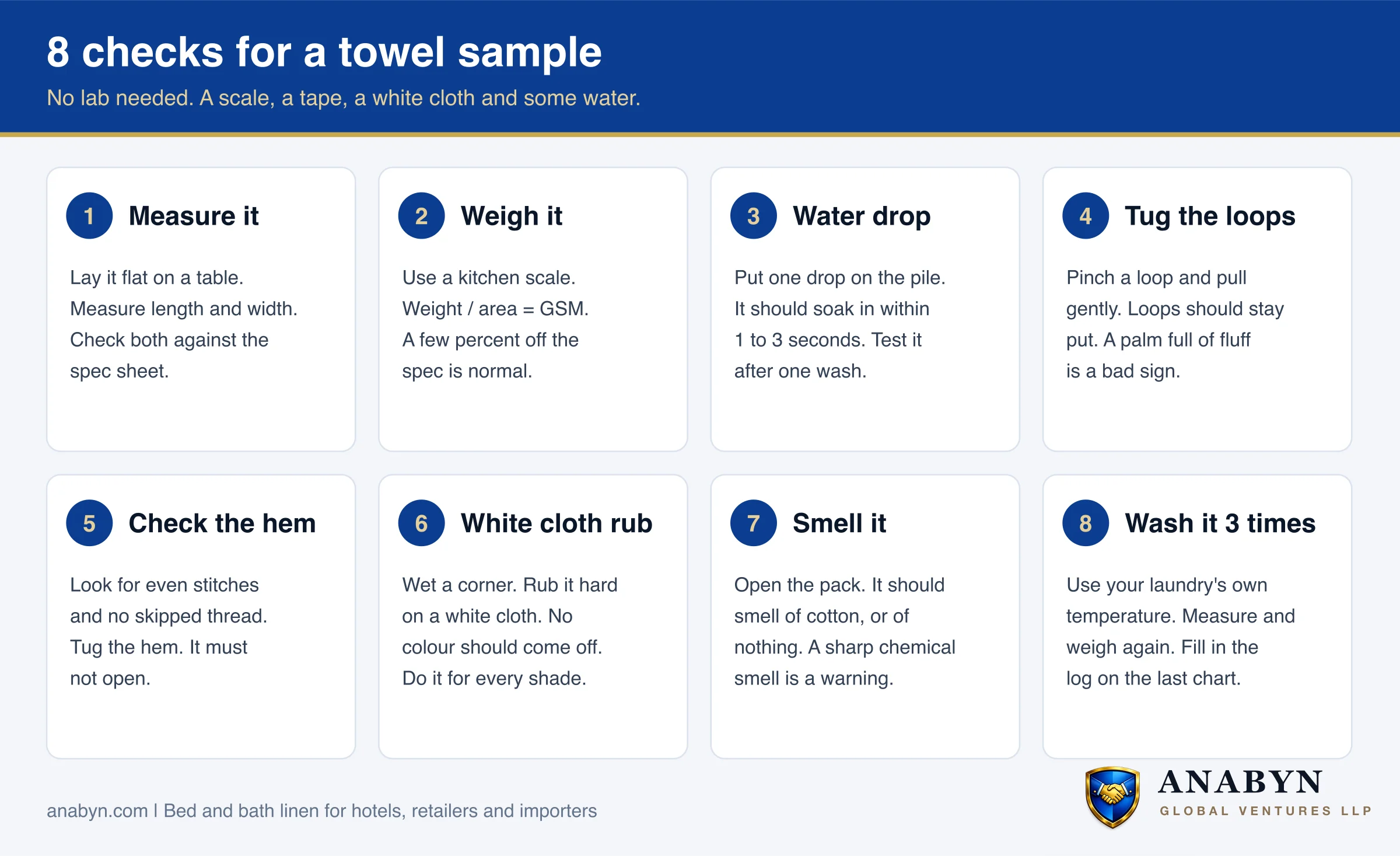
1. Measure it
Lay the towel flat on a table. Don't stretch it. Measure length and width and compare with the spec sheet.
A 70 x 140 cm bath towel should measure close to that. If the sheet says 70 x 140 and you get 66 x 132, ask whether the size on the sheet is before or after washing. It matters. See our towel size chart for the sizes hotels usually order.
2. Weigh it
GSM means grams per square metre. It is the weight of the fabric, so a kitchen scale can check it.
Multiply length by width in metres to get the area. A 70 x 140 cm towel is 0.98 square metres. Then multiply by the GSM on the spec sheet to get the weight you should see.
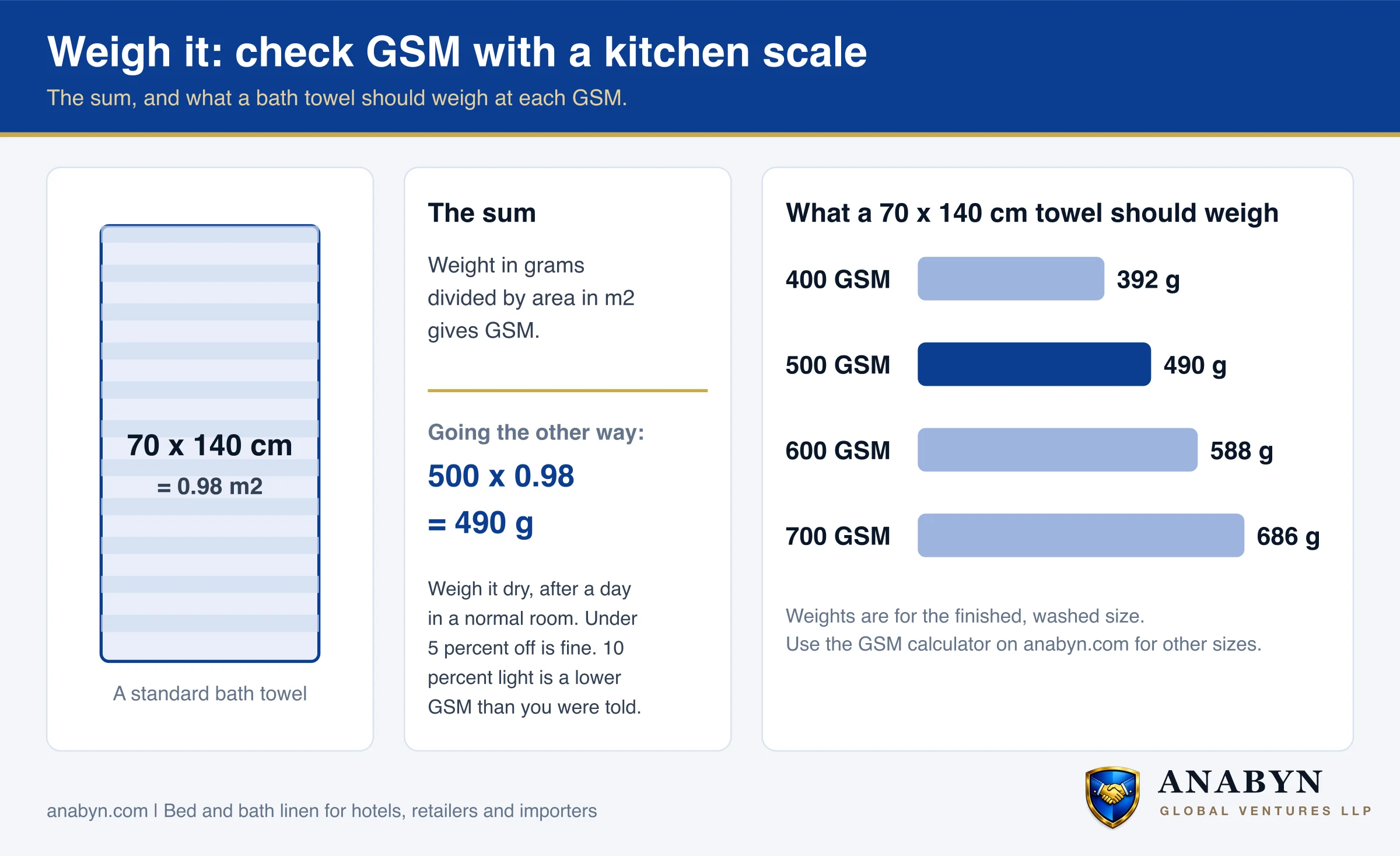
Weigh the towel dry, after it has sat in a normal room for a day. A few percent either way is normal. If the sample is 10 percent lighter than the sums say, it is a lower GSM than you were told.
For other sizes, use the GSM calculator. If you are not sure which GSM you need, read the GSM guide first.
3. The water drop
Put one drop of water on the dry pile. A good towel soaks it in within 1 to 3 seconds.
New towels sometimes carry a softening finish that makes the first drop sit on top. That is why you also run this test after one wash. If the drop still sits there after a wash, the towel will not dry a guest well. Read more in how to read a textile test report.
4. Tug the loops
Terry cloth is made of loops. Pinch a few and pull gently. They should stay in the towel.
Rub your palm hard over the surface. A little fluff on a new towel is normal. A lot of fluff, or loops that come away, means the pile is weak and the towel will go bald in a few months of washing.
5. Check the hem
Turn the towel over. Look at the hem stitching along all four sides.
The hem is where a towel fails first in a commercial laundry. A weak hem is a cheap thing to check and an expensive thing to find out later.
6. Rub it on a white cloth
Wet a corner of the towel. Rub it hard on a white cloth for about ten seconds. If any colour comes off, the dye is not fixed, and it will stain other linen in your laundry.
Do this for every colour you plan to order, not just the first one. White towels are safest. Dark and bright colours are where bleeding shows up. Our colour fastness guide explains the lab version of the same test.
7. Smell it
Open the pack and smell it. A towel should smell of cotton, or of nothing. A sharp chemical smell can mean leftover finishing chemicals. Ask the supplier what was used, and whether the towels are tested for harmful substances. Our certified mill lines carry OEKO-TEX Standard 100.
8. Wash it three times
This is the check that matters most. Wash the towel three times at the temperature your laundry really uses, and dry it the way your laundry dries. Don't be kind to it. Measure and weigh it again.
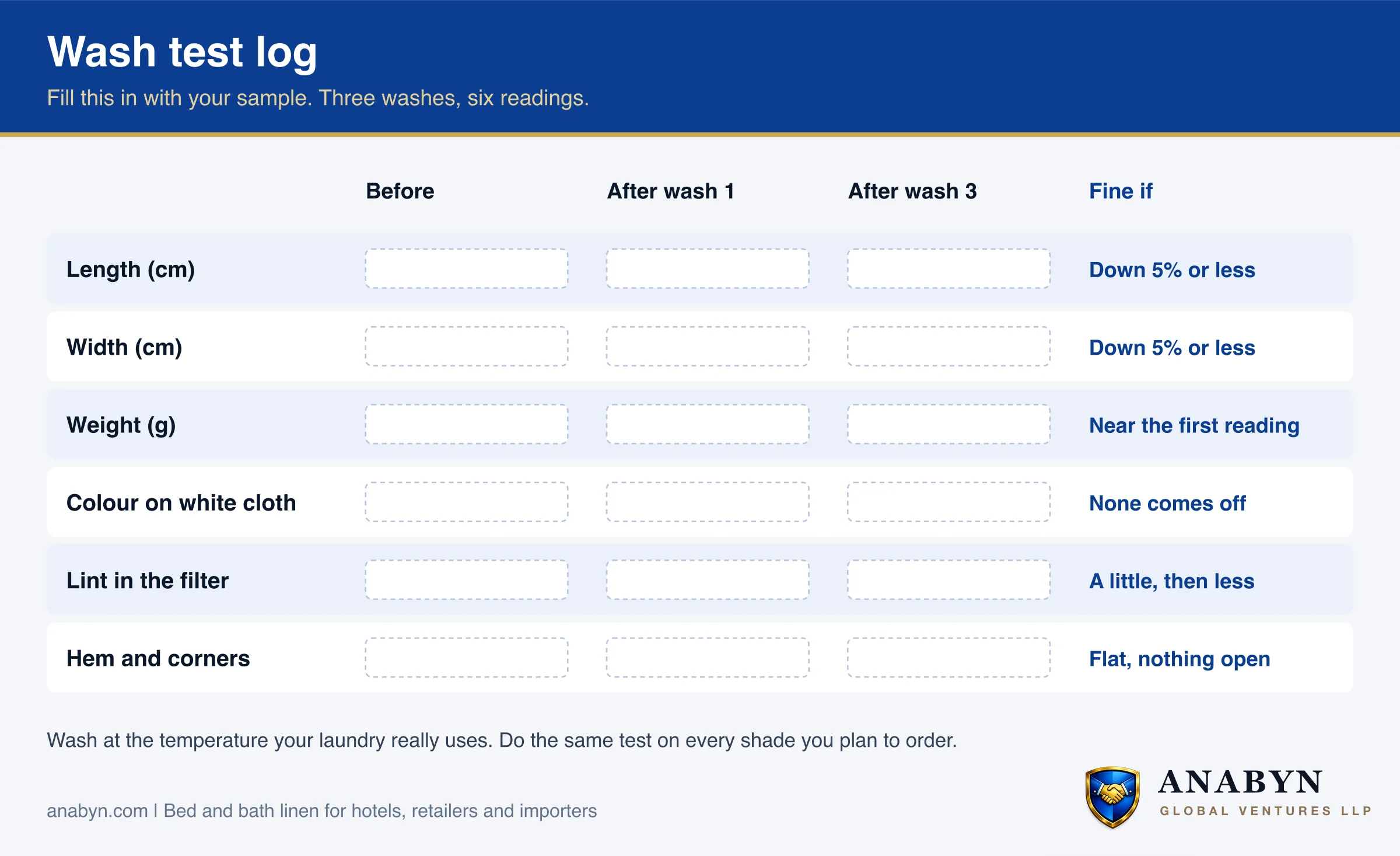
What to expect:
What to do with the results
If the sample passes, you have a baseline. Write down the numbers and put them in the purchase order. Then the bulk order has something to be measured against.
If it fails one check, tell the supplier which one and ask them to fix and resend. A good supplier will ask for your numbers. A weak one will tell you it is normal.
The same checks apply to the bulk shipment. We inspect every shipment to AQL 2.5 before it leaves. What AQL 2.5 means is worth reading before your first order.
A note on how we work
Anabyn is an export house. Our towels are made in specialist partner mills, to a spec we write and check. That is why every order starts from a written spec sheet you can check against.
Want samples to run this test on? Ask for samples and a quote. Tell us the size and GSM you want, and we'll send the spec sheet with them.
Share this article
Want pricing on what you just read?
Leave your work email — our export desk replies with specs, MOQ and a quote within 1 business day.

Author Bio
Dr Abin Babu
Published by the Anabyn Export Intelligence Team - dedicated to providing technical clarity and compliance guidance for global textile procurement.
Ready to Order?
Discuss your technical specifications with our sourcing desk. We provide comprehensive export proposals within 24 hours.
Request an Export QuoteWhere to go next