
In pictures
In this article
How to Verify an Indian Textile Exporter: A Buyer's Checklist
India is the world's largest cotton terry towel exporter, with thousands of legitimate manufacturers - and, as in any large market, some intermediaries who over-promise. The good news: India has transparent public registries that make supplier verification straightforward. Here is the checklist serious buyers run before placing a first order.
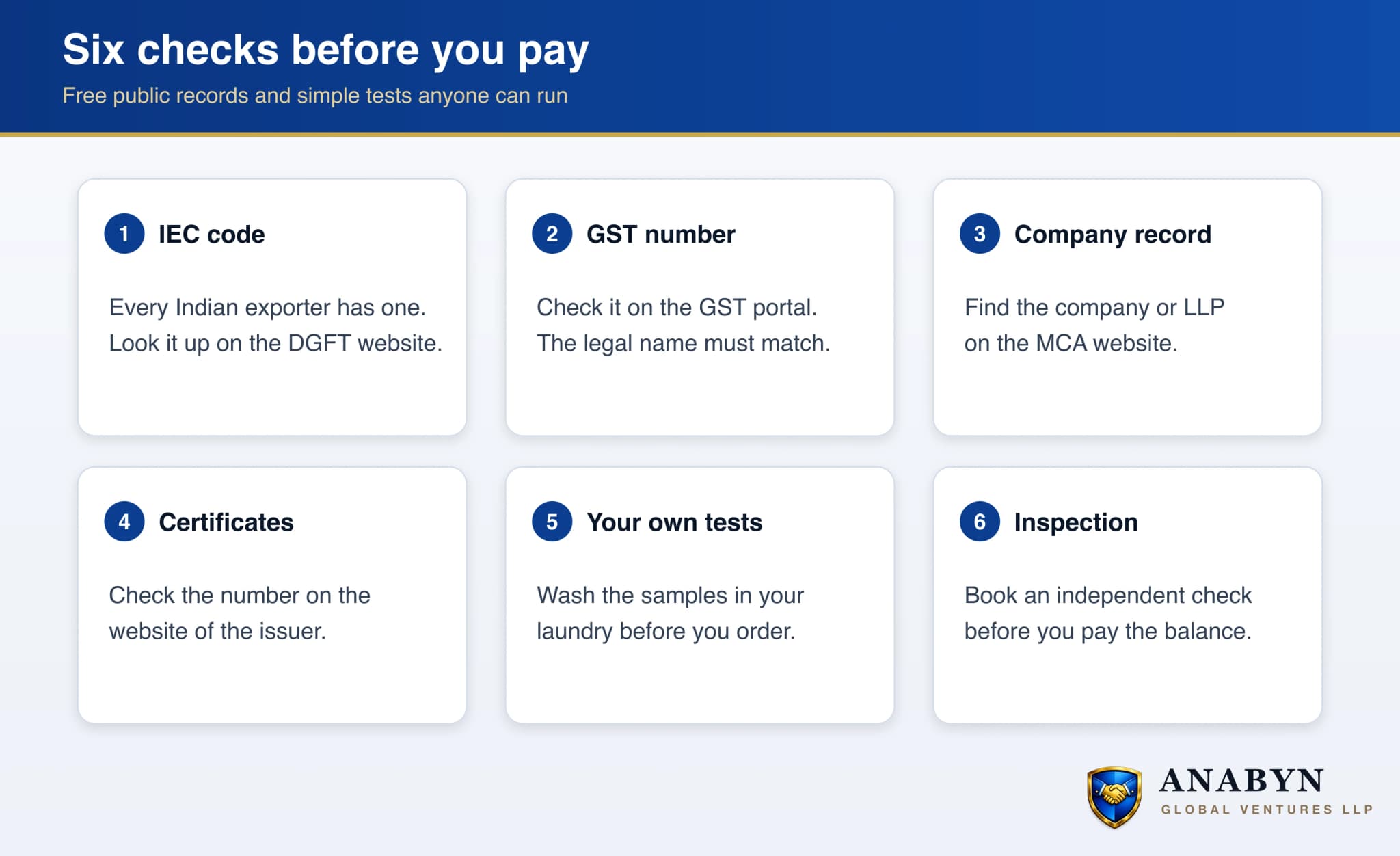
1. Verify the IEC (Import Export Code)
Every legally exporting business in India holds an IEC issued by the Directorate General of Foreign Trade (DGFT). Ask for it, then verify it on the DGFT portal. No valid IEC means the company cannot legally clear goods through Indian customs - a hard stop.
2. Cross-Check GST Registration
A genuine business has a GSTIN (Goods and Services Tax Identification Number). You can validate it on the official GST portal, which confirms the legal name and registration status. The legal name should match the IEC and the bank account you are asked to pay.
3. Confirm Manufacturer vs. Trader
Ask directly whether they are the manufacturer or a trading house. Both can be legitimate, but it changes your quality-control approach. A manufacturer controls GSM, yarn, and finishing in-house; a trader subcontracts, which adds a layer between you and production. Ask for factory photos, a video walk-through, or a live video call from the production floor.
 Enlarge
4. Verify Certifications Independently
Never accept a PDF certificate at face value. Each certifying body has an online registry: verify GOTS scope certificates at the Global Standard public database, OEKO-TEX with the Label Check tool and certificate number, and ISO 9001 with the issuing certification body. A certificate copy proves nothing until the number checks out on the issuer's own site. See what verifiable documentation looks like on our certifications page.
5. Test a Physical Sample Before Bulk
A credible exporter will send a physical master sample. Inspect it for GSM accuracy (weigh a cut swatch; it should be within 5% of spec), hand-feel and pile density, colourfastness with a quick rub and wash test, and stitching and hem quality. The approved sample becomes the seal sample - the contractual reference for bulk production. Refusal to provide samples is a red flag.
Step 1
Cut a 10 × 10 cm square
Cut from the plain middle. A border or hem adds weight and gives a false high reading.
Step 2
Weigh it
Use a scale that reads to 0.1 g. Let the towel rest 24 hours in normal room air first.
Step 3
Multiply by 100
5.0 g × 100 =
500 GSM
A 10 × 10 cm square is 1/100 of a square metre. So its weight × 100 is the GSM.
Is the result fair?
A 500 GSM order may test from 475 to 525. That is the normal ±5%.
Inside the green band: a normal variation.
Below 475: a valid quality claim, not rounding.
6. Structure Payment to Protect Yourself
Payment terms are your biggest financial safeguard. For a first order, 30 to 50% advance by T/T with the balance against a copy of the Bill of Lading is standard - avoid 100% advance with any new supplier. For orders above roughly 30,000 US dollars, a Letter of Credit at sight protects both parties. Always confirm the beneficiary bank account name matches the verified legal entity exactly; a mismatch is the classic sign of a diverted-payment scam.
You
Banks
Anabyn
You ·1.You confirm the order
After you approve the paid sample.
You ·2.You wire the 50% advance
$25,000A normal bank transfer. Production starts.
Anabyn ·3.We make the order
30–45 days in specialist units, then AQL 2.5 inspection.
You ·4.You wire the 50% balance
$25,000When production is done, before dispatch. You have the inspection report first.
Anabyn ·5.We ship and send documents
Bill of lading, invoice, packing list and certificate of origin.
Bank cost at $50,000
$40–100 in wire fees (two transfers)
Extra time
No extra time
7. Require a Pre-Shipment Inspection
For any first-time relationship or order above about 10,000 US dollars, book an independent pre-shipment inspection at AQL 2.5 Level II through SGS, Bureau Veritas, Intertek, or QIMA. A passed report also gives you leverage in any later dispute. Learn how the standard works in our AQL 2.5 guide.
Your order size
200
pieces checked
≤10
major defects pass
11+
fail the lot
200 of 5,000 pieces, about 4.0%. They are pulled at random from many cartons.
The lot passes.
Red Flags Summary
Watch for no IEC or a GSTIN that fails verification; reluctance to provide samples or allow inspection; a bank account name that differs from the legal entity; prices more than 20% below market (usually hidden in yarn quality or GSM); and WhatsApp-only communication with no company domain email.
FAQ
How do I check if an Indian exporter is legitimate?
Verify their IEC on the DGFT portal and their GSTIN on the GST portal, confirm certifications on each issuing body's registry, and require a physical sample plus a third-party pre-shipment inspection before paying the balance.
What documents should a real exporter provide?
At minimum the IEC and GST registration, and for the shipment a Commercial Invoice, Packing List, Bill of Lading, and Certificate of Origin, plus test reports and any certification (GOTS, OEKO-TEX, ISO) certificate numbers.
Is it safe to pay an advance to an Indian supplier?
A partial advance of 30 to 50% by bank transfer is normal for first orders, with the balance against the Bill of Lading copy. Avoid full advance payment, and always confirm the bank account name matches the verified legal entity.
What is an IEC and why does it matter?
The Import Export Code is the licence issued by India's DGFT that authorises a business to export. Without a valid IEC, a company cannot legally ship goods out of India - making it the first thing to verify.
---
*Ready to work with a verified, documentation-complete exporter? Request a quote from Anabyn or read the complete guide to terry towel exports from India.*
Share this article
Want pricing on what you just read?
Leave your work email — our export desk replies with specs, MOQ and a quote within 1 business day.

Written by
Dr Abin Babu
Founder & Chairman, Anabyn Global Ventures
Anabyn exports hotel and home linen from Kerala, India. These guides come from the questions buyers ask our desk. About the team
Ready to Order?
Send us your specification. We reply within one business day and send a priced quote within 48 hours.
Request an Export QuoteWhere to go next