
LC vs TT Payment Terms in Textile Export
Letter of Credit vs Telegraphic Transfer explained - typical structures, risk for buyer and seller, and what Anabyn offers.
How Payment Terms Work in Bulk Textile Export
If this is your first container from India, the payment-terms question comes up before anything else - usually in the first email. Most bulk orders settle one of two ways: TT (Telegraphic Transfer), a direct bank wire structured as a percentage advance plus a balance before shipment, or LC (Letter of Credit), a bank-issued guarantee that pays out once the seller presents shipping documents matching the LC's terms exactly.
The most common textile-export TT structure is 30% advance on order confirmation, 70% before shipment - the advance funds raw material purchase and production start, while the balance is collected once the buyer has approved a pre-shipment sample or received an independent inspection report.
LC shifts settlement risk to the banking system: the buyer's bank commits to pay once compliant documents are presented, giving the buyer assurance the goods were shipped as agreed before funds are released - but the strict document-matching requirement means even small discrepancies can delay payment.
Worked Example: A $50,000 Bulk Linen Order
Paying by TT
- Buyer wires $15,000 (30%) on order confirmation - production starts.
- Anabyn ships a pre-shipment sample or inspection report for approval.
- Buyer wires the remaining $35,000 (70%) before the container leaves Cochin.
- Goods ship; buyer receives bill of lading and shipping documents directly.
Total bank cost: a flat wire fee (~$20–$50) per transfer. No document-compliance risk on either side.
Paying by LC
- Buyer's bank issues an irrevocable LC at sight for $50,000, naming Anabyn as beneficiary.
- Anabyn produces and ships the order, then presents shipping documents to its bank.
- Documents are checked against the LC terms - any mismatch (date, quantity, description) can delay payment.
- On compliant documents, Anabyn's bank is paid by the issuing bank within a few banking days.
Total bank cost: ~0.5–2% of $50,000 ($250–$1,000) split across issuance, advising and negotiation fees, plus 1–3 weeks for issuance and document checking.
The Documents You'll Actually See
Whether you pay by TT or LC, these are the documents that move with the shipment - LC payment is released strictly against them, and TT buyers should request the same set for their own records and customs clearance.
Bill of Lading
Proof of shipment issued by the carrier - title document for the goods.
Commercial Invoice
Itemised value of the shipment, used for customs valuation.
Packing List
Carton-by-carton breakdown of contents, weights and dimensions.
Certificate of Origin
Confirms India origin - required for preferential duty (CEPA/GSP) claims.
Pre-Shipment Inspection Report
Third-party or buyer-approved QC check before the container is sealed.
Insurance Certificate
Required for CIF/CIP shipments; covers transit loss or damage.
A Third Option: Escrow / Trade Assurance
Some first-time buyers now ask about escrow or platform-based trade assurance (e.g. Alibaba Trade Assurance) instead of a direct TT. In an escrow structure, a third party holds the buyer's funds and releases them to the seller only after the buyer confirms receipt and inspection of the goods - shifting timing risk away from both direct-transfer trust and LC document formality. It typically costs more than a flat TT wire fee and is less common for established bulk-container trade than for smaller first orders, but Anabyn can work within an escrow structure on request for buyers who prefer it for a first transaction.
LC vs TT Comparison
| Factor | Letter of Credit (LC) | Telegraphic Transfer (TT) |
|---|---|---|
| Payment trigger | Bank pays on compliant document presentation | Direct transfer per agreed schedule/milestone |
| Buyer risk | Low - documents verified before payment | Higher - funds sent ahead of/against shipment |
| Seller risk | Document discrepancy can delay/block payment | Low if advance secured before production |
| Typical cost | ~0.5–2% in bank fees (both sides) | Low - flat wire transfer fee |
| Speed to arrange | Days to weeks (issuance + document checks) | Same day to a few banking days |
| Common in textile trade for | Large corporate/retail buyers, first large orders | SME buyers, repeat orders, most bulk B2B trade |
Export documents, in order
Under a letter of credit, the bank checks these papers before it pays.
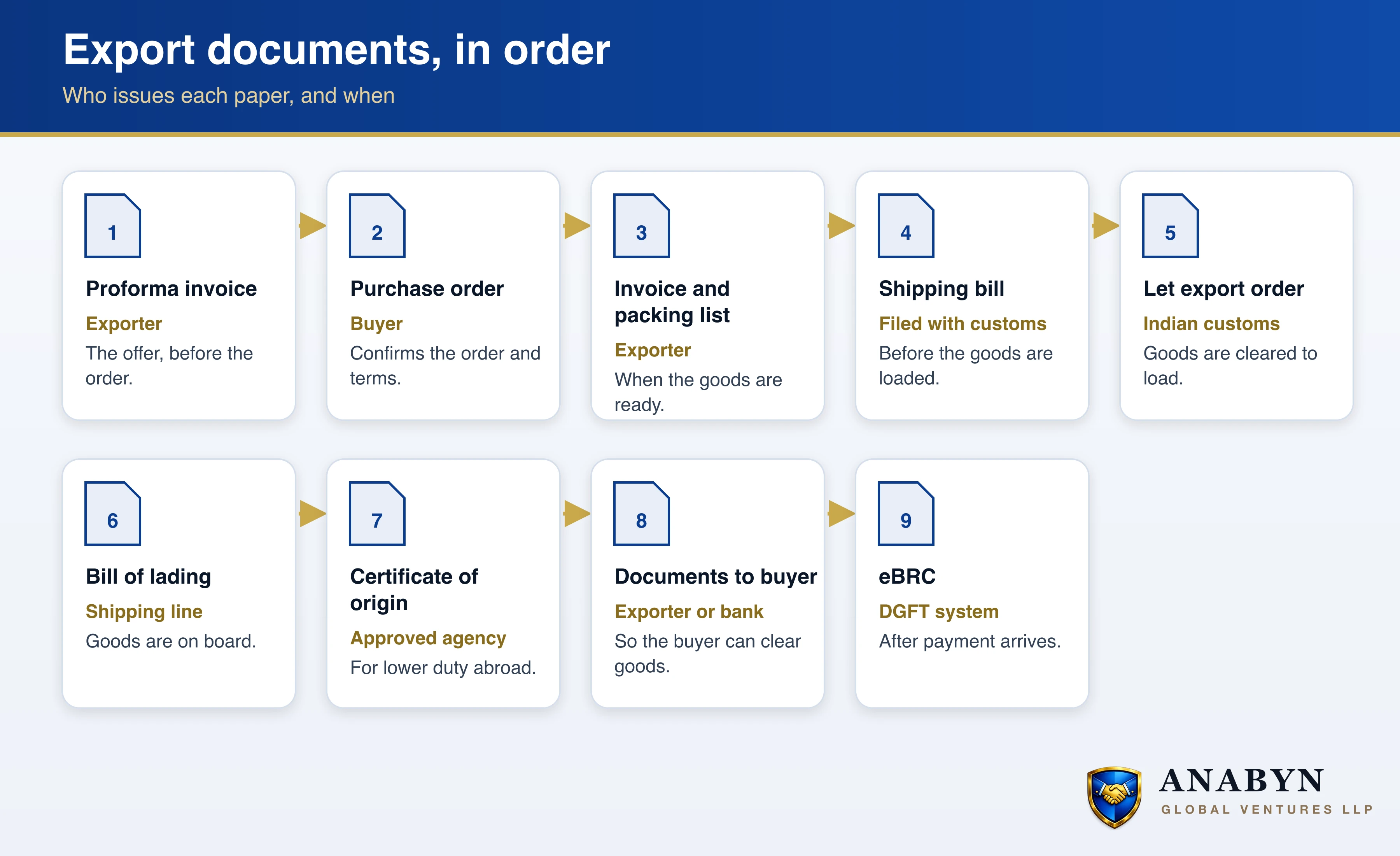 Tap to enlarge
Frequently Asked Questions
What is the difference between LC and TT payment terms?
TT (Telegraphic Transfer, also called T/T or wire transfer) is a direct bank-to-bank funds transfer, typically structured in instalments - commonly 30% advance on order confirmation and 70% before shipment (against a copy of the bill of lading or pre-shipment inspection report). LC (Letter of Credit) is a bank-issued payment guarantee: the buyer's bank commits to pay the seller once the seller presents specified shipping documents (bill of lading, commercial invoice, packing list, certificate of origin, inspection certificate) that exactly match the LC terms - the bank, not the buyer directly, is the paying party, subject to strict document compliance.
What is a typical TT payment structure for a textile export order?
The most common structure for first and repeat orders is 30% advance TT on order confirmation (used by the manufacturer to purchase raw materials and begin production) and 70% TT before shipment, paid once the buyer has approved a pre-shipment sample or received a pre-shipment inspection report confirming quality and quantity. Some long-standing repeat buyers negotiate more buyer-favourable terms, such as a smaller advance or partial payment against documents after shipment.
Is LC or TT safer for the buyer?
LC is generally considered safer for the buyer because payment is only released once the seller presents documents proving the goods were shipped as specified - the buyer's bank checks compliance before releasing funds, and if documents don't match the LC terms, payment can be withheld pending correction. TT, especially advance TT, carries more buyer risk since funds are transferred before or during production with less independent verification, relying more on trust and the seller's track record.
Is LC or TT safer for the seller (manufacturer)?
TT with an advance payment is generally safer for the seller, since a portion of funds is secured upfront before committing raw materials and production capacity, and the balance is typically collected before the goods leave the factory or port. LC, while a bank-backed guarantee, exposes the seller to the risk of document discrepancies - banks can refuse payment over even minor mismatches between the LC terms and the shipping documents, delaying or jeopardizing payment despite goods having shipped.
What payment terms does Anabyn typically offer?
For first-time buyers, Anabyn requests 50% advance TT to confirm the order and begin production, with the remaining 50% TT due when production is complete, before dispatch, against a pre-shipment inspection report and the approved sample. For established repeat buyers with a proven payment history, more flexible terms can be negotiated. Confirmed Letters of Credit at sight are also accepted for larger orders, particularly from buyers whose procurement policy requires LC-based payment.
What is a Letter of Credit "at sight"?
An LC "at sight" means the issuing bank pays the seller immediately (typically within a few banking days) upon presentation of compliant shipping documents, rather than at a deferred future date (as in a usance or deferred-payment LC). At-sight LCs are the most common structure in textile export trade and are generally preferred by sellers since they avoid extended payment delay after shipment.
What are the costs associated with using an LC versus TT?
LC transactions typically incur bank charges on both sides - issuance fees for the buyer's bank, advising/confirmation and negotiation fees for the seller's bank - which can add roughly 0.5–2% of transaction value depending on the bank and LC complexity, plus processing time of several days to weeks for issuance and document checking. TT transfers are typically faster and cheaper, limited mainly to standard wire transfer fees (often a flat fee per transaction, e.g. $20–$50), making TT the lower-friction option for buyers and sellers with established trust.
Agree Payment Terms That Work for Both Sides
Tell us your preferred payment method - TT or LC - and order size, and we'll confirm terms clearly upfront.
Request Factory Quote