
What Is Reactive Dyeing in Cotton Textiles?
The chemistry of reactive dyeing, ISO 105 colour fastness standards, and why hotel buyers specify reactive-dyed textiles for all programmes.
The Chemistry of Reactive Dyeing
Reactive dyes contain a reactive group - typically a triazine or vinyl sulphone group - that forms a covalent bond with the hydroxyl groups (-OH) present in cotton cellulose. The reaction occurs in an alkaline bath (sodium carbonate) at elevated temperature. Once the covalent bond forms, the dye molecule is chemically incorporated into the fibre structure itself.
This is fundamentally different from direct dyes (held by van der Waals forces), acid dyes (ionic bonds on protein fibres), or disperse dyes (diffused into synthetic fibres). Covalent bonds are significantly stronger than these physical attractions - which is why reactive-dyed cotton withstands commercial laundering at 60–95°C while other dye types fade rapidly.
Modern reactive dyes are bifunctional - they carry two reactive groups, increasing fixation rate from ~70% (monofunctional) to ~80–85%. Higher fixation means less unfixed dye washed out in post-treatment, reducing wastewater dye load and improving shade consistency between batches.
Why Hotels Require Reactive Dyeing
Hotel linen procurement specifications almost universally mandate reactive dyeing for coloured towels and bed linen. The commercial logic is straightforward: hotel towels are laundered at 60–70°C with enzymatic detergents 300–500 times over their service life. Without wash-fast colour, towels fade within 50–100 cycles, creating an inconsistent appearance across a room set that guests notice immediately.
Colour consistency across repeat orders is the second driver. A hotel running a 3-year linen replacement programme needs to reorder towels that match the original shade precisely. Reactive dye formulations can be reproduced with spectrophotometric precision across years and manufacturing batches.
Reactive Dyeing vs Vat Dyeing
| Property | Reactive Dyeing | Vat Dyeing |
|---|---|---|
| Bond type | Covalent (chemical bond) | Physical entrapment (reduction-oxidation) |
| Colour vibrancy | Bright, full spectrum | Muted, limited palette |
| Wash fastness | 4–5/5 (ISO 105-C06) | 4–5/5 (ISO 105-C06) |
| Chlorine bleach | 3–4/5 | 4–5/5 (superior) |
| Best for | Coloured hotel towels, bed linen | White institutional, hospital |
| Cost | Moderate | Higher (complex process) |
ISO 105 Colour Fastness Testing Reference
| ISO Test | Description | Hotel Minimum | Reactive Dye Rating | Vat Dye Rating |
|---|---|---|---|---|
| ISO 105-C06 | Wash fastness (40°C, 60°C, 95°C) | 4–5/5 | 4–5/5 | 4–5/5 |
| ISO 105-E04 | Perspiration (acid & alkaline) | 4/5 | 4–5/5 | 4–5/5 |
| ISO 105-X12 | Rubbing/crocking (wet & dry) | 4/5 | 4–5/5 | 4–5/5 |
| ISO 105-N01 | Chlorine bleach resistance | 3/5 | 3–4/5 | 4–5/5 |
| ISO 105-B02 | Artificial light (xenon arc) | 4/5 | 4–5/5 | 4–5/5 |
| ISO 105-E01 | Water fastness | 4/5 | 4–5/5 | 4–5/5 |
Scale: 1 = severe colour loss, 5 = no colour change. Hotel minimum is 4/5 across all tests.
Frequently Asked Questions
What is reactive dyeing in textiles?
Reactive dyeing is a dyeing process in which the dye molecule forms a covalent chemical bond with the cotton fibre - the same type of bond that holds molecules together within the fibre itself. This is the key distinction from other dye types: reactive dyes become part of the cotton fibre rather than sitting on the surface or being held by physical attraction. The result is superior wash fastness, brilliant colour depth, and consistent colour that does not fade significantly through hundreds of commercial wash cycles. All premium hotel and hospitality towels specify reactive-dyed fabric.
What colour fastness rating do reactive dyes achieve?
Reactive dyes on cotton achieve ISO 105-C06 wash fastness of 4–5 on the 1–5 scale, where 5 is the highest (no colour change). Perspiration fastness (ISO 105-E04) is typically 4–5. Chlorine bleach fastness varies by dye class: standard reactive dyes achieve 3–4, while advanced bifunctional reactive dyes achieve 4–5 even with chlorine exposure. Rubbing fastness (ISO 105-X12) is typically 4–5 wet, 4–5 dry. The hotel industry standard minimum is 4/5 for all categories - a specification that reactive dyeing reliably meets.
What is the difference between reactive dyeing and vat dyeing?
Reactive dyeing forms a covalent bond between dye and fibre. Vat dyeing deposits an insoluble pigment within the fibre through a reduction-oxidation process - the dye is not chemically bonded to the fibre. Vat dyes have excellent chlorine bleach resistance (rating 5), making them preferred for white and light-colour hospital and institutional textiles. However, vat dyes produce less vibrant, more muted colours than reactive dyes. For bright hotel towel colours (blue, teal, green, burgundy), reactive dyeing produces superior vibrancy. For clinical white and pastel applications requiring bleach-tolerance, vat dyeing is preferred.
Why do hotels specify reactive-dyed towels?
Hotels specify reactive-dyed towels for two primary reasons: colour consistency across repeat orders, and wash fastness through commercial laundering. A hotel ordering 5,000 towels today and 2,000 replenishment towels 18 months later needs identical colour - reactive dyeing's covalent bond mechanism allows manufacturers to precisely reproduce colour batches. Second, hotel towels are washed at 60–70°C with commercial detergents hundreds of times per year. Reactive dyes maintain colour at these temperatures, while lesser dye types (direct dyes, acid dyes on inappropriate fibres) fade noticeably within 50–100 wash cycles.
What is ISO 105 and how does it relate to textile dyeing?
ISO 105 is the international standard series covering textile colour fastness testing methods. Key sub-standards relevant to hotel textiles include: ISO 105-C06 (colour fastness to domestic and commercial laundering), ISO 105-E01 (water), ISO 105-E04 (perspiration), ISO 105-X12 (rubbing/crocking), ISO 105-B02 (artificial light), and ISO 105-N01 (bleaching). Each test produces a rating from 1 (severe colour change) to 5 (no colour change). The hotel procurement standard requires a minimum rating of 4 on all wash, perspiration, and rubbing tests. Indian textile exporters test to ISO standards through accredited laboratories (SGS, Bureau Veritas, Intertek).
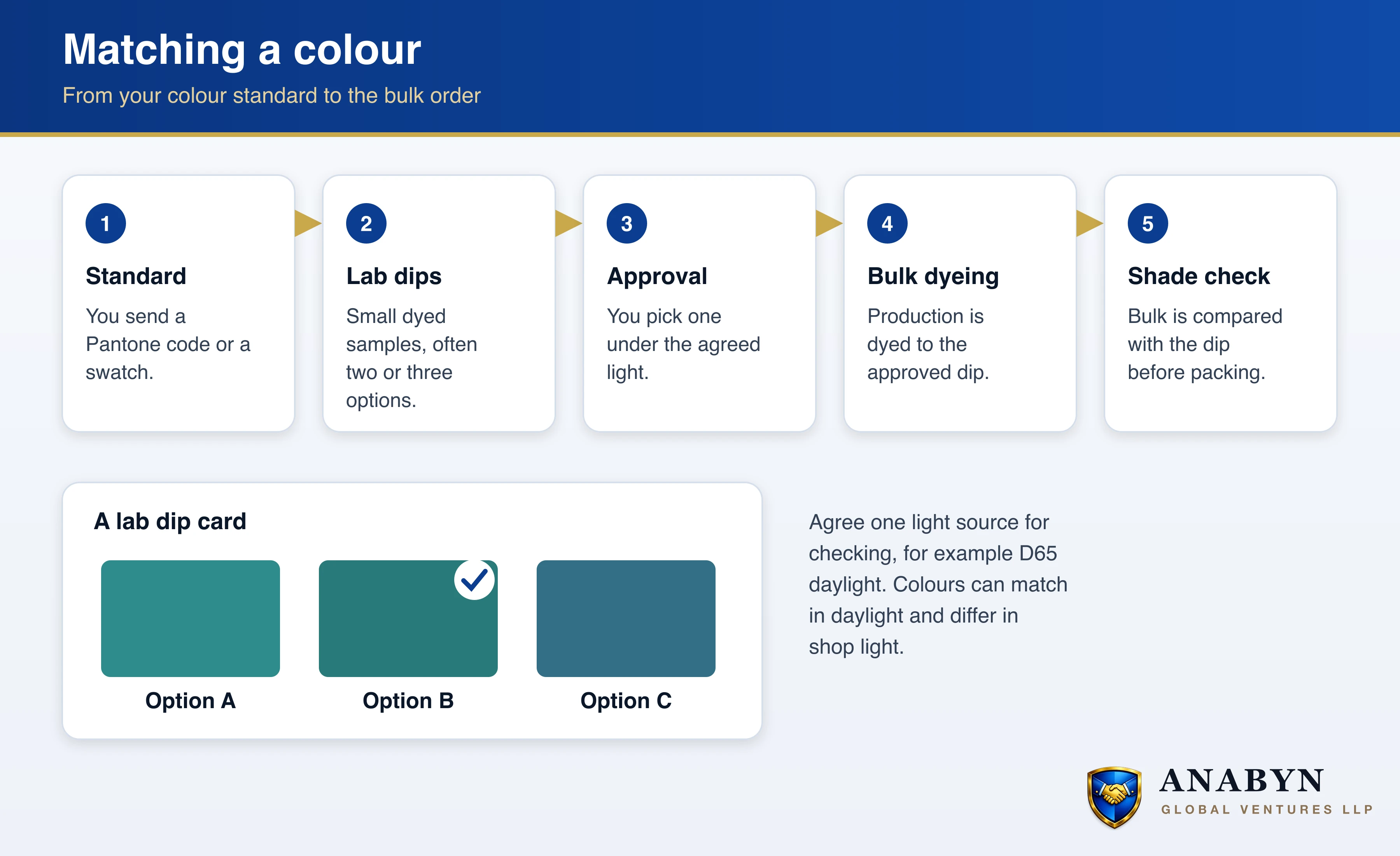
Pantone TCX vs TPX, and what is a lab dip?
Pantone TCX swatches are dyed on cotton cloth, so they are the right reference for cotton towels and sheets. TPX swatches are printed on paper, so they look different from dyed cotton. Name the TCX code on the order.
A lab dip is a small dyed sample made to match your reference. Approve it before bulk dyeing, and keep the approved piece as the master standard for reorders.
Pigment print vs reactive print: what is the difference?
Pigment printing sticks colour to the surface with a binder. It is simpler and can be used on many fibres, but the print can feel stiffer and may wear or rub off with washing. Reactive printing bonds dye chemically to cotton, so it lasts better and feels softer, at a higher cost.
Source Reactive-Dyed Towels & Linen from India
All Anabyn towels and bed linen use reactive dyes with ISO 105 colour fastness ≥4/5. Test reports available. MOQ 500 units. FOB Cochin.
Get a Quote