
Colour Fastness Testing: What Textile Buyers Need to Know
ISO 105 test types, hotel minimum ratings, how to specify colour fastness in procurement briefs, and what accredited test reports should confirm.
Understanding Colour Fastness
Colour fastness is not a single measurement - it is a family of tests that simulate different real-world exposures a textile will encounter. A towel in a hotel environment is exposed to hot water washing (wash fastness), body perspiration (perspiration fastness), physical rubbing when drying guests (rubbing fastness), and sometimes chlorine bleach in the laundry (bleach fastness). A bed sheet is exposed to sweat, washing, and light if stored near windows (light fastness).
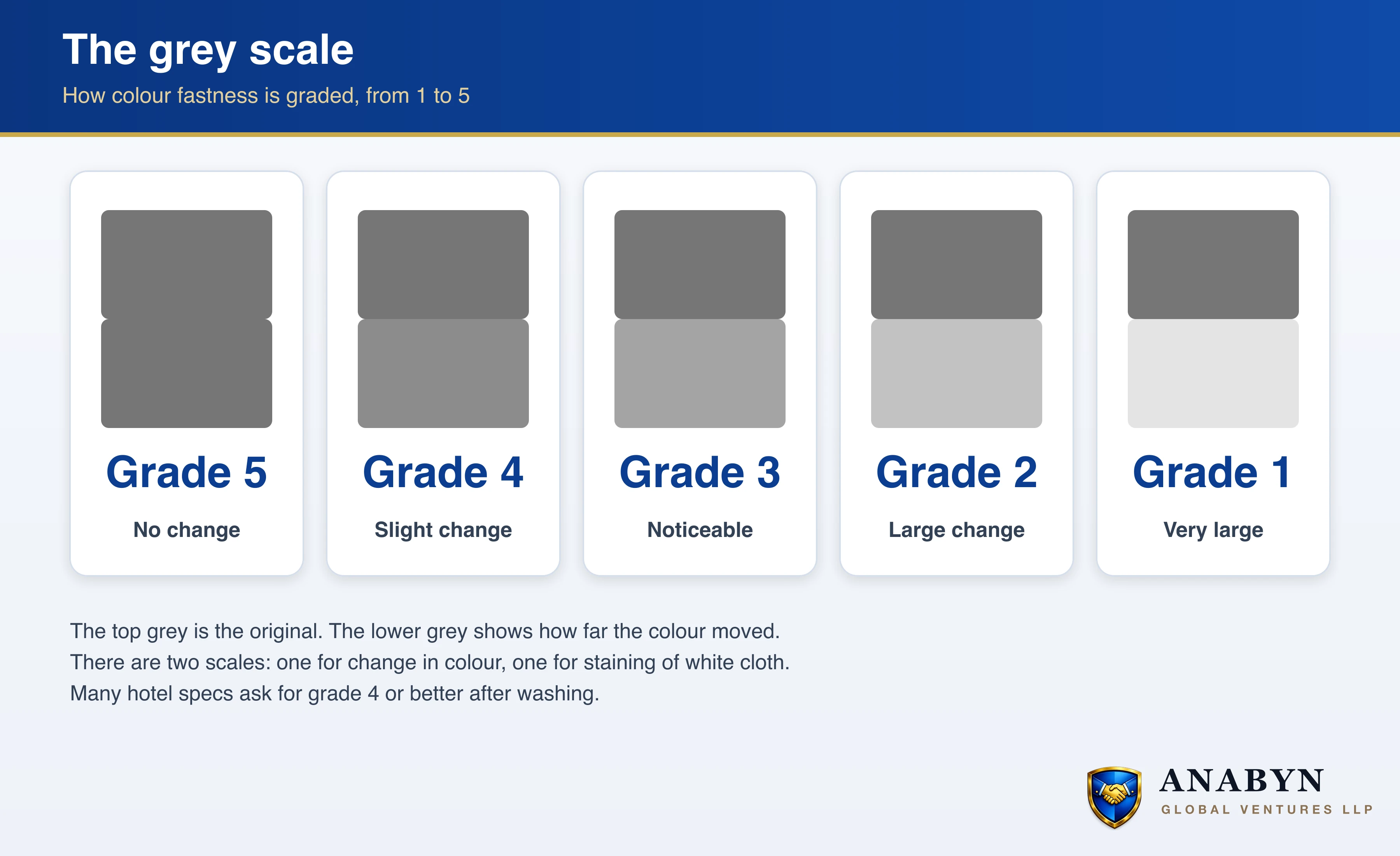
Each exposure is tested separately under standardised ISO conditions. The results are compared against standard grey scales - physical scale references used to assess the degree of colour change (to the tested sample) and colour staining (to an adjacent white fabric). Ratings from 1–5 are assigned, where 5 means no perceptible change and 1 means severe change.
For hotel buyers, understanding which tests matter most and what rating to specify is the difference between linen that maintains appearance for 2+ years and linen that looks faded and stained after 6 months.
The ISO 105 Grey Scale System
ISO 105 tests use two physical grey scales for assessment:
- Grey Scale for Assessing Change in Colour: Five pairs of grey patches showing decreasing colour difference. Rating 5 = no difference (excellent); Rating 1 = maximum difference (failed).
- Grey Scale for Staining: Five pairs showing colour staining on adjacent white fabric. Rating 5 = no staining; Rating 1 = severe staining.
Half-step ratings (4-5, 3-4, 2-3, 1-2) are used when the result falls between two standard steps. Hotel specifications always reference the grey scale rating - for example "ISO 105-C06: ≥4/5" means the test result must be at the 4 rating or higher (4, 4-5, or 5).
ISO 105 Colour Fastness Tests: Hotel Buyer Reference
| ISO Test | Type | Test Conditions | Hotel Minimum | Notes |
|---|---|---|---|---|
| ISO 105-C06 | Wash fastness | 40°C, 60°C, or 95°C with reference detergent | ≥4/5 | Most critical test - simulates commercial laundering |
| ISO 105-E04 | Perspiration fastness | Acid (pH 5.5) and alkaline (pH 8.0) | ≥4/5 | Critical for pillowcases and body-contact linen |
| ISO 105-X12 | Rubbing (crocking) | Dry and wet friction | ≥4/5 dry, ≥3/5 wet | Prevents colour transfer to guests' clothes |
| ISO 105-N01 | Chlorine bleach | Sodium hypochlorite solution | ≥3/5 | Many hotel laundries use chlorine bleach |
| ISO 105-B02 | Light fastness | Xenon arc lamp (artificial daylight) | ≥4/5 | For linen near windows or outdoor use |
| ISO 105-E01 | Water fastness | Distilled water immersion | ≥4/5 | Baseline water resistance test |
Frequently Asked Questions
What is colour fastness in textiles?
Colour fastness is a measure of how resistant a textile's colour is to fading or running when exposed to external agents - washing, perspiration, rubbing, bleaching, light, or water. It is rated on a scale of 1 to 5 using internationally standardised grey scales: 1 indicates very poor fastness (severe colour change or staining), while 5 indicates excellent fastness (no perceptible change). Colour fastness is the critical quality parameter for any textile that will be commercially laundered, exposed to perspiration, or subjected to direct light. Hotel textiles must achieve minimum ratings of 4/5 across all relevant test categories to maintain appearance through their commercial service life.
What are the main types of colour fastness tests for hotel textiles?
The ISO 105 standard series covers six types of colour fastness relevant to hotel textiles: (1) Wash fastness (ISO 105-C06) - tests colour resistance at 40°C, 60°C, or 95°C laundering; (2) Perspiration fastness (ISO 105-E04) - tests both acid (pH 5.5) and alkaline (pH 8.0) perspiration, critical for pillowcases and towels; (3) Rubbing/crocking fastness (ISO 105-X12) - tests colour transfer under dry and wet friction; (4) Chlorine bleach fastness (ISO 105-N01) - critical for hotel laundries using sodium hypochlorite; (5) Light fastness (ISO 105-B02) - tests resistance to fading under xenon arc light, important for linen stored or used near windows; (6) Water fastness (ISO 105-E01) - tests colour resistance when wet. Hotel buyers specify minimum ratings for each relevant test in their procurement specifications.
What colour fastness rating do hotels require?
Most 4–5 star hotel chains specify ISO 105 colour fastness ratings of 4–5/5 across all relevant test categories as a minimum standard. Specifically: wash fastness (ISO 105-C06 at 60°C) ≥4/5, perspiration fastness (ISO 105-E04) ≥4/5, rubbing fastness dry ≥4/5 and wet ≥3/5, chlorine bleach fastness ≥3/5. Some luxury hotel brands require wash fastness at 5/5 and light fastness at 5/5 for window-adjacent linens. These ratings are achievable with reactive-dyed cotton using modern bifunctional reactive dye systems. Economy-grade direct dyes typically achieve only 3/5 wash fastness - insufficient for commercial hotel laundering.
What testing laboratories verify colour fastness for Indian textiles?
Indian textile exporters use accredited third-party testing laboratories for colour fastness verification. Major labs operating in India include: SGS India (Chennai, Mumbai, Bangalore - ISO/IEC 17025 accredited), Bureau Veritas Testing (Mumbai, Tirupur - NABL accredited), Intertek India (multiple locations), TESTEX India, and national labs such as SITRA (South India Textile Research Association) in Coimbatore and ATIRA in Ahmedabad. All accredited labs issue test reports valid for import into the EU, UK, USA, and other markets. Anabyn provides SGS or Bureau Veritas colour fastness test reports as standard documentation for hotel buyers.
How do I specify colour fastness in a hotel linen procurement brief?
Include the following specification language in your purchase order or request for quotation: 'Colour fastness shall meet or exceed: ISO 105-C06 (wash, 60°C) ≥4/5; ISO 105-E04 (perspiration, acid and alkaline) ≥4/5; ISO 105-X12 (rubbing, dry) ≥4/5, (wet) ≥3/5; ISO 105-N01 (chlorine bleach) ≥3/5; ISO 105-B02 (light) ≥4/5. All ratings measured against ISO Grey Scale for Assessing Change in Colour and Grey Scale for Staining. Test reports from accredited laboratory (ISO/IEC 17025) required before dispatch.' Suppliers will understand and can provide test reports from SGS, Bureau Veritas, or SITRA confirming compliance.
What causes poor colour fastness in towels and sheets?
Poor colour fastness is caused by: (1) Wrong dye class - direct dyes (cheap, commonly used in non-hotel grade production) achieve only 2–3/5 wash fastness vs reactive dyes at 4–5/5; (2) Insufficient fixation - reactive dyes that are not fully fixed to the fibre will wash out; (3) Inadequate after-washing - unfixed dye remaining on fibre surface must be completely removed by thorough after-washing; (4) Incorrect pH - reactive dye fixation requires controlled alkaline conditions; deviation reduces fixation rate; (5) Low-quality reactive dyes - economy reactive dyes achieve lower fixation rates than premium bifunctional dyes; (6) Incorrect laundering - the buyer's laundry using the wrong chemicals (especially chlorine on reactive-dyed fabrics not rated for it) can cause rapid colour degradation.
Why do dark towels bleed colour?
Dark and saturated colours need more dye. Any dye that did not bond to the fibre during dyeing comes out in the first washes and can stain other items in the load. Careful wash-off at the mill removes it.
Write the fastness grade for washing and for staining on adjacent fabric into the order, name the ISO 105 method, and ask for the test report. Tell your laundry to wash new dark towels apart for the first cycles.
Read more: Care problems
How is colour fastness graded?
Lab results use a grey scale from 1 to 5. Grade 5 means no visible change. The tester compares the washed sample with the original under set light.
There is one scale for change in colour and another for staining of white cloth washed alongside. A report should give both.
Source Colour-Fast Hotel Textiles from India
Anabyn provides SGS or Bureau Veritas ISO 105 colour fastness test reports as standard. All products use reactive dyes achieving ≥4/5 across wash, perspiration, and rubbing tests.
Request Test Reports & Quote