

In pictures
In this article
German hospitality procurement has always been quality-first. The hotel groups that built their reputation on precision - Steigenberger, Maritim, Mövenpick - don't compromise on Frottee weight or Bettwäsche thread count. What has changed in 2026 is *where* that quality is being sourced from.
The Search Signals: What German Buyers Are Looking For
Top German-language B2B textile search queries:
- "Hotelwäsche Großhandel"
- "Frottee Handtücher Import Indien"
- "Bettwäsche Hotel Lieferant"
- "Hotelhandtücher 600 GSM Großhandel"
- "Bio-Baumwolle Handtücher GOTS"
Notice how "Indien" and "GOTS" appear together. German buyers connect the two: they expect Indian-sourced linen to come with European-standard certification.
The Compliance Triple-Lock for the German Market
German hospitality buyers issue RFPs that demand all three of:
What each standard looks at
OEKO-TEX STANDARD 100
- ·
Cotton farm
- ·
Spinning
- ·
Weaving
- ·
Dyeing & finishing
- ✓
Finished product
Blue stages are inside the standard. Grey stages are not checked by it.
What it proves
The finished article was lab tested for a list of harmful substances and passed.
What it does not tell you
It says nothing about how the cotton was grown or how the mill treats its water.
How to check it
Enter the label number in the OEKO-TEX Label Check. It shows the holder, the products and the expiry date.
1. OEKO-TEX Standard 100 - chemical safety, mandatory
2. REACH compliance - EU-wide chemical regulation, applies to dyes and finishes
3. GOTS if marketed as Bio-Baumwolle (organic cotton)
Indian exporters who hold all three are a small subset of the market - perhaps 15% of registered textile exporters. They are also the only group German buyers will shortlist.
GSM Standards in the German Market
German hotel chains run heavier than the global average. Where US mid-scale uses 500 GSM, German mid-scale uses 550–600 GSM. The reasoning is straightforward: German laundry cycles are more aggressive (90°C wash), and heavier yarn survives more wash cycles before pilling. Buy 600 GSM combed cotton or don't bother.
Drag to pick a towel weight
Mid-weight. Most 3 and 4 star hotel bath towels.
Bars compare weights from 300 to 800 GSM. They are a guide, not lab results.
The loops
Weight per piece, drawn to scale
45 g
Face
30×30
140 g
Hand
40×70
490 g
Bath
70×140
810 g
Bath sheet
90×180
1,000 bath towels at 500 GSM weigh about 490 kg.
Bath towel 70×140 cm at 500 GSM, FOB Cochin
$2.20–$2.80 per piece · Mid-range band (500–550 GSM)
Bettwäsche: Percale vs. Sateen
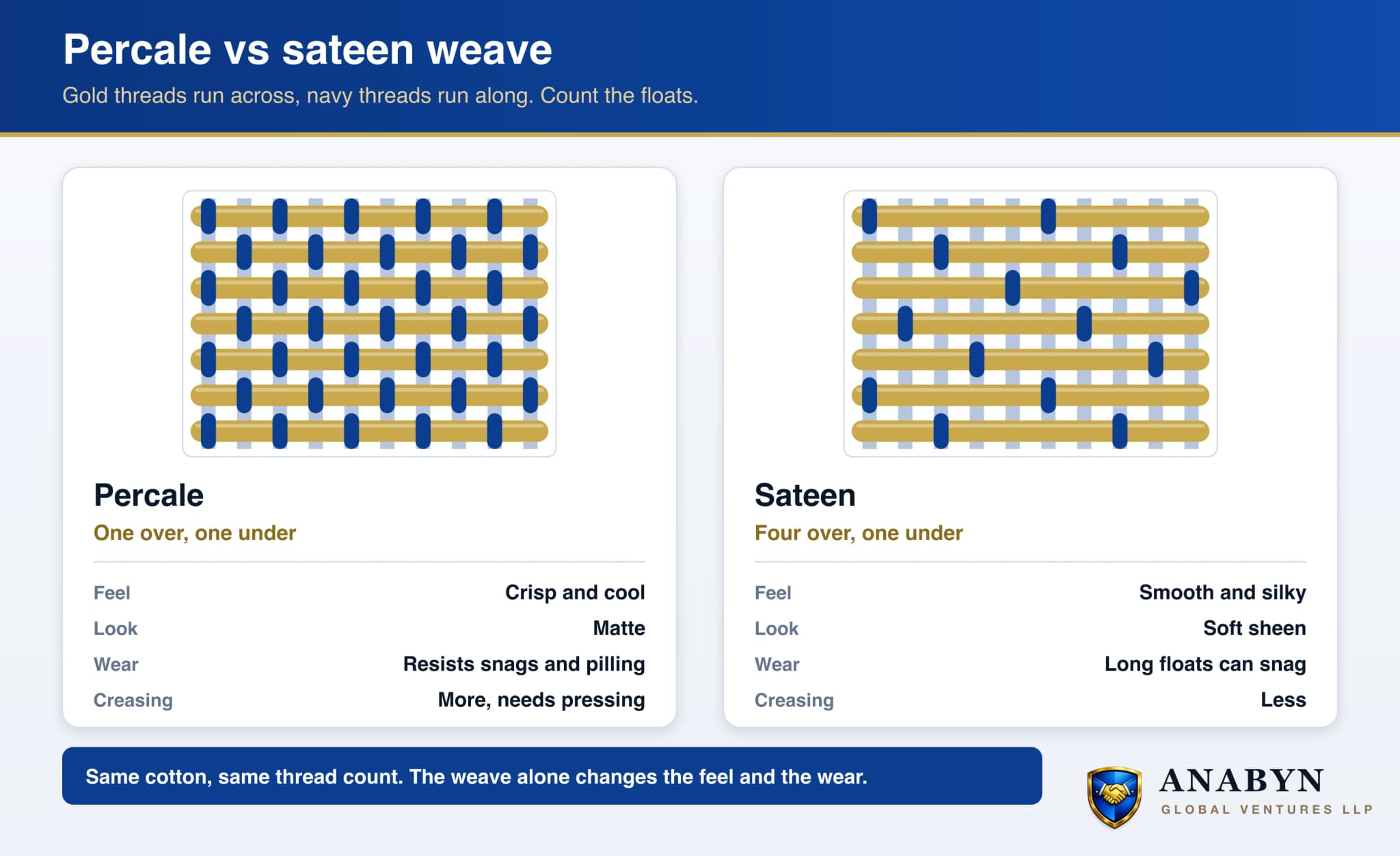
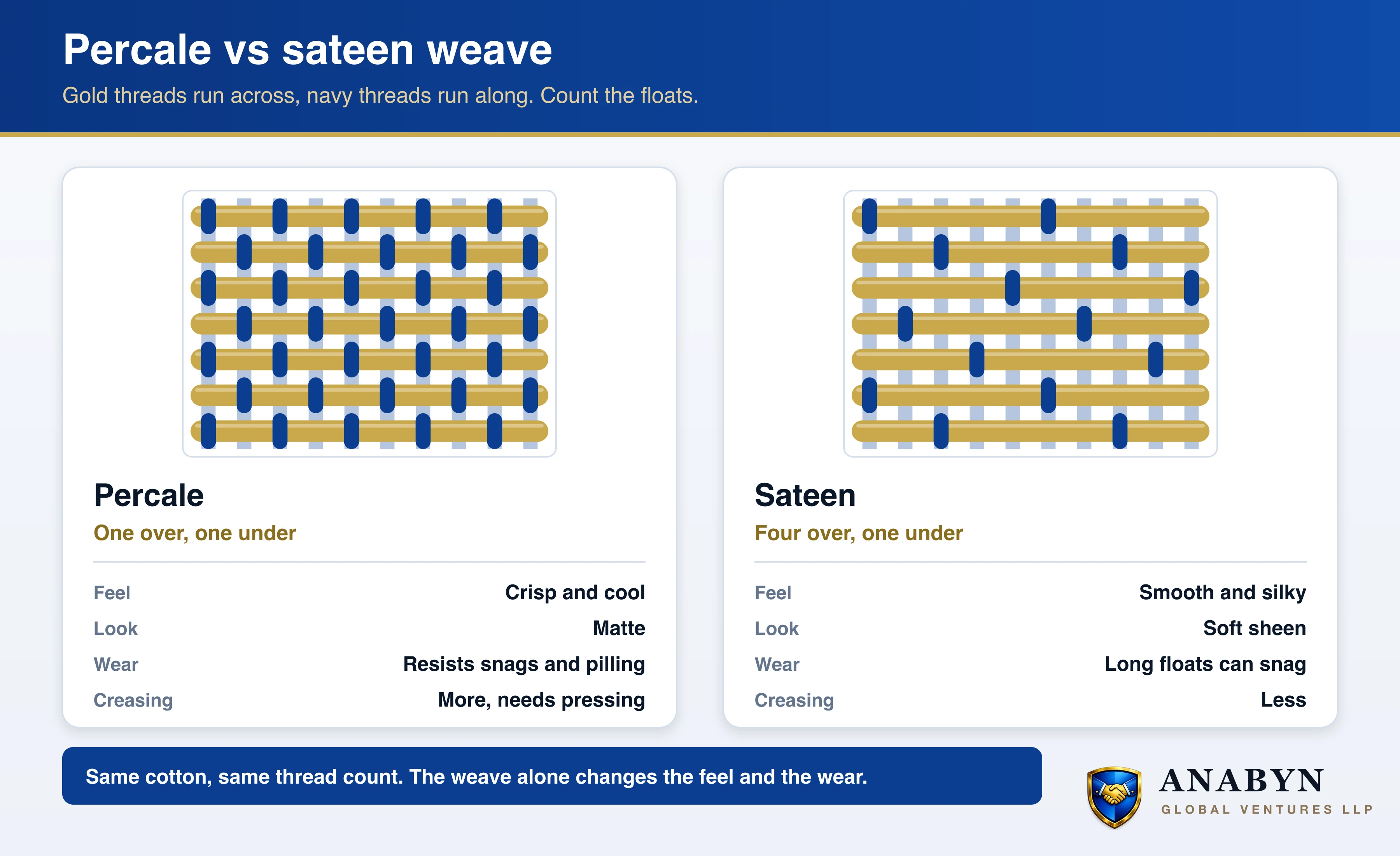
German preference skews to percale weaves (TC 200–300) for hotel Bettwäsche - crisp, breathable, cool. Sateen (TC 300+) is gaining share in the luxury Berlin / Hamburg market but remains the minority. Indian Karur and Erode mills produce both at scale.
 Enlarge
EU-FTA: The Tariff Picture in 2026
The India–EU Free Trade Agreement negotiations have entered final-stage discussions in 2026. Even without ratification, current textile tariffs into the EU are 8–12% - and Indian manufacturers absorb this competitively. Compared to:
I import into
India
Anabyn ships from here12 percent
UK, GCC and Australian buyers, hotel and private label programmes that want several towel types on one order, and anyone starting with a trial run.
China
12 percent
Printed, velour and microfibre towels, promotional programmes, and buyers outside the US who need very large volumes fast.
Pakistan
0 percent under GSP plus
EU buyers of standard white hotel and institutional terry in container volumes, where the 0 percent GSP plus duty decides the price.
Türkiye
0 percent
European retailers and boutique hotels who value short lead times, design and the Turkish cotton story over unit price.
Bangladesh
0 percent under EBA, until 2029
EU and UK buyers who already source garments in Bangladesh and want to add simple towels to the same supply base.
The India EU FTA was concluded on 27 January 2026 and still has to be ratified; most analysts expect entry into force in 2027. Until then, an EU buyer pays 12 points more on Indian towels than on Pakistani, Bangladeshi or Turkish ones.
Duty on cotton terry towels, HS 6302.60, as of October 2026. Bed linen and robes often follow the same pattern, but check your own line in the duty calculator. Source: EU TARIC.
- Turkey (EU customs union): 0% tariff but higher base cost
- Bangladesh (EBA): 0% tariff, lower base cost, but quality gap in 600+ GSM segment
- China: higher base cost + anti-dumping investigations on home textiles
India sits in a competitive sweet spot for the German market.
Landed Cost Indication
For a 600 GSM Frottee Handtuch, 70x140cm, MOQ 5,000, delivered Hamburg:
- FOB Mundra: EUR 2.85 – 3.30 per piece
- Ocean freight to Hamburg: ~EUR 0.16 per piece
- EU import duty (~9.6%): included in landed
- Inland Hamburg → Frankfurt/Munich: ~EUR 0.08 per piece
Total: EUR 3.40 – 3.95 delivered. German wholesalers retail the same at EUR 5.20–6.50.
What German Buyers Should Include in an RFQ
- Genaue GSM-Angabe (exact GSM, not range)
- Zertifikate (OEKO-TEX, REACH, GOTS as applicable)
- Pflegeetikett in deutscher Sprache (German-language care label)
- Inkoterm (CIF Hamburg / Bremerhaven typical)
- Liefertermin gestaffelt (staggered delivery schedule for cash-flow reasons)
Conclusion
German hospitality procurement in 2026 favors Indian manufacturers who can document compliance as rigorously as German auditors expect. The cost gap to Turkish or Bangladeshi competitors widens once you factor in laundry-cycle longevity at 600 GSM.
Sourcing Hotelwäsche for a German property? Request a quote with German-language documentation and Anabyn will include OEKO-TEX, REACH and (where applicable) GOTS certificates in the dossier.
Share this article
Want pricing on what you just read?
Leave your work email — our export desk replies with specs, MOQ and a quote within 1 business day.

Written by
Dr Abin Babu
Founder & Chairman, Anabyn Global Ventures
Anabyn exports hotel and home linen from Kerala, India. These guides come from the questions buyers ask our desk. About the team
Ready to Order?
Send us your specification. We reply within one business day and send a priced quote within 48 hours.
Request an Export QuoteWhere to go next